Department of Elderly Health Management, Shenzhen Center for Chronic Disease Control, Shenzhen, Guangdong, China.
Department of Elderly Health Management, Shenzhen Center for Chronic Disease Control, Shenzhen, Guangdong, China
BMJ Open. 2022 Mar 9;12(3):e056100. doi: 10.1136/bmjopen-2021-056100.
Anaemia leads to poor health outcomes in older adults; however, most current research in China has focused on younger adults. This study aimed to investigate the prevalence of anaemia and its associated factors in older adults in an urban district in China.
A cross-sectional study.
An urbanised region, Shenzhen, China.
A total of 121 981 participants aged ≥65 years were recruited at local community health service centres in Shenzhen from January to December 2018.
The prevalence of anaemia was analysed and potential associated factors were evaluated.
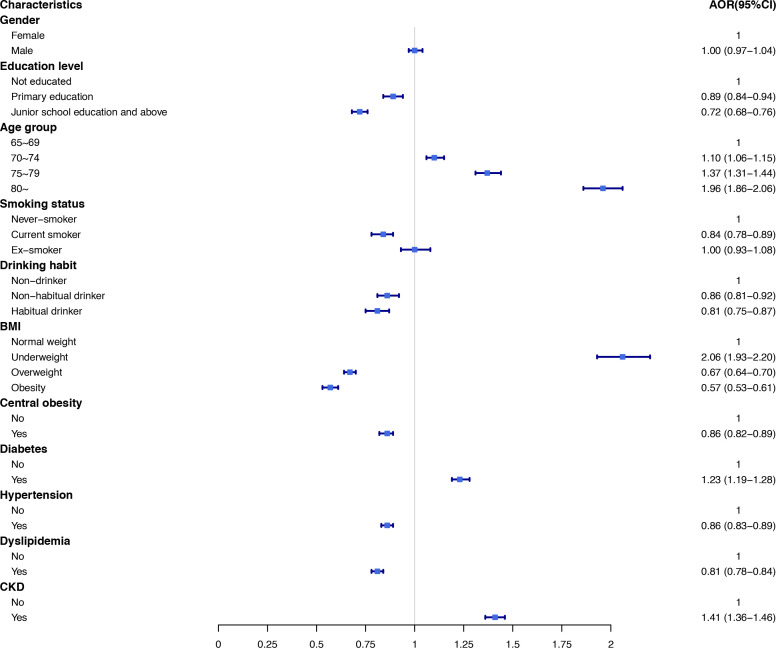
The mean haemoglobin level was 136.40±16.66 g/L and the prevalence of anaemia was 15.43%. The prevalences of mild, moderate and severe anaemia were 12.24%, 2.94% and 0.25%, respectively. Anaemia was positively associated with older age, being underweight (adjusted OR (AOR) 2.06, 95% CI 1.93 to 2.20), diabetes (AOR 1.23, 95% CI 1.19 to 1.28) and chronic kidney disease (AOR 1.41, 95% CI 1.36 to 1.46), and inversely with higher education level, current-smoker (AOR 0.84, 95% CI 0.78 to 0.89), non-habitual drinker (AOR 0.86, 95% CI 0.81 to 0.92), habitual drinker (AOR 0.81, 95% CI 0.75 to 0.87), overweight (AOR 0.67, 95% CI 0.64 to 0.70), obesity (AOR 0.57, 95% CI 0.53 to 0.61), central obesity (AOR 0.86, 95% CI 0.82 to 0.89), hypertension (AOR 0.86, 95% CI 0.83 to 0.89) and dyslipidaemia (AOR 0.81, 95% CI 0.78 to 0.84).
Anaemia is prevalent among people aged 65 years and older in China. Screening of high-risk populations and treatment of senile anaemia should be a top priority in Shenzhen, and should be listed as important public health intervention measures for implementation.
贫血可导致老年人健康状况恶化;然而,中国目前的大多数研究都集中在年轻人身上。本研究旨在调查中国一个城市城区老年人贫血的患病率及其相关因素。
横断面研究。
中国深圳市一个城市化地区。
2018 年 1 月至 12 月,在深圳市当地社区卫生服务中心共招募了 121981 名年龄≥65 岁的参与者。
分析贫血的患病率,并评估潜在的相关因素。
平均血红蛋白水平为 136.40±16.66g/L,贫血患病率为 15.43%。轻度、中度和重度贫血的患病率分别为 12.24%、2.94%和 0.25%。贫血与年龄较大、体重不足(调整后的比值比(OR)2.06,95%置信区间 1.93 至 2.20)、糖尿病(OR 1.23,95%置信区间 1.19 至 1.28)和慢性肾脏病(OR 1.41,95%置信区间 1.36 至 1.46)呈正相关,与较高的教育水平、当前吸烟者(OR 0.84,95%置信区间 0.78 至 0.89)、非习惯性饮酒者(OR 0.86,95%置信区间 0.81 至 0.92)、习惯性饮酒者(OR 0.81,95%置信区间 0.75 至 0.87)、超重(OR 0.67,95%置信区间 0.64 至 0.70)、肥胖(OR 0.57,95%置信区间 0.53 至 0.61)、中心性肥胖(OR 0.86,95%置信区间 0.82 至 0.89)、高血压(OR 0.86,95%置信区间 0.83 至 0.89)和血脂异常(OR 0.81,95%置信区间 0.78 至 0.84)呈负相关。
贫血在中国 65 岁及以上人群中较为普遍。筛查高危人群并治疗老年贫血应成为深圳市的重中之重,并应作为实施的重要公共卫生干预措施列入清单。