Chang Kai-Cheng, Shao Shih-Chieh, Chen Hui-Yu, Chan Yuk-Ying, Fang Yueh-Fu
Department of Pharmacy, Linkou Chang Gung Memorial Hospital, Taoyuan 333, Taiwan.
Department of Pharmacy, Keelung Chang Gung Memorial Hospital, Keelung 204, Taiwan.
Cancers (Basel). 2022 Feb 24;14(5):1157. doi: 10.3390/cancers14051157.
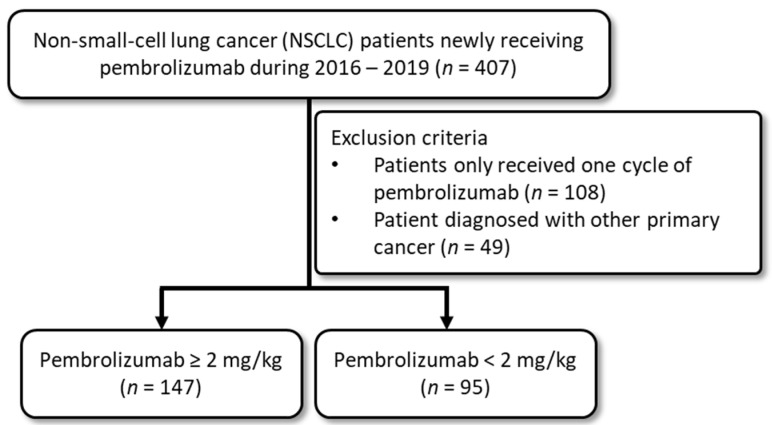
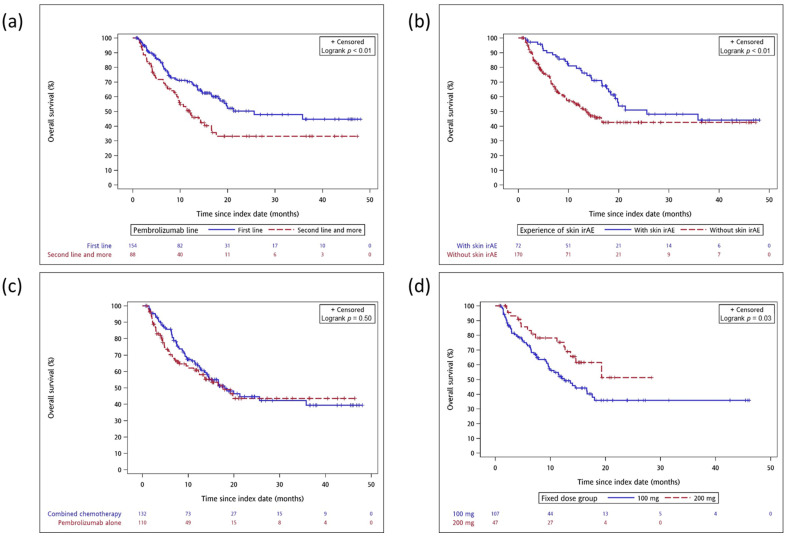
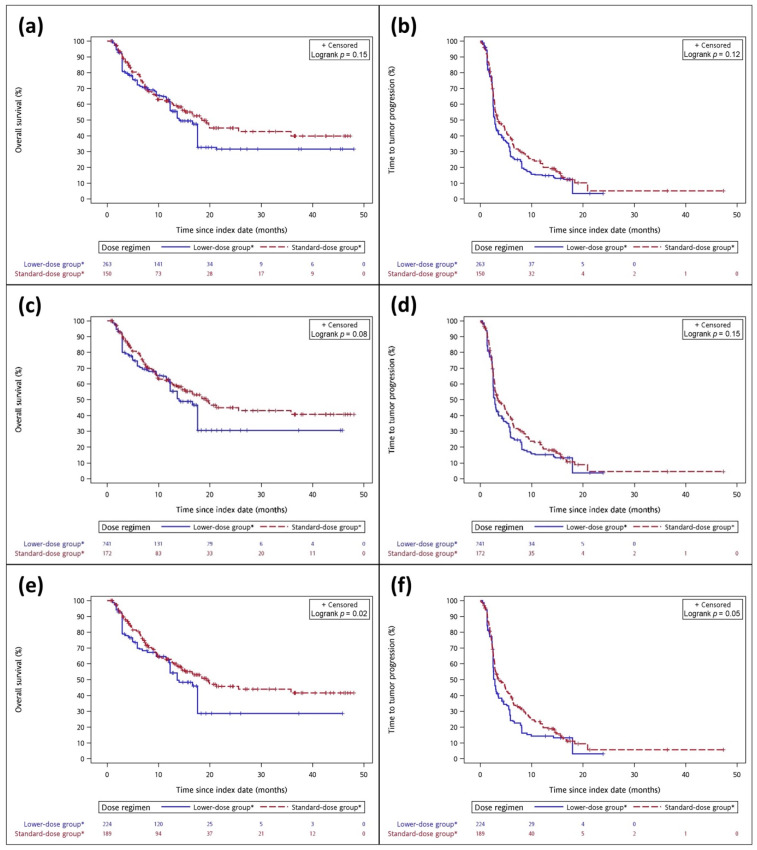
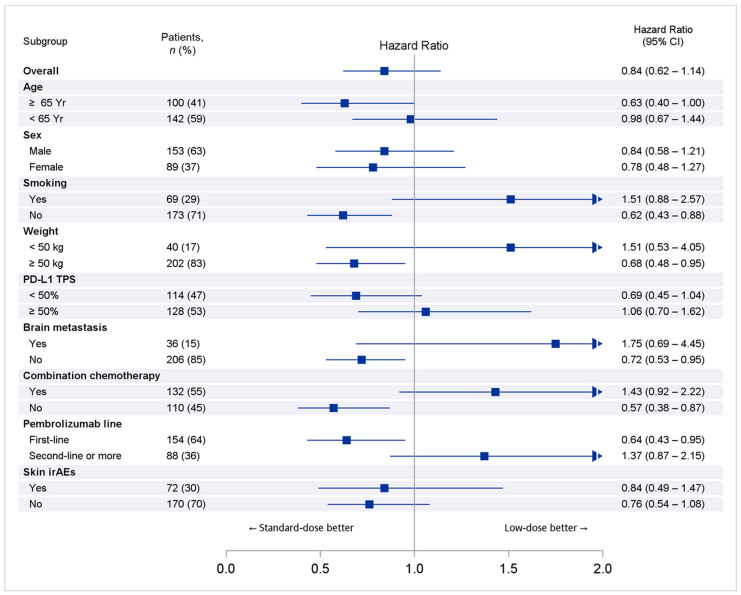
Fixed doses at 200 mg of pembrolizumab or 2 mg/kg every 3 weeks are the standard dosages for first- and second-line treatment of non-small-cell lung cancer (NSCLC); however, in clinical practice, patients with NSCLC may receive lower doses of pembrolizumab due to drug product availability or economic factors. To date, the comparative effectiveness and safety of the standard dose and lower doses of pembrolizumab in these patients still remains limited. We conducted a retrospective cohort study by analyzing electronic medical records data from the largest multi-institutional hospital system in Taiwan. Advanced NSCLC patients newly receiving pembrolizumab with or without chemotherapy were included. Patients were classified into: (1) the standard-dose group (≥2 mg/kg), and (2) the low-dose group (<2 mg/kg). We applied inverse probability of treatment weighting (IPTW) to compare the overall survival (OS) and immune-related adverse events (irAEs) between the two treatment groups, and to evaluate the minimum clinically effective dose of pembrolizumab. We included a total of 147 NSCLC patients receiving standard-dose pembrolizumab (mean [range] age: 63.7 [58.0−73.0] years; male: 62.6%; mean [range] body weight: 60.5 [58.0−73.0] kg) and 95 patients receiving low-dose pembrolizumab (mean [range] age: 62.0 [50.0−68.8] years; male: 64.2%; mean [range] body weight: 63.9 [55.0−73.8] kg). After IPTW adjustments, the median OS was similar for both the standard-dose and low-dose pembrolizumab groups (19.3 vs. 14.3 months, log-rank p = 0.15). Also, the rate for all classes of irAEs was similar for both groups. We found that patients with a pembrolizumab dose ≥1.8 mg/kg were associated with better OS than those receiving <1.8 mg/kg. Our findings suggested no significant difference in OS and irAEs between patients receiving pembrolizumab ≥2 mg/kg and <2 mg/kg in clinical practice. A pembrolizumab dose ≥1.8 mg/kg may be the clinically most efficient dose.
帕博利珠单抗200mg固定剂量或每3周2mg/kg是用于非小细胞肺癌(NSCLC)一线和二线治疗的标准剂量;然而,在临床实践中,由于药品供应或经济因素,NSCLC患者可能接受较低剂量的帕博利珠单抗。迄今为止,帕博利珠单抗标准剂量和较低剂量在这些患者中的相对有效性和安全性仍然有限。我们通过分析台湾最大的多机构医院系统的电子病历数据进行了一项回顾性队列研究。纳入新接受帕博利珠单抗治疗且接受或未接受化疗的晚期NSCLC患者。患者被分为:(1)标准剂量组(≥2mg/kg),和(2)低剂量组(<2mg/kg)。我们应用治疗权重逆概率(IPTW)来比较两个治疗组之间的总生存期(OS)和免疫相关不良事件(irAE),并评估帕博利珠单抗的最小临床有效剂量。我们共纳入了147例接受标准剂量帕博利珠单抗的NSCLC患者(平均[范围]年龄:63.7[58.0 - 73.0]岁;男性:62.6%;平均[范围]体重:60.5[58.0 - 73.0]kg)和95例接受低剂量帕博利珠单抗的患者(平均[范围]年龄:62.0[50.0 - 68.8]岁;男性:64.2%;平均[范围]体重:63.9[55.0 - 73.8]kg)。经过IPTW调整后,标准剂量和低剂量帕博利珠单抗组的中位OS相似(19.3个月对14.3个月,对数秩检验p = 0.15)。此外,两组所有类型irAE的发生率相似。我们发现,帕博利珠单抗剂量≥1.8mg/kg的患者比接受<1.8mg/kg的患者OS更好。我们的研究结果表明,在临床实践中,接受≥2mg/kg和<2mg/kg帕博利珠单抗的患者在OS和irAE方面无显著差异。帕博利珠单抗剂量≥1.8mg/kg可能是临床最有效的剂量。