Department of Pediatrics, Dana Dwek Children's Hospital, Tel Aviv Sourasky Medical Center, Tel Aviv 6423906, Israel.
Pediatric Gastroenterology Institute, Dana Dwek Children's Hospital, Tel Aviv Sourasky Medical Center, Tel Aviv 6423906, Israel.
Nutrients. 2022 Mar 3;14(5):1064. doi: 10.3390/nu14051064.
Commercial infant formulas attempt to imitate human milk's unique composition. However, lactose-free and milk protein-free formulas are often chosen due to medical reasons or personal preferences. The aim of this study was to determine the glycemic and insulinemic indices of a variety of infant formulas.
We conducted a three-arm, randomized, double-blind, crossover study. Participants were 25-40-year-old healthy adults. Three commercial infant formulas (cow's milk protein-based ["standard"], soy protein-based, and lactose-free) were randomly given to each participant. Glycemic and insulinemic responses were determined and compared between the three formulas.
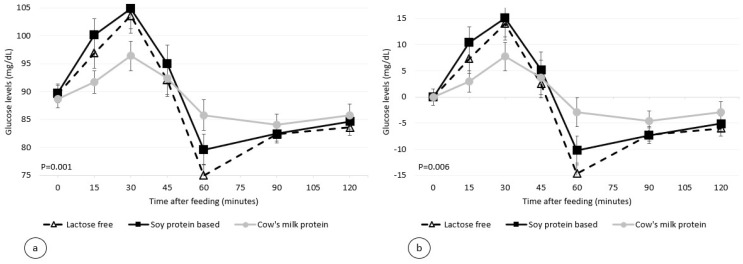
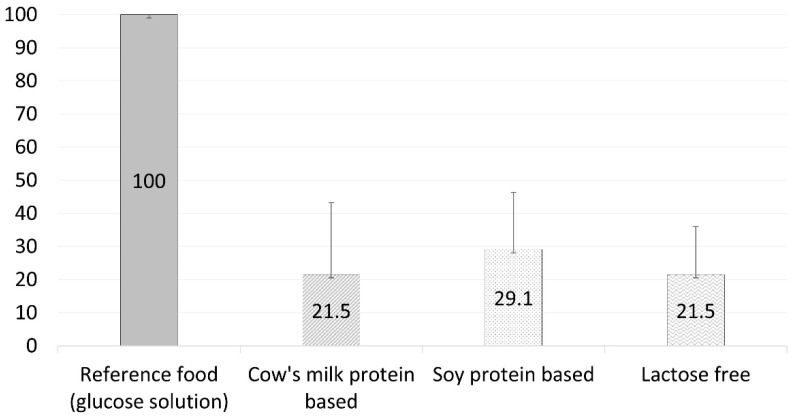
Twenty subjects were enrolled (11 females/9 males, mean age 32.8 ± 2.9 years). No significant difference was found in the glycemic index between the three formulas (21.5, 29.1, and 21.5 for the standard, soy protein-based, and lactose-free formulas, respectively, = 0.21). However, maximal glucose levels were significantly higher for the soy protein-based formula compared to both the standard and lactose-free formulas (111.5 compared to 101.8 and 105.8 mg/dL, respectively, = 0.001).
Cow's milk protein-based, soy protein-based, and lactose-free formulas have a similar glycemic index. However, soy protein-based formula produced a significantly higher increase in postprandial glucose levels. The implication and biological significance of these results have yet to be determined.
商业婴儿配方奶粉试图模仿人乳的独特成分。然而,由于医疗原因或个人偏好,常选择无乳糖和无乳蛋白配方。本研究旨在确定各种婴儿配方奶粉的血糖和胰岛素指数。
我们进行了一项三臂、随机、双盲、交叉研究。参与者为 25-40 岁健康成年人。每位参与者随机接受三种商业婴儿配方奶粉(基于牛奶蛋白的[标准]、基于大豆蛋白的和无乳糖)。测定并比较三种配方的血糖和胰岛素反应。
共纳入 20 名受试者(11 名女性/9 名男性,平均年龄 32.8 ± 2.9 岁)。三种配方的血糖指数无显著差异(标准、大豆蛋白和无乳糖配方分别为 21.5、29.1 和 21.5, = 0.21)。然而,大豆蛋白配方的最大血糖水平明显高于标准配方和无乳糖配方(分别为 111.5 比 101.8 和 105.8 mg/dL, = 0.001)。
基于牛奶蛋白的、大豆蛋白的和无乳糖的配方具有相似的血糖指数。然而,大豆蛋白配方会显著增加餐后血糖水平。这些结果的含义和生物学意义尚待确定。