Regional Centre for Biotechnology, NCR Biotech Science Cluster, Faridabad 121001, Haryana, India.
Int J Mol Sci. 2022 Feb 28;23(5):2694. doi: 10.3390/ijms23052694.
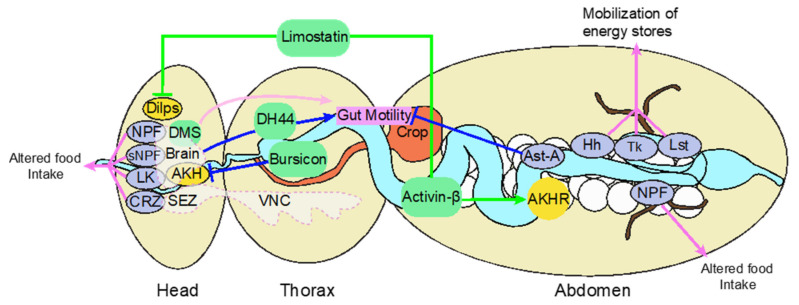
Nutrient-sensing mechanisms in animals' sense available nutrients to generate a physiological regulatory response involving absorption, digestion, and regulation of food intake and to maintain glucose and energy homeostasis. During nutrient sensing via the gastrointestinal tract, nutrients interact with receptors on the enteroendocrine cells in the gut, which in return respond by secreting various hormones. Sensing of nutrients by the gut plays a critical role in transmitting food-related signals to the brain and other tissues informing the composition of ingested food to digestive processes. These signals modulate feeding behaviors, food intake, metabolism, insulin secretion, and energy balance. The increasing significance of fly genetics with the availability of a vast toolbox for studying physiological function, expression of chemosensory receptors, and monitoring the gene expression in specific cells of the intestine makes the fly gut the most useful tissue for studying the nutrient-sensing mechanisms. In this review, we emphasize on the role of gut in nutrient-sensing to maintain metabolic homeostasis and gut-brain cross talk using endocrine and neuronal signaling pathways stimulated by internal state or the consumption of various dietary nutrients. Overall, this review will be useful in understanding the post-ingestive nutrient-sensing mechanisms having a physiological and pathological impact on health and diseases.
动物通过感知营养物质的机制来感知可用的营养物质,从而产生涉及吸收、消化和调节食物摄入的生理调节反应,以维持葡萄糖和能量的体内平衡。在通过胃肠道进行营养感知的过程中,营养物质与肠道内的肠内分泌细胞上的受体相互作用,肠内分泌细胞则通过分泌各种激素来做出反应。肠道对营养物质的感知在将与食物相关的信号传递到大脑和其他组织中起着关键作用,这些信号告知大脑摄入食物的成分,从而调节消化过程。这些信号调节摄食行为、食物摄入、代谢、胰岛素分泌和能量平衡。随着用于研究生理功能、化学感觉受体表达和监测肠道特定细胞基因表达的大量工具的出现,果蝇遗传学的重要性日益增加,使得果蝇肠道成为研究营养感知机制的最有用的组织。在这篇综述中,我们强调了肠道在通过内分泌和神经元信号通路感知营养物质以维持代谢平衡和肠脑对话中的作用,这些信号通路是由内部状态或各种膳食营养素的消耗所刺激的。总的来说,这篇综述将有助于理解对健康和疾病具有生理和病理影响的摄食后营养感知机制。