Department of Computer and Telematic Systems Engineering, Polytechnic School of Cáceres, University of Extremadura, 10003 Cáceres, Spain.
Health and Care Research Group (GISyC), University of Extremadura, 10003 Cáceres, Spain.
Int J Environ Res Public Health. 2022 Mar 3;19(5):2947. doi: 10.3390/ijerph19052947.
In the context of growing population ageing, technologies aimed at helping people age in place play a fundamental role. Acceptance of the implementation of technological solutions can be defined as the intention to use a technology or the effective use of it. Approaches based on the technology acceptance model (TAM) have been shown to have good predictive power for pre-implementation attitudes towards new technologies.
To analyze the degree of acceptability of the use of new technologies for ageing in place and the factors associated with greater acceptance in people older than 64 years.
A descriptive cross-sectional study was carried out. Sociodemographic, clinical and environmental variables, architectural barriers, social risk and quality of life, degree of autonomy, morbidity, and risk of falls were collected in a population sample over 64 years of age in a large region of western Spain. The degree of acceptance of the use of technologies was measured through a scale based on the TAM.
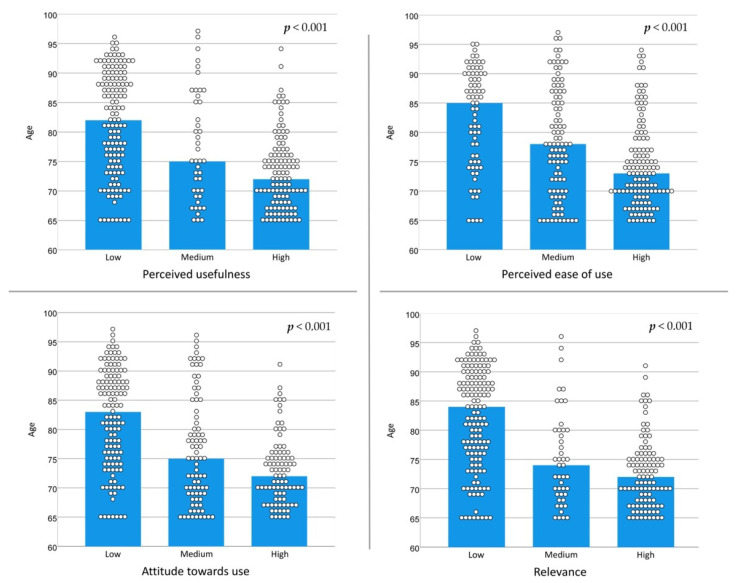
Of the 293 people included in the study, 36.2% exhibited a high acceptability of new technologies, 28.3% exhibited a medium acceptability, and 35.5% exhibited a low acceptability. Of all the factors, age, education level, and living alone were significantly associated with high acceptance in the adjusted analyses.
Younger age, a higher education level, and living alone are factors associated with a greater degree of acceptance of the use of technologies for ageing in place.
在人口老龄化不断加剧的背景下,旨在帮助人们就地养老的技术发挥着重要作用。对技术实施的接受程度可以定义为使用技术的意图或对技术的有效使用。基于技术接受模型(TAM)的方法已被证明对新技术实施前的态度具有良好的预测能力。
分析 64 岁以上人群对新技术在就地养老中的使用的接受程度,以及与更高接受度相关的因素。
进行了一项描述性的横断面研究。在西班牙西部的一个大区,对超过 64 岁的人群样本进行了社会人口统计学、临床和环境变量、建筑障碍、社会风险和生活质量、自主性程度、发病率和跌倒风险的收集。通过基于 TAM 的量表来衡量对技术使用的接受程度。
在纳入研究的 293 人中,36.2%表现出对新技术的高度接受度,28.3%表现出中等接受度,35.5%表现出低度接受度。在所有因素中,年龄、教育水平和独居在调整后的分析中与高度接受显著相关。
年龄较小、教育程度较高和独居是与对新技术在就地养老中的使用更高接受度相关的因素。