Laboratory of Neurophysiology, National Institute for Basic Biology, Higashiyama 5-1, Myodaiji-cho, Okazaki, Aichi, 444-8787, Japan.
College of Comprehensive Psychology, Ritsumeikan University, Iwakura-cho 2-150, Ibaraki, Osaka, 567-8570, Japan.
Sci Rep. 2022 Mar 10;12(1):3893. doi: 10.1038/s41598-022-07438-3.
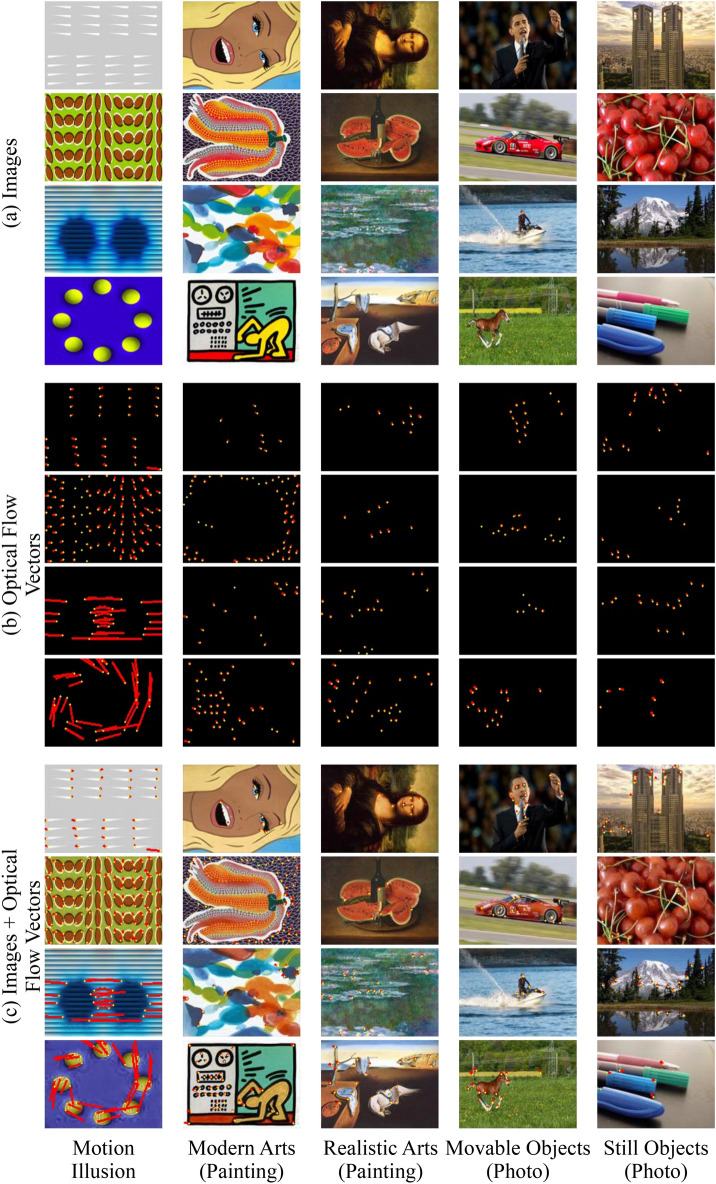
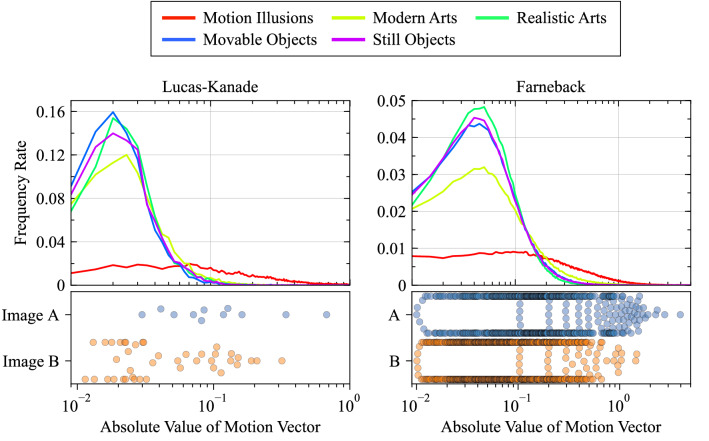
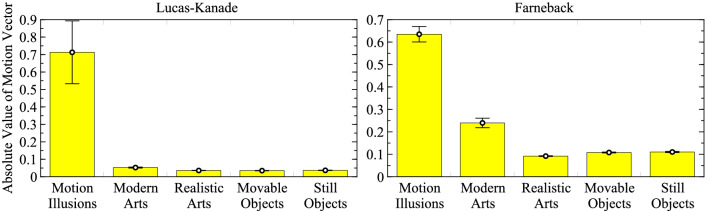
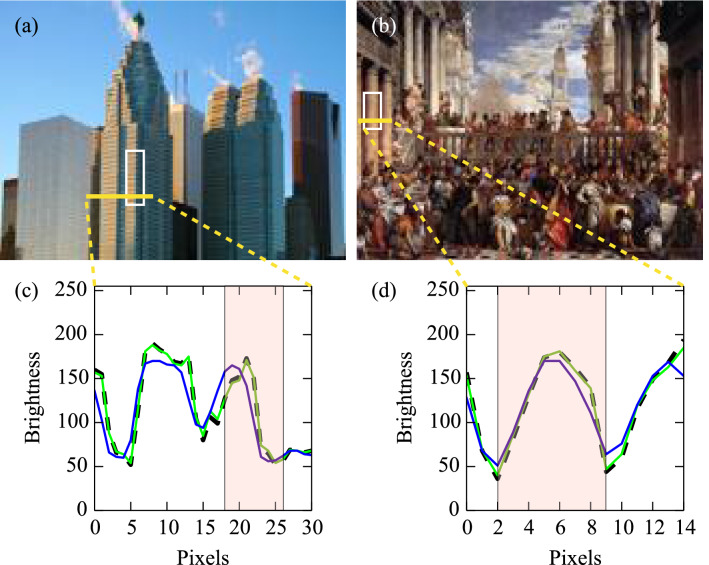
In our previous study, we successfully reproduced the illusory motion perceived in the rotating snakes illusion using deep neural networks incorporating predictive coding theory. In the present study, we further examined the properties of the network using a set of 1500 images, including ordinary static images of paintings and photographs and images of various types of motion illusions. Results showed that the networks clearly classified a group of illusory images and others and reproduced illusory motions against various types of illusions similar to human perception. Notably, the networks occasionally detected anomalous motion vectors, even in ordinally static images where humans were unable to perceive any illusory motion. Additionally, illusion-like designs with repeating patterns were generated using areas where anomalous vectors were detected, and psychophysical experiments were conducted, in which illusory motion perception in the generated designs was detected. The observed inaccuracy of the networks will provide useful information for further understanding information processing associated with human vision.
在我们之前的研究中,我们成功地使用结合了预测编码理论的深度神经网络再现了旋转蛇错觉中感知到的虚幻运动。在本研究中,我们使用一组 1500 张图像进一步研究了网络的特性,这些图像包括普通的绘画和照片静态图像以及各种类型的运动错觉图像。结果表明,该网络能够清晰地区分一组错觉图像和其他图像,并再现与人类感知相似的各种类型错觉的虚幻运动。值得注意的是,即使在人类无法感知任何错觉运动的普通静态图像中,网络偶尔也会检测到异常运动矢量。此外,使用检测到异常矢量的区域生成了具有重复模式的错觉样设计,并进行了心理物理实验,检测了在生成的设计中是否存在错觉运动感知。网络的观察到的不准确性将为进一步理解与人类视觉相关的信息处理提供有用的信息。