Exploratory Research Center on Life and Living Systems (ExCELLS) and Institute for Molecular Science (IMS), National Institutes of Natural Sciences, 5-1 Higashiyama, Myodaiji-cho, Okazaki, 444-8787, Japan.
Graduate School of Pharmaceutical Sciences, Nagoya City University, 3-1 Tanabe-dori, Mizuhoku, Nagoya, 467-8603, Japan.
Commun Biol. 2022 Mar 10;5(1):184. doi: 10.1038/s42003-022-03143-z.
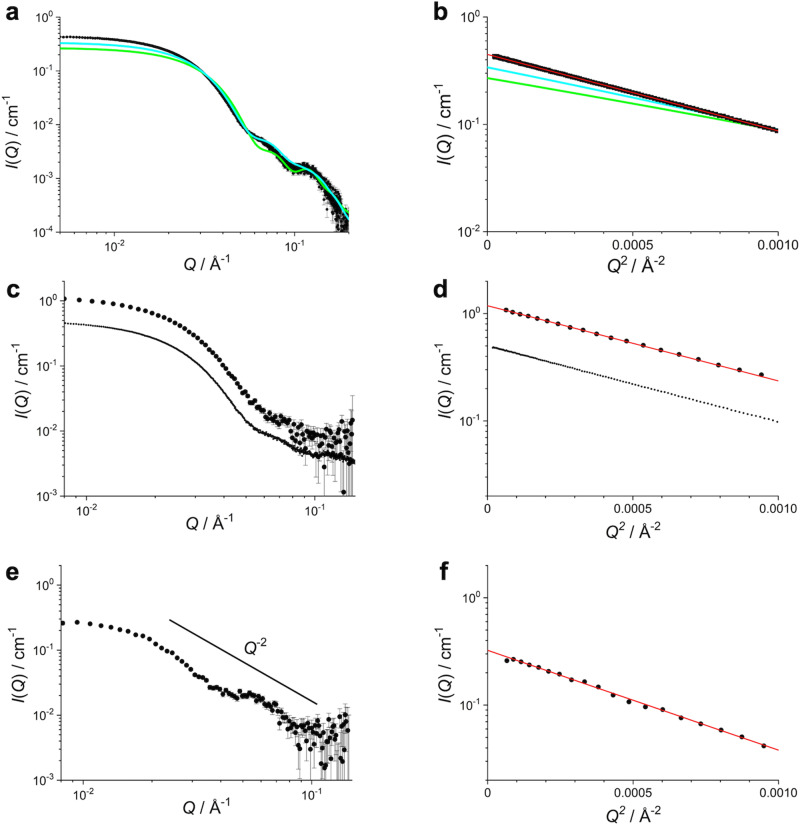
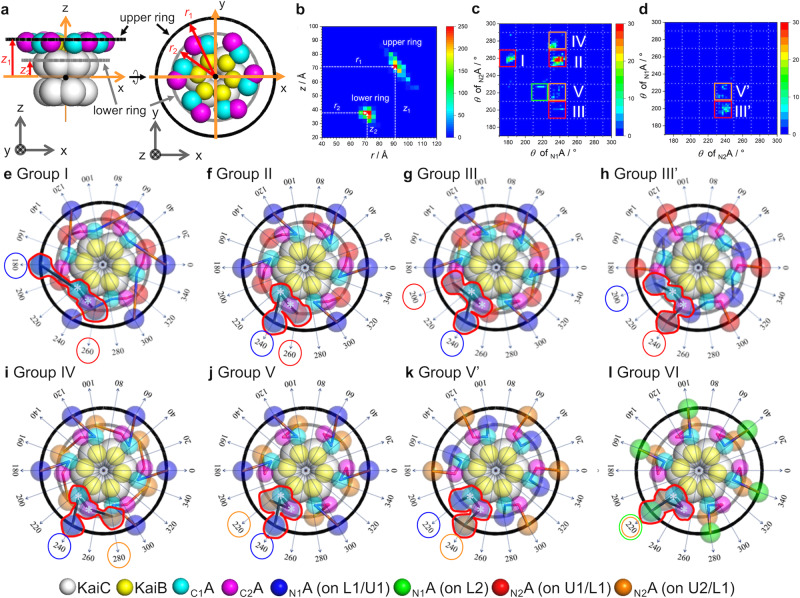
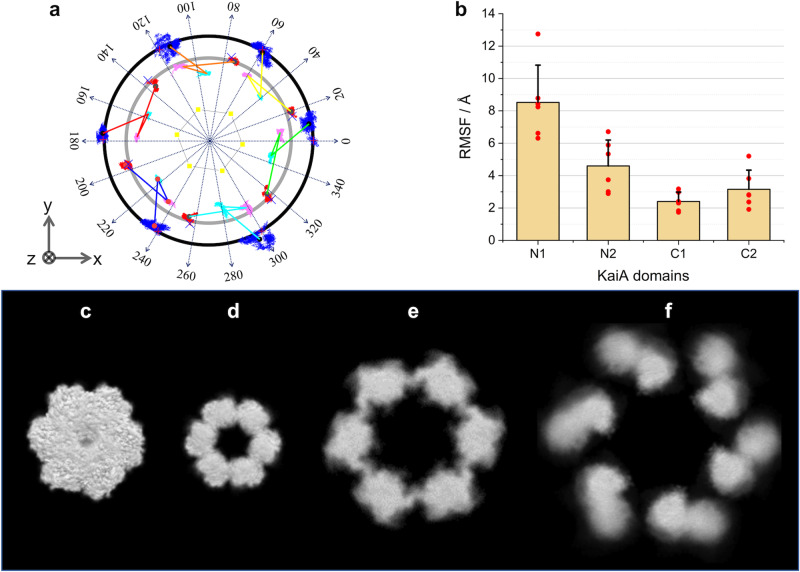
In the cyanobacterial circadian clock system, KaiA, KaiB and KaiC periodically assemble into a large complex. Here we determined the overall structure of their fully assembled complex by integrating experimental and computational approaches. Small-angle X-ray and inverse contrast matching small-angle neutron scatterings coupled with size-exclusion chromatography provided constraints to highlight the spatial arrangements of the N-terminal domains of KaiA, which were not resolved in the previous structural analyses. Computationally built 20 million structural models of the complex were screened out utilizing the constrains and then subjected to molecular dynamics simulations to examine their stabilities. The final model suggests that, despite large fluctuation of the KaiA N-terminal domains, their preferential positionings mask the hydrophobic surface of the KaiA C-terminal domains, hindering additional KaiA-KaiC interactions. Thus, our integrative approach provides a useful tool to resolve large complex structures harboring dynamically fluctuating domains.
在蓝藻生物钟系统中,KaiA、KaiB 和 KaiC 周期性地组装成一个大型复合物。在这里,我们通过整合实验和计算方法来确定它们完全组装的复合物的整体结构。小角度 X 射线和逆对比匹配小角中子散射与分子筛层析技术相结合,为突出 KaiA N 端结构域的空间排列提供了约束条件,这在之前的结构分析中没有得到解决。利用这些约束条件,从计算构建的 2000 万个复合物结构模型中筛选出结构模型,然后进行分子动力学模拟来检验它们的稳定性。最终的模型表明,尽管 KaiA N 端结构域波动较大,但它们的优先定位掩盖了 KaiA C 端结构域的疏水面,阻止了额外的 KaiA-KaiC 相互作用。因此,我们的综合方法为解决含有动态波动结构域的大型复合物结构提供了一种有用的工具。