Zhu Jie, Xue Xiaoou, He Zhiping, Zhang Jiawei, Sun Haiyun
Department of Gynaecology, Dongzhimen Hospital of Beijing University of Chinese Medicine, Beijing, China.
Ann Transl Med. 2022 Feb;10(4):198. doi: 10.21037/atm-22-419.
This study sought to explore the anti-inflammatory mechanism of Wuyao (radix linderae)-Danshen (salviae miltiorrhiza) in endometriosis (EMS) based on network pharmacology and molecular docking.
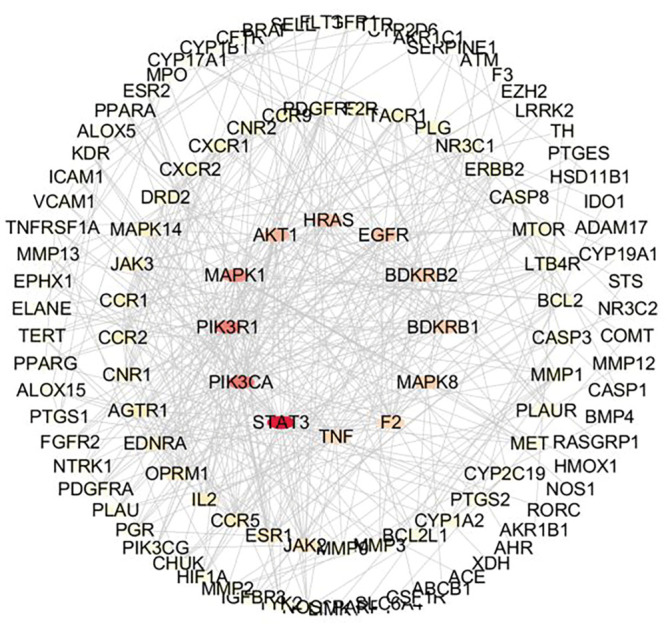
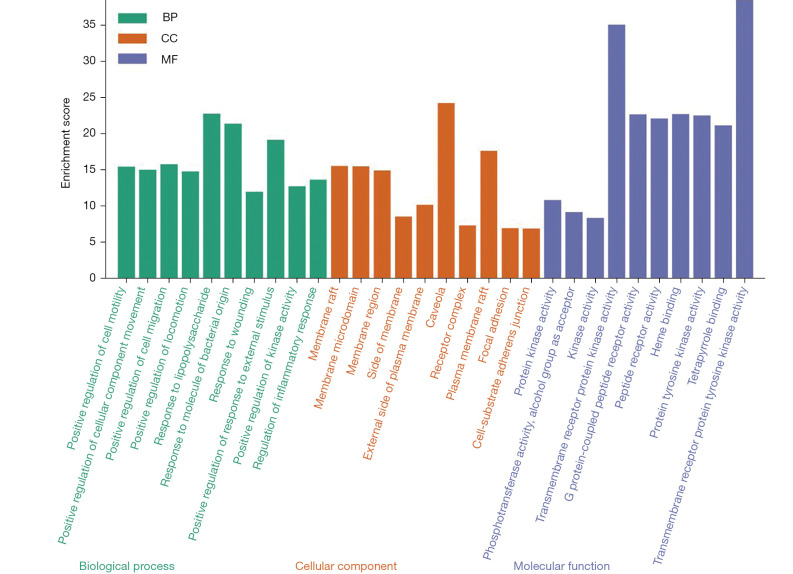
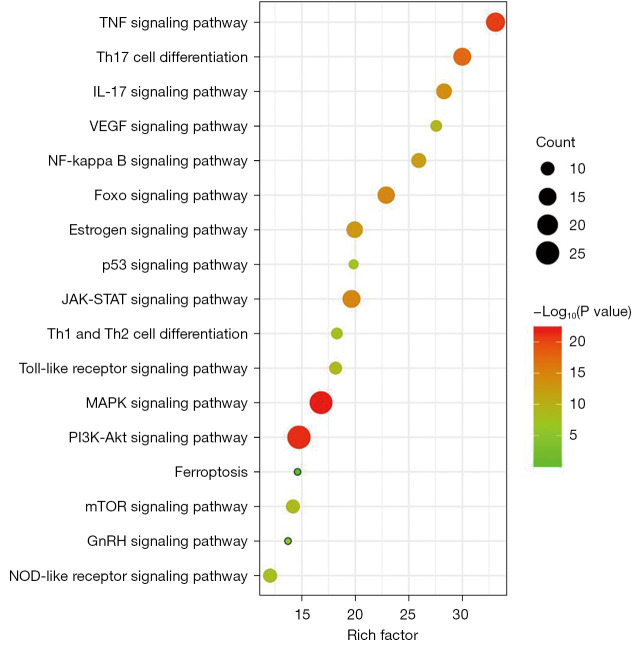
The active constituents of Wuyao-Danshen were collected and identified using the Traditional Chinese Medicine Systems Pharmacology Database, and used to predict and identify the protein targets. The EMS targets and anti-inflammatory targets were obtained from Genecards, Online Mendelian Inheritance in Man, and Drugbank. The Search Tool for the Retrieval of Interacting Genes/Proteins database was used to analyze the protein interactions (PPIs) and core targets, and a target PPI network was constructed by importing the software of Cytoscape. The Metascape database was used to conduct enrichment analyses of the Gene Ontology (GO) functions and the Kyoto Encyclopedia of Genes and Genomes (KEGG) signaling pathways for the key anti-inflammatory targets of EMS. Finally, Autodock Vina software was used to verify the results of the active ingredients and key anti-inflammatory targets.
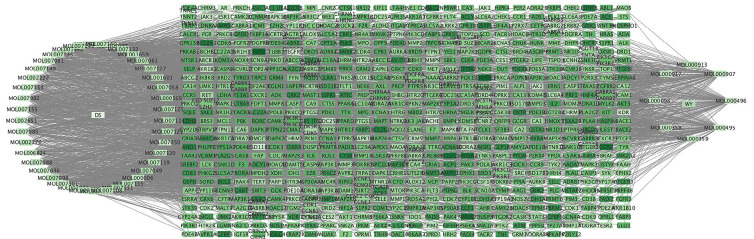
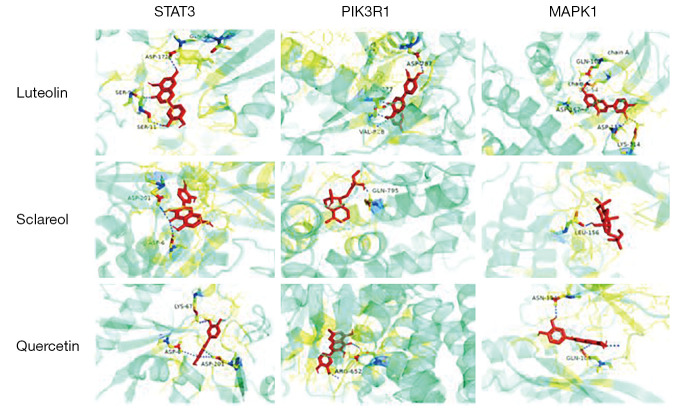
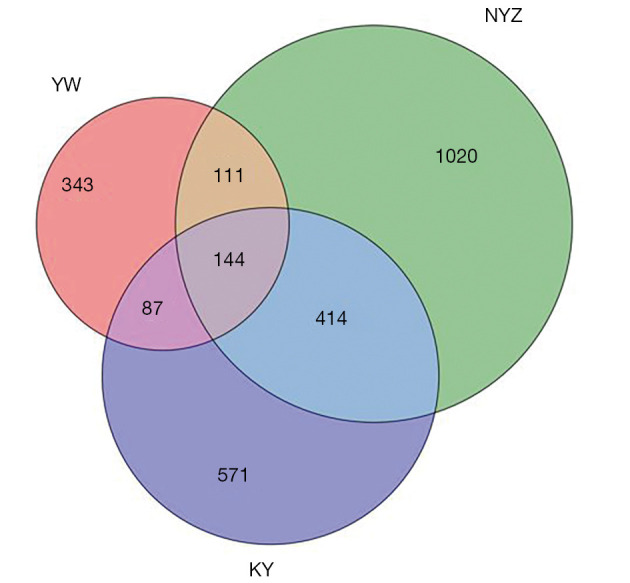
There were 8 active components in Wuyao, 65 in Danshen, and 591 corresponding protein targets in Danshen, and 375 in Wuyao, including luteolin, quercetin, vancomyl alcohol, and salvianol. One thousand and six hundred eighty-nine disease targets, 1,216 anti-inflammatory targets, and 144 key anti-inflammatory targets were identified, including the (signal transduction and transcriptional activator 3) , phosphatidyl inositol-3 kinase regulates subunit 1 () and mitogen-activated protein kinase 1 () protein kinase B. Three hundred and fifty-three biological processes (BPs), 21 cellular components, and 25 molecular functions (MFs) were enriched with GO functions, and 108 KEGG pathways were enriched and analyzed, including the and signaling pathways. Molecular docking confirmed that luteolin, coumarin, and quercetin could bind to the key target proteins (i.e., , , and ).
Based on network pharmacology and molecular docking, Wuyao-Danshen was found to act on EMS through anti-inflammatory targets and related signaling pathways. Our findings provide a basis for further research.
本研究旨在基于网络药理学和分子对接探索乌药 - 丹参治疗子宫内膜异位症(EMS)的抗炎机制。
利用中药系统药理学数据库收集并鉴定乌药 - 丹参的活性成分,用于预测和鉴定蛋白质靶点。从Genecards、人类孟德尔遗传在线数据库和药物银行获取EMS靶点和抗炎靶点。使用检索相互作用基因/蛋白质数据库工具分析蛋白质相互作用(PPI)和核心靶点,并通过导入Cytoscape软件构建靶点PPI网络。利用Metascape数据库对EMS关键抗炎靶点进行基因本体(GO)功能和京都基因与基因组百科全书(KEGG)信号通路的富集分析。最后,使用Autodock Vina软件验证活性成分与关键抗炎靶点的结果。
乌药中有8种活性成分,丹参中有65种,丹参中有591个相应的蛋白质靶点,乌药中有375个,包括木犀草素、槲皮素、香草醇和丹酚。鉴定出1689个疾病靶点、1216个抗炎靶点和144个关键抗炎靶点,包括信号转导和转录激活因子3、磷脂酰肌醇 - 3激酶调节亚基1和丝裂原活化蛋白激酶1蛋白激酶B。353个生物学过程(BP)、21个细胞成分和25个分子功能(MF)通过GO功能得到富集,108条KEGG通路得到富集和分析,包括和信号通路。分子对接证实木犀草素、香豆素和槲皮素可与关键靶蛋白(即、和)结合。
基于网络药理学和分子对接,发现乌药 - 丹参通过抗炎靶点和相关信号通路作用于EMS。我们的研究结果为进一步研究提供了依据。