Patel Nikil, Peterson Katie A, Ingram Ruth U, Storey Ian, Cappa Stefano F, Catricala Eleonora, Halai Ajay, Patterson Karalyn E, Lambon Ralph Matthew A, Rowe James B, Garrard Peter
Molecular and Clinical Sciences Research Institute, St George's, University of London, London SW17 0RE, UK.
Department of Clinical Neurosciences and Cambridge University Hospitals NHS Trust, University of Cambridge, Cambridge CB2 0SP, UK.
Brain Commun. 2021 Dec 21;4(2):fcab299. doi: 10.1093/braincomms/fcab299. eCollection 2022.
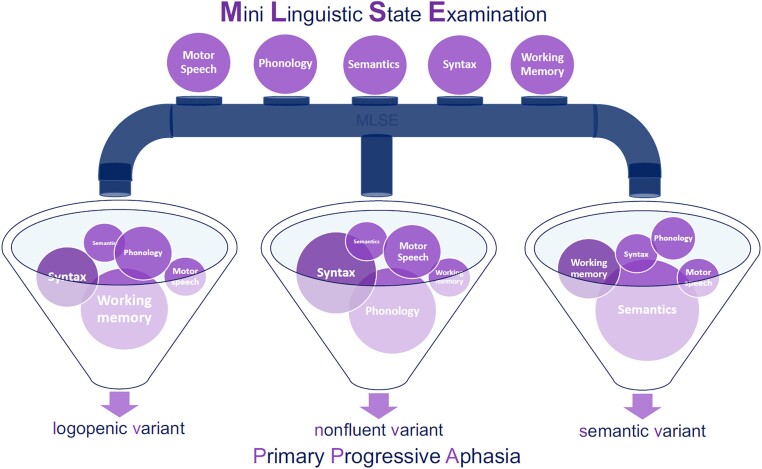
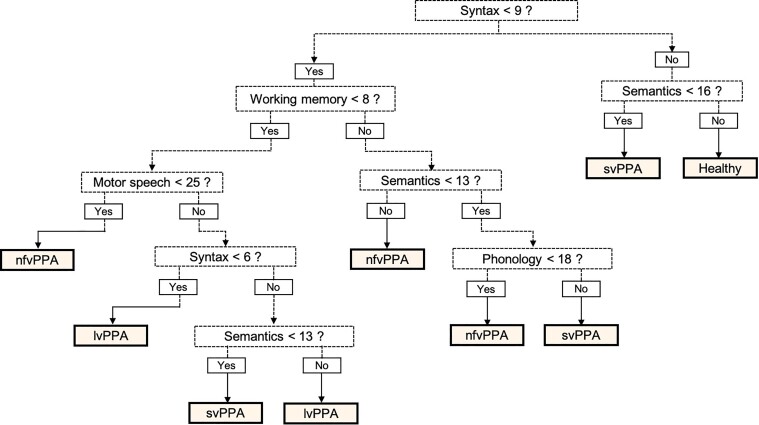
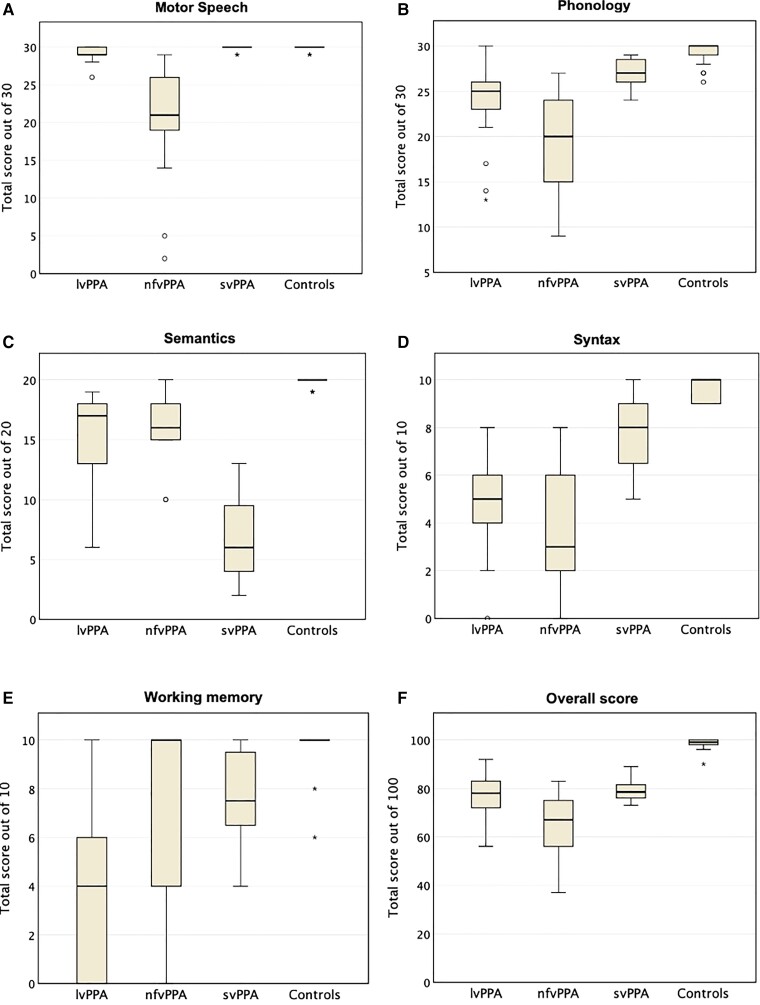
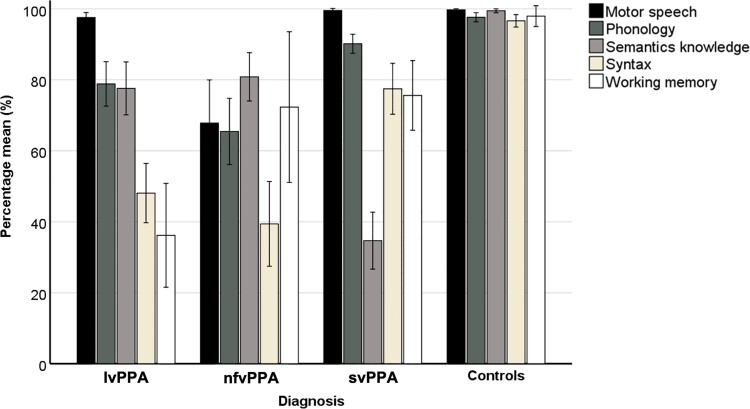
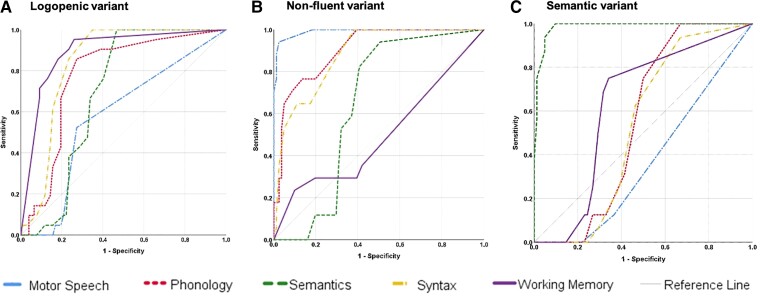
There are few available methods for qualitatively evaluating patients with primary progressive aphasia. Commonly adopted approaches are time-consuming, of limited accuracy or designed to assess different patient populations. This paper introduces a new clinical test-the Mini Linguistic State Examination-which was designed uniquely to enable a clinician to assess and subclassify both classical and mixed presentations of primary progressive aphasia. The adoption of a novel assessment method (error classification) greatly amplifies the clinical information that can be derived from a set of standard linguistic tasks and allows a five-dimensional profile to be defined. Fifty-four patients and 30 matched controls were recruited. Five domains of language competence (motor speech, phonology, semantics, syntax and working memory) were assessed using a sequence of 11 distinct linguistic assays. A random forest classification was used to assess the diagnostic accuracy for predicting primary progressive aphasia subtypes and create a decision tree as a guide to clinical classification. The random forest prediction model was 96% accurate overall (92% for the logopenic variant, 93% for the semantic variant and 98% for the non-fluent variant). The derived decision tree produced a correct classification of 91% of participants whose data were not included in the training set. The Mini Linguistic State Examination is a new cognitive test incorporating a novel and powerful, yet straightforward, approach to scoring. Rigorous assessment of its diagnostic accuracy confirmed excellent matching of primary progressive aphasia syndromes to clinical gold standard diagnoses. Adoption of the Mini Linguistic State Examination by clinicians will have a decisive impact on the consistency and uniformity with which patients can be described clinically. It will also facilitate screening for cohort-based research, including future therapeutic trials, and is suitable for describing, quantifying and monitoring language deficits in other brain disorders.
目前用于定性评估原发性进行性失语患者的方法很少。常用的方法耗时、准确性有限或旨在评估不同的患者群体。本文介绍了一种新的临床测试——迷你语言状态检查,它是专门设计的,使临床医生能够对原发性进行性失语的经典和混合表现进行评估和分类。采用一种新颖的评估方法(错误分类)极大地扩充了可从一组标准语言任务中得出的临床信息,并允许定义一个五维概况。招募了54名患者和30名匹配的对照。使用11种不同的语言测试序列评估了语言能力的五个领域(运动言语、音系学、语义学、句法和工作记忆)。使用随机森林分类来评估预测原发性进行性失语亚型的诊断准确性,并创建一个决策树作为临床分类指南。随机森林预测模型总体准确率为96%(语音变异型为92%,语义变异型为93%,非流利变异型为98%)。得出的决策树对数据未包含在训练集中的91%的参与者进行了正确分类。迷你语言状态检查是一种新的认知测试,采用了一种新颖、强大且简单的评分方法。对其诊断准确性的严格评估证实了原发性进行性失语综合征与临床金标准诊断的高度匹配。临床医生采用迷你语言状态检查将对临床描述患者的一致性和统一性产生决定性影响。它还将有助于基于队列的研究筛查,包括未来的治疗试验,并且适用于描述、量化和监测其他脑部疾病中的语言缺陷。