
多特蒙德生命研究中生物和生活方式因素对认知老化及工作能力的影响:一项跨学科、横断面和纵向研究的方案
Impact of Biological and Lifestyle Factors on Cognitive Aging and Work Ability in the Dortmund Vital Study: Protocol of an Interdisciplinary, Cross-sectional, and Longitudinal Study.
作者信息
Gajewski Patrick D, Getzmann Stephan, Bröde Peter, Burke Michael, Cadenas Cristina, Capellino Silvia, Claus Maren, Genç Erhan, Golka Klaus, Hengstler Jan G, Kleinsorge Thomas, Marchan Rosemarie, Nitsche Michael A, Reinders Jörg, van Thriel Christoph, Watzl Carsten, Wascher Edmund
机构信息
Leibniz Research Centre for Working Environment and Human Factors (IfADo) at the Technical University of Dortmund, Dortmund, Germany.
出版信息
JMIR Res Protoc. 2022 Mar 14;11(3):e32352. doi: 10.2196/32352.
BACKGROUND
Previous research revealed several biological and environmental factors modulating cognitive functioning over a human's lifespan. However, the relationships and interactions between biological factors (eg, genetic polymorphisms, immunological parameters, metabolic products, or infectious diseases) and environmental factors (eg, lifestyle, physical activity, nutrition, and work type or stress at work) as well as their impact on cognitive functions across the lifespan are still poorly understood with respect to their complexity.
OBJECTIVE
The goal of the Dortmund Vital Study is to validate previous hypotheses as well as generate and validate new hypotheses about the relationships among aging, working conditions, genetic makeup, stress, metabolic functions, the cardiovascular system, the immune system, and mental performance over the human lifespan with a focus on healthy working adults. The Dortmund Vital Study is a multidisciplinary study involving the Departments of Ergonomics, Immunology, Psychology and Neurosciences, and Toxicology at the Leibniz Research Centre for Working Environment and Human Factors at the Technical University of Dortmund (IfADo) in Germany, as well as several national and international partners.
METHODS
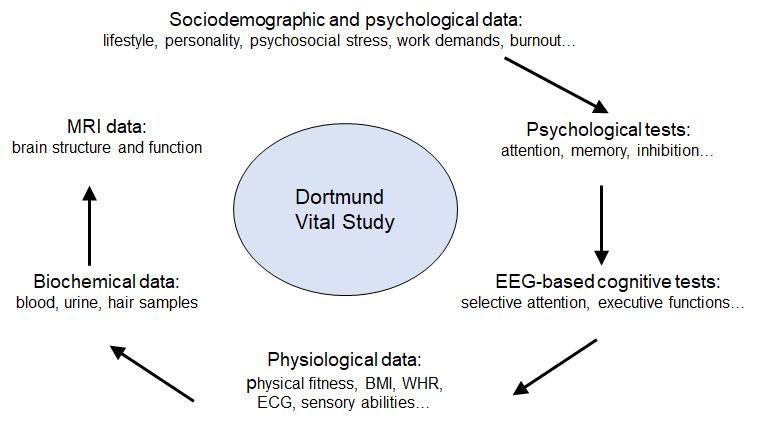
The Dortmund Vital Study is designed as a combined cross-sectional and longitudinal study. Approximately 600 healthy subjects aged between 20 and 70 years will participate. A wide range of demographic, psychological, behavioral, sensory, cardiovascular, immunological, and biochemical data, a comprehensive electroencephalography (EEG)-based cognitive test battery as well as structural and functional magnetic resonance imaging (MRI) have been included in the study.
RESULTS
The study was approved by the Ethics Committee of IfADo in October 2015. The baseline testing was conducted between 2016 and 2021 and will be repeated every 5 years (3 follow-up measures until 2035). As of March 2020 (until the outbreak of the COVID-19 pandemic), 593 participants have been enrolled. Some results from the cross-sectional part of the study were already published, further results will be published soon. Longitudinal data will be analyzed and published by 2025.
CONCLUSIONS
We anticipate that the study will shed light on sources of interindividual differences in the alterations of cognitive functioning with increasing age and reveal biological and lifestyle markers contributing to work ability, longevity, and healthy aging on the one hand, and to risk factors for cognitive decline, mild cognitive impairment, or even dementia on the other hand.
TRIAL REGISTRATION
ClinicalTrials.gov NCT05155397; https://clinicaltrials.gov/ct2/show/NCT05155397.
INTERNATIONAL REGISTERED REPORT IDENTIFIER (IRRID): DERR1-10.2196/32352.
背景
先前的研究揭示了几种在人类生命周期中调节认知功能的生物和环境因素。然而,生物因素(如基因多态性、免疫参数、代谢产物或传染病)与环境因素(如生活方式、体育活动、营养、工作类型或工作压力)之间的关系和相互作用,以及它们在整个生命周期中对认知功能的影响,由于其复杂性,目前仍知之甚少。
目的
多特蒙德生命研究的目标是验证先前的假设,并就衰老、工作条件、基因构成、压力、代谢功能、心血管系统、免疫系统和人类生命周期中的心理表现之间的关系提出并验证新的假设,重点关注健康的在职成年人。多特蒙德生命研究是一项多学科研究,涉及德国多特蒙德工业大学莱布尼茨工作环境与人类因素研究中心(IfADo)的工效学、免疫学、心理学和神经科学以及毒理学系,以及几个国内和国际合作伙伴。
方法
多特蒙德生命研究设计为横断面研究和纵向研究相结合。约600名年龄在20至70岁之间的健康受试者将参与研究。研究纳入了广泛的人口统计学、心理学、行为学、感官、心血管、免疫和生化数据,一套基于脑电图(EEG)的综合认知测试组,以及结构和功能磁共振成像(MRI)。
结果
该研究于2015年10月获得IfADo伦理委员会批准。基线测试在2016年至2021年期间进行,并将每5年重复一次(到2035年进行3次随访测量)。截至2020年3月(直到COVID-19大流行爆发),已有593名参与者登记入组。该研究横断面部分的一些结果已经发表,更多结果将很快发表。纵向数据将在2025年进行分析并发表。
结论
我们预计该研究将阐明随着年龄增长认知功能变化中个体差异的来源,并揭示一方面有助于工作能力、长寿和健康衰老,另一方面又是认知衰退、轻度认知障碍甚至痴呆风险因素的生物和生活方式标志物。
试验注册
ClinicalTrials.gov NCT05155397;https://clinicaltrials.gov/ct2/show/NCT05155397。
国际注册报告识别码(IRRID):DERR(1-10.2196/32352)。
 Zotero 插件