Department of Obstetrics and Gynaecology, Division of Obstetrics and Prenatal Medicine, Erasmus MC, University Medical Centre Rotterdam, Rotterdam, The Netherlands.
Faculty of Medicine, Vrije Universiteit Amsterdam, Amsterdam, The Netherlands.
Exp Clin Endocrinol Diabetes. 2022 Nov;130(11):740-750. doi: 10.1055/a-1797-8317. Epub 2022 Mar 14.
Not much is known about the effects of glycemic variability (GV) during the pre- and periconception period on pregnancy/perinatal complications. GV could potentially contribute to identification of high-risk pregnancies in women with type 1 diabetes.
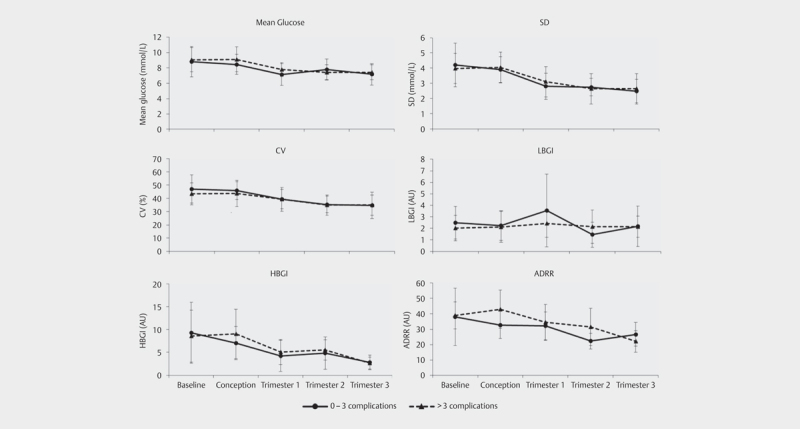
An explorative retrospective cohort study was conducted between January 2014 and May 2019. Glucose data were retrieved from electronic patient charts. Pre-/periconceptional GV and GV during all three trimesters was expressed as mean glucose, standard deviation (SD), Coefficient of Variation (CV), High Blood Glucose Index (HBGI), Low Blood Glucose Index (LBGI) and Average Daily Risk Range (ADRR). Maternal and neonatal complications were summarized using a composite total complication score. Binary logistic regression analyses were conducted to assess associations between the GV measures and a total complication score>3, a maternal complication score>1 and a neonatal complication score>1.
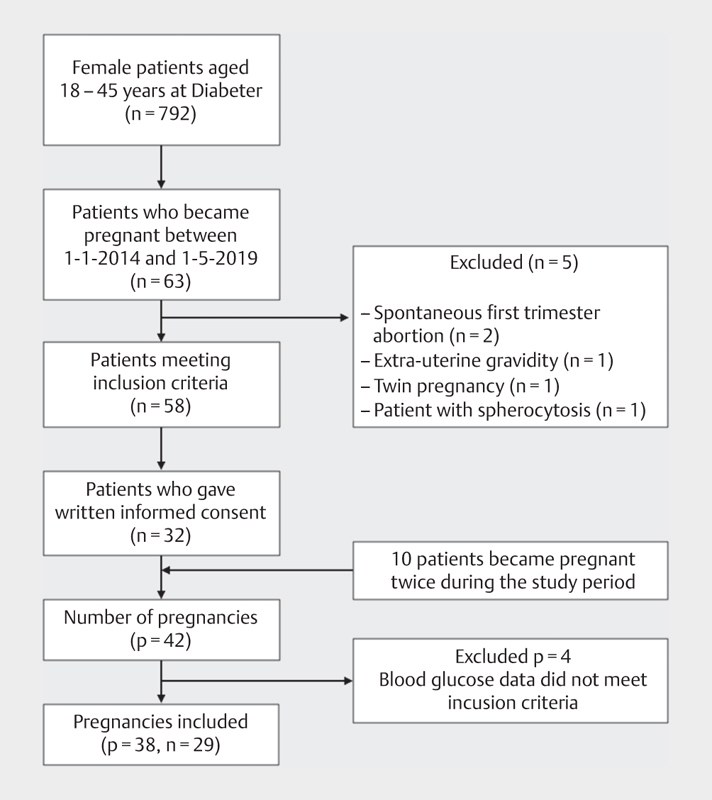
Of 63 eligible women, 29 women (38 pregnancies) were included. Women in the group with a total complication score>3 had a significantly higher ADRR at conception (OR 1.1, CI 1.0-1.2, p=0.048). No statistically significant correlations between complication score and any other GV metric besides the ADRR were found. Although not significant, in the group with a complication score>3, odds ratios>1 were found for SD in trimester 1 (OR 1.6, CI 0.6-4.5, p=0.357) and trimester 2 (OR 1.8, CI 0.5-6.2, p=0.376).
Presence of a positive association between GV and pregnancy and perinatal complications depends on which pregnancy period is assessed and the GV metrics that are used.
在妊娠和围产期,关于血糖变异性(GV)对妊娠/围产期并发症的影响,我们知之甚少。GV 可能有助于识别 1 型糖尿病女性的高危妊娠。
本研究为 2014 年 1 月至 2019 年 5 月进行的探索性回顾性队列研究。从电子病历中检索血糖数据。GV 包括妊娠前和妊娠期间以及所有三个孕程的平均血糖、标准差(SD)、变异系数(CV)、高血糖指数(HBGI)、低血糖指数(LBGI)和平均日风险范围(ADRR)。使用复合总并发症评分总结母婴并发症。采用二元逻辑回归分析评估 GV 指标与总并发症评分>3、母体并发症评分>1 和新生儿并发症评分>1 的相关性。
在 63 名符合条件的女性中,有 29 名女性(38 例妊娠)纳入研究。总并发症评分>3 的女性在受孕时的 ADRR 显著更高(OR 1.1,CI 1.0-1.2,p=0.048)。除 ADRR 外,并发症评分与任何其他 GV 指标之间未发现统计学显著相关性。虽然没有统计学意义,但在并发症评分>3 的组中,发现 1 期(OR 1.6,CI 0.6-4.5,p=0.357)和 2 期(OR 1.8,CI 0.5-6.2,p=0.376)SD 的比值比>1。
GV 与妊娠和围产期并发症之间存在正相关关系,这取决于评估的妊娠阶段和使用的 GV 指标。