Key Laboratory of Saline-Alkali Vegetation Ecology Restoration (Northeast Forestry University), Ministry of Education, Harbin 150040, China.
Heilongjiang Key Laboratory of Plant Bioactive Substance Biosynthesis and Utilization, Northeast Forestry University, Harbin 150040, China.
Proc Natl Acad Sci U S A. 2022 Mar 22;119(12):e2118709119. doi: 10.1073/pnas.2118709119. Epub 2022 Mar 15.
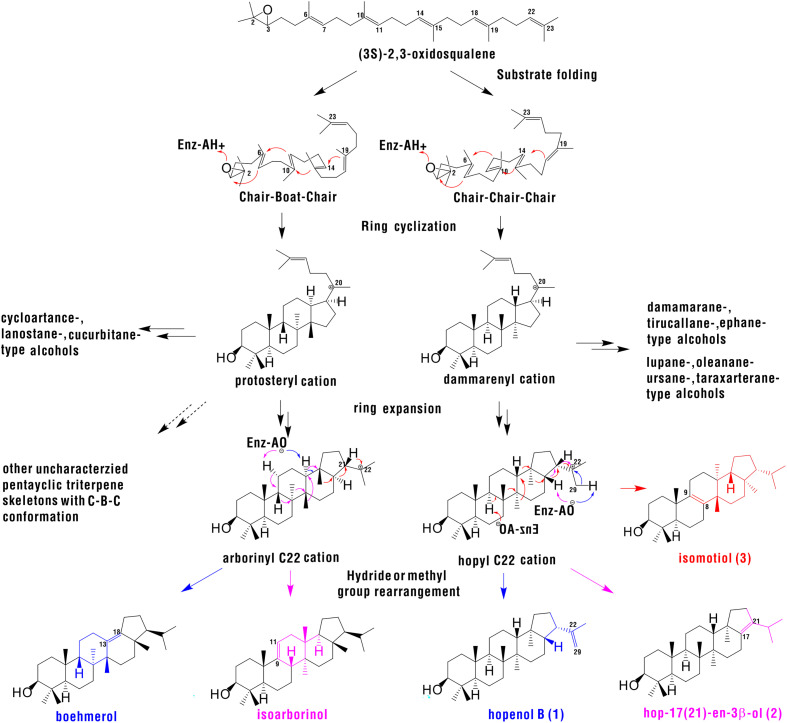
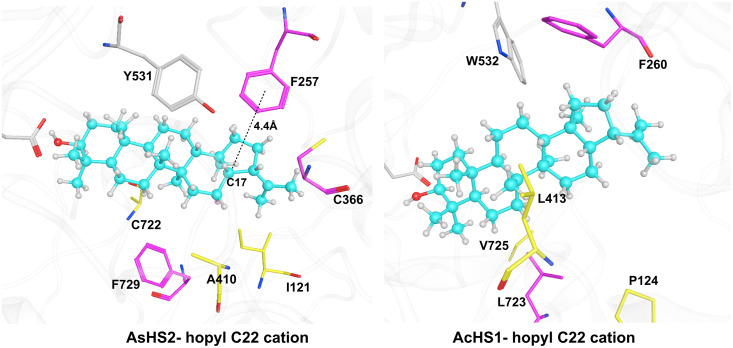
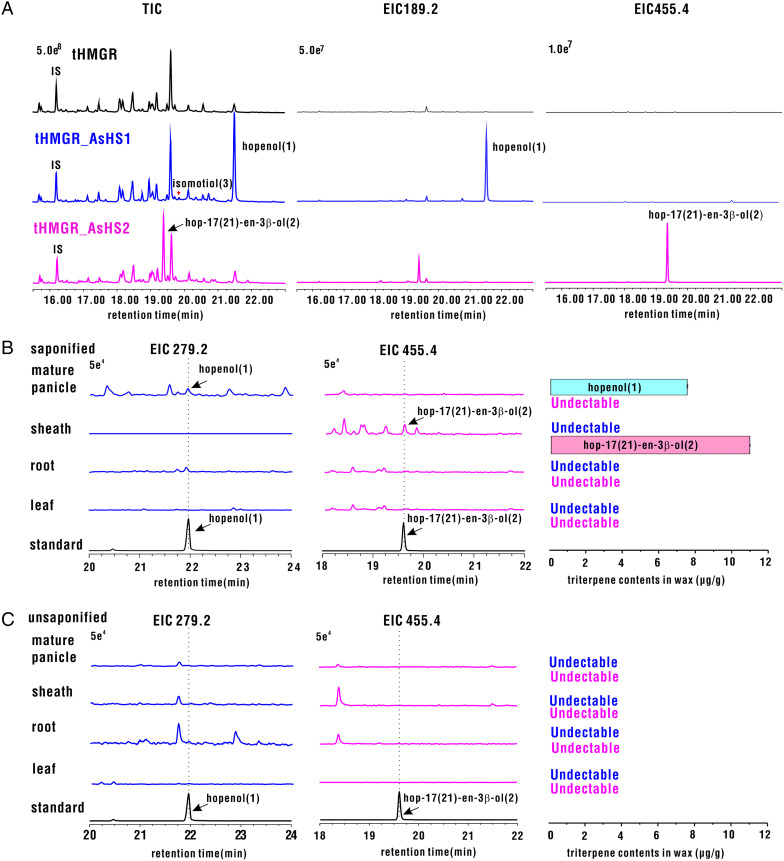
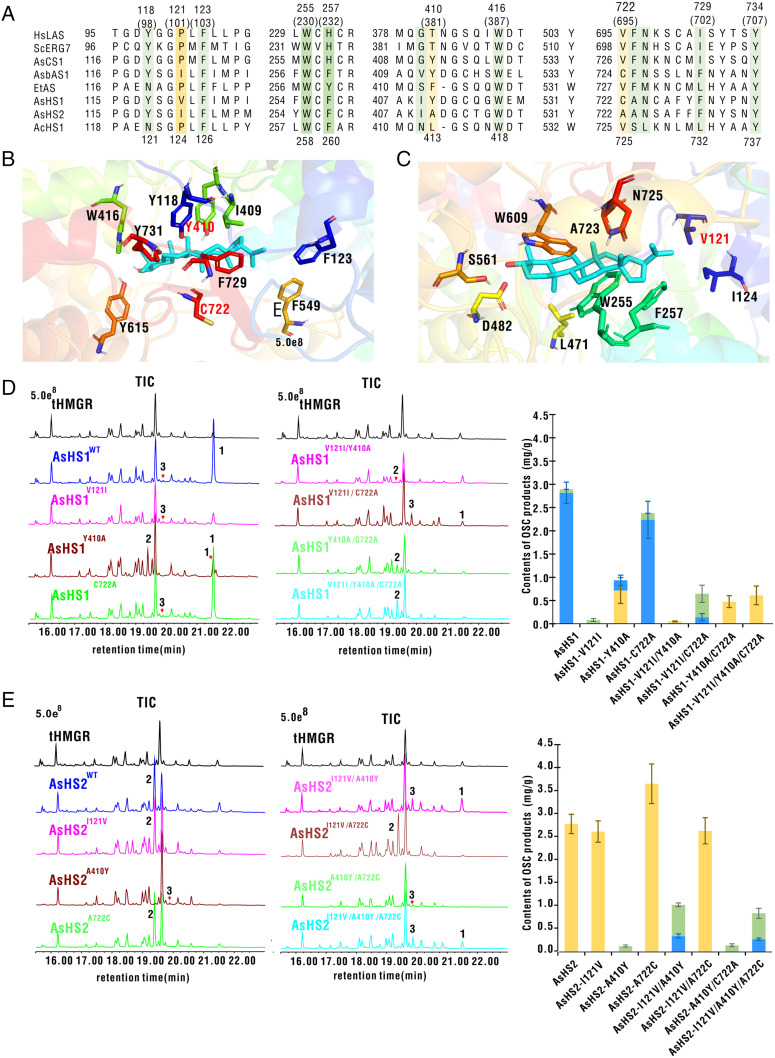
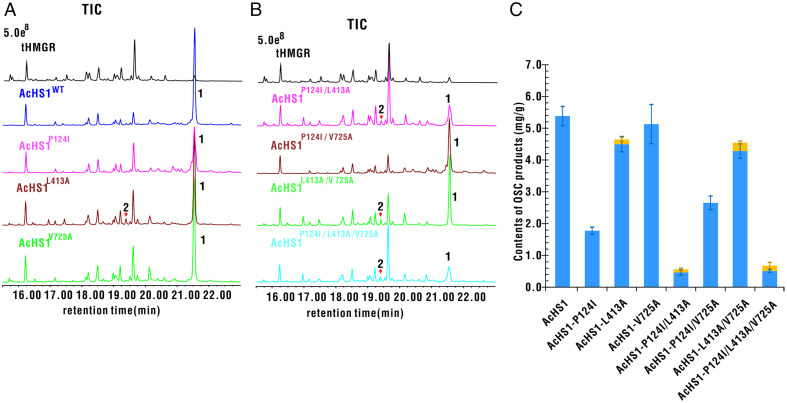
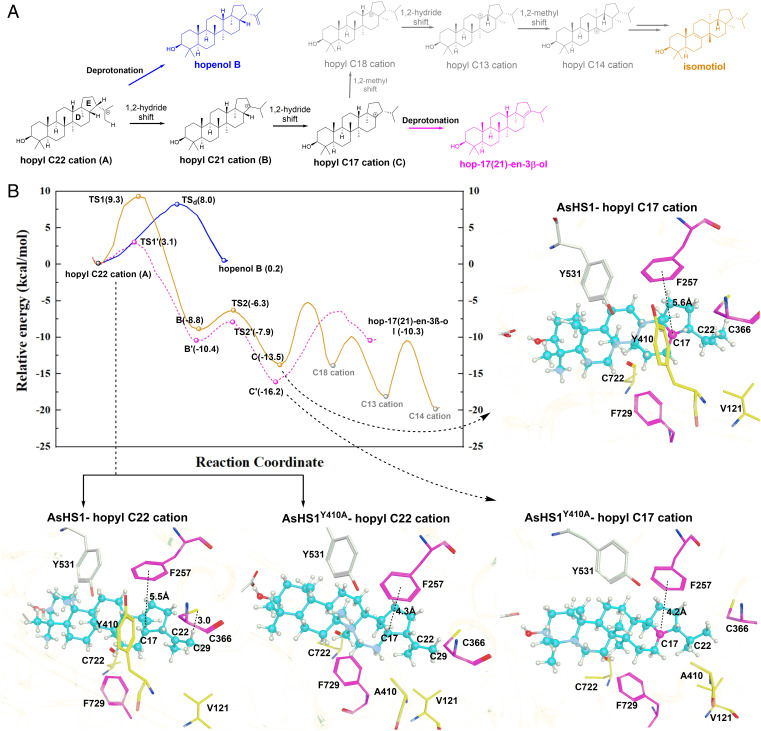
Triterpenoids are biologically active metabolites synthesized from a common linear precursor catalyzed by 2,3-oxidosqualene cyclases (OSCs) to form diverse triterpenoid skeletons. OSCs corresponding to many discovered triterpene alcohols in nature have not been functionally and mechanistically characterized due to the diversity of chemical structures and complexity of the cyclization mechanism. We carried out a genome-wide investigation of OSCs from Avena strigosa and discovered two triterpene synthases, namely, AsHS1 and AsHS2, using a Nicotiana benthamiana expression system. These synthases produce hopenol B and hop-17(21)-en-3β-ol, which are components of surface wax in oat panicles and sheathes, respectively. We demonstrated that substitutions of two to three amino acid residues in AsHS1 with corresponding residues from AsHS2 allowed it to be completely converted into a hop-17(21)-en-3β-ol synthase. AsHS2 mutants with a substitution at site 410 could synthesize hopenol B alone or mixed with a side product isomotiol. The combined quantum mechanics and molecular mechanics calculation demonstrated that the side chain size of the residue at site 410 regulated the relative orientations between the hopyl C22 cation and Phe257, leading to a difference in deprotonation positions through providing or not providing cation–π interaction between the aromatic ring of F257 and the carbocation intermediate. A similar mechanism could be applied to a hopenol B synthase from a dicotyledonous plant Aquilegia. This study provided mechanistic insight into triterpenoid synthesis and discovered key amino acid residues acting on hydride transfer and a deprotonation site to differentiate between hopane-type scaffolds in diverse plant species.
三萜类化合物是由 2,3-氧化鲨烯环化酶 (OSCs) 催化的共同线性前体生物合成的生物活性代谢物,形成多种三萜骨架。由于化学结构的多样性和环化机制的复杂性,许多在自然界中发现的三萜醇的 OSCs 尚未在功能和机制上进行表征。我们对野燕麦 Avena strigosa 的 OSCs 进行了全基因组研究,并使用烟草 Nicotiana benthamiana 表达系统发现了两种三萜合酶,即 AsHS1 和 AsHS2。这些合酶分别产生了 hopenol B 和 hop-17(21)-en-3β-ol,它们分别是燕麦穗和叶鞘表面蜡的组成部分。我们证明,用 AsHS2 中相应的残基取代 AsHS1 中的两个到三个氨基酸残基,可以使其完全转化为 hop-17(21)-en-3β-ol 合酶。在 410 位发生取代的 AsHS2 突变体可以单独合成 hopenol B 或与副产物异摩醇混合合成。量子力学和分子力学的联合计算表明,410 位残基侧链的大小调节了 hopyl C22 阳离子和 Phe257 之间的相对取向,通过提供或不提供 F257 的芳环与碳正离子中间体之间的阳离子-π 相互作用,导致去质子化位置的差异。类似的机制也可以应用于双子叶植物 Aquilegia 的 hopenol B 合酶。本研究为三萜类化合物的合成提供了机制上的见解,并发现了作用于氢化物转移和去质子化位点的关键氨基酸残基,以区分不同植物物种中霍烷型支架。