The Institute for Advanced Studies (IAS), Wuhan University, Wuhan, 430072, People's Republic of China.
Shanghai Institute for Advanced Study, Institute of Quantitative Biology, College of Life Sciences, Zhejiang University, Hangzhou, 310027, People's Republic of China.
Nat Commun. 2022 Mar 17;13(1):1402. doi: 10.1038/s41467-022-29123-9.
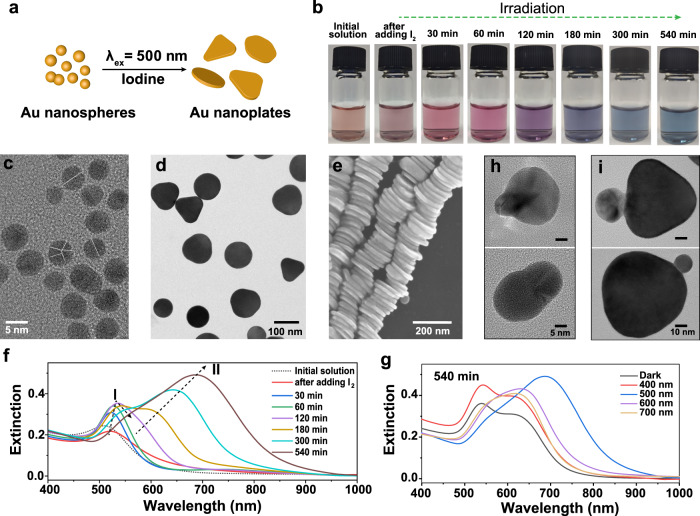
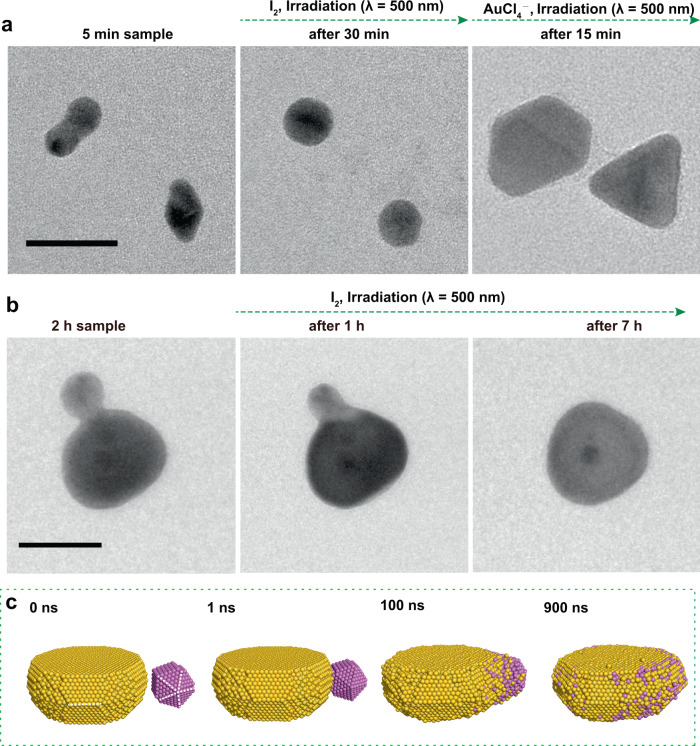
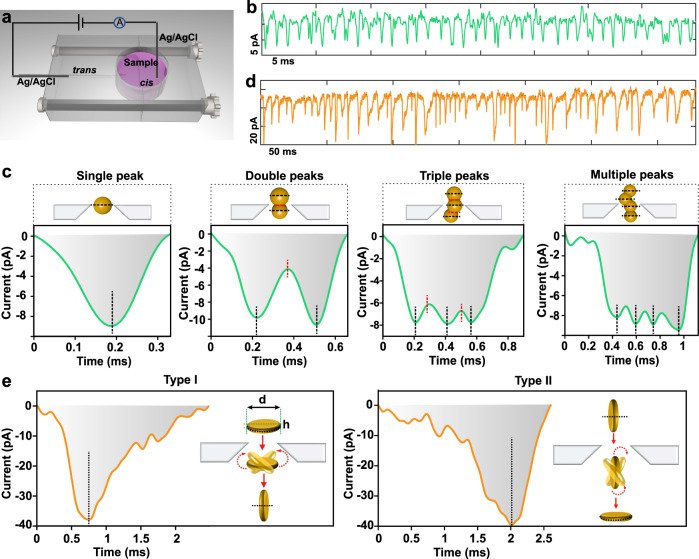
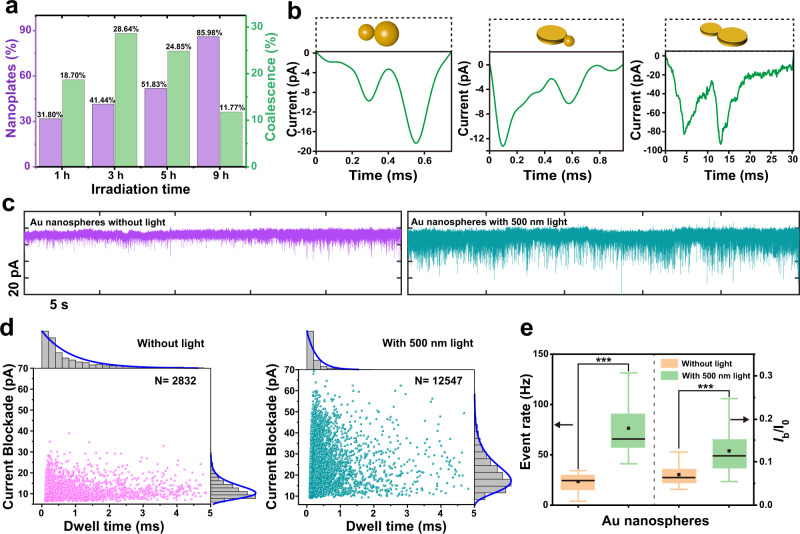
The fascinating phenomenon that plasmon excitation can convert isotropic silver nanospheres to anisotropic nanoprisms has already been developed into a general synthetic technique since the discovery in 2001. However, the mechanism governing the morphology conversion is described with different reaction processes. So far, the mechanism based on redox reactions dominated anisotropic growth by plasmon-produced hot carriers is widely accepted and developed. Here, we successfully achieved plasmon-driven high yield conversion of gold nanospheres into nanoplates with iodine as the inducer. To investigate the mechanism, nanopore sensing technology is established to statistically study the intermediate species at the single-nanoparticle level. Surprisingly, the morphology conversion is proved as a hot hole-controlled coalescence-dominated growth process. This work conclusively elucidates that a controllable plasmon-driven nanoparticle-coalescence mechanism could enable the production of well-defined anisotropic metal nanostructures and suggests that the nanopore sensing could be of general use for studying the growth process of nanomaterials.
自 2001 年发现以来,等离子体激元激发可以将各向同性银纳米球转化为各向异性纳米棱柱这一迷人现象已发展成为一种通用的合成技术。然而,对于形态转化的机制则有不同的反应过程来描述。到目前为止,基于等离子体产生的热载流子引发的氧化还原反应来主导各向异性生长的机制已被广泛接受和发展。在这里,我们成功地利用碘作为诱导剂,实现了金纳米球的高效等离子体驱动转化为纳米板。为了研究这一机制,我们建立了纳米孔传感技术,以在单纳米颗粒水平上对中间物种进行统计研究。令人惊讶的是,形态转化被证明是一个热空穴控制的聚结主导的生长过程。这项工作明确地阐明了一种可控的等离子体驱动的纳米颗粒聚结机制,可以实现具有良好定义的各向异性金属纳米结构的生产,并表明纳米孔传感可普遍用于研究纳米材料的生长过程。