Wang Yu-Na, Jiang Rui-Ruo, Ding Heng, Zhang Xiao-Long, Wang Ning, Zhang Yun-Fa, Li Yue, Chen Jin-Jin, Zhang Pan-He, Li Hao, Jiang Jia-Fu, Liu Lan-Zheng, Yu Meng-Bin, Wang Gang, Zhang Xiao-Ai, Liu Wei
State Key Laboratory of Pathogen and Biosecurity, Beijing Institute of Microbiology and Epidemiology, Beijing, China.
Institute of NBC Defence, PLA Army, Beijing, China.
Front Microbiol. 2022 Mar 3;13:791563. doi: 10.3389/fmicb.2022.791563. eCollection 2022.
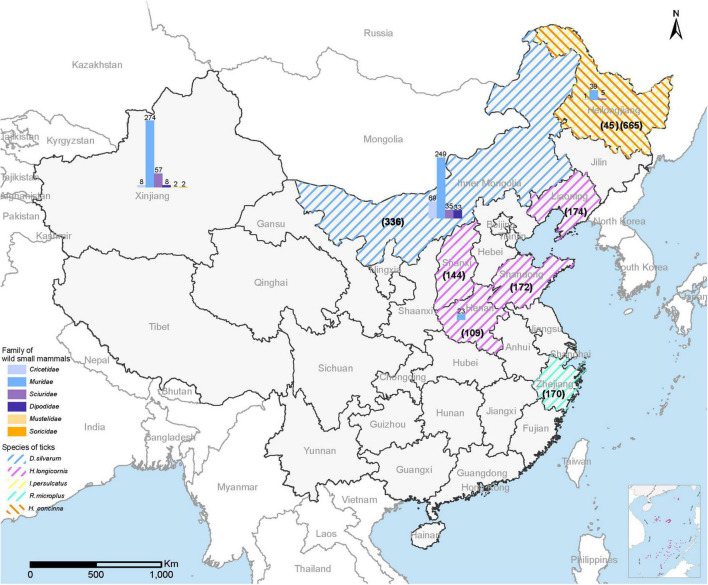
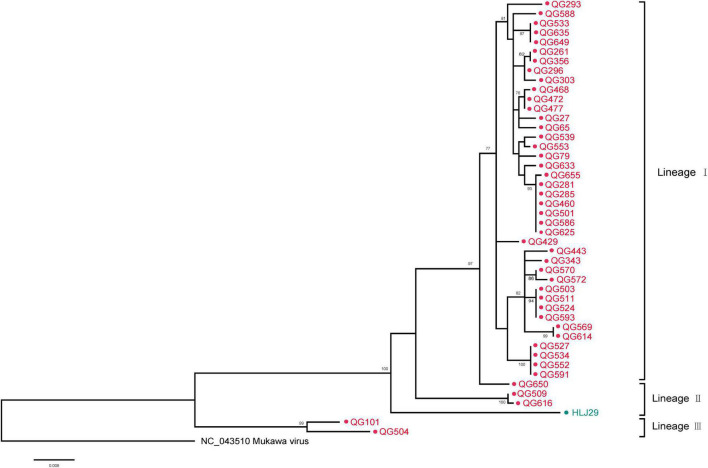
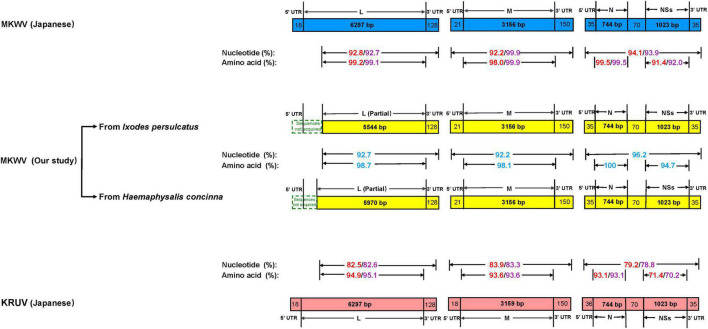
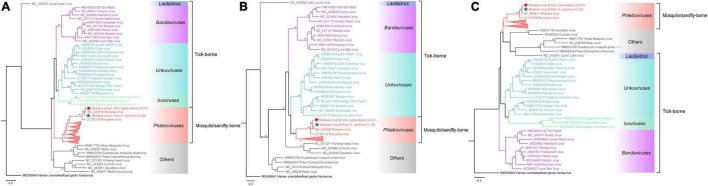
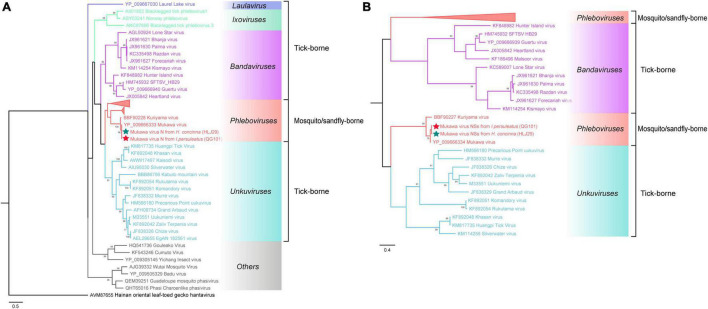
Mukawa virus (MKWV), a novel tick-borne virus (TBV) of the genus of family , has been firstly reported in in Japan. In this study, we made an epidemiological investigation in China to obtain the geographic distribution and genetic features of this virus outside Japan. We screened 1,815 adult ticks (665 , 336 , 599 , 170 , 45 ) and 805 wild small mammals collected from eight provinces. The positive rate of 6.77% (45/665, including 18 female and 27 male ) and 2.22% (1/45, 1 male ) were obtained from and in Heilongjiang province, respectively. No evidence of MKWV infection was found in other three tick species or any of the mammalian species. The virus can infect the Vero cells successfully, indicating the ability of MKWV to replicate in mammalian cells. A phylogenetic tree based on the nucleotide sequences of L, M, and S segments demonstrated that the Japanese MKWV variant, our two MKWV variants, and KURV were clustered with the members of the mosquito/sandfly-borne phleboviruses and distant from other tick-borne phenuiviruses. A phylogenetic analysis based on 895 bp partial L gene sequences ( = 46) showed that all MKWV sequences were separated into three lineages. Our results showed the presence of MKWV in and in northeast of China, highlighting the necessity of epidemiological study in wider regions. Due to the ability of MKWV to replicate in mammalian cells, the potential for zoonosis, and wide distribution of and in China, the important vectors of MKWV, further screening to more tick species, wild animals, domestic animals, and humans raises up practical significance.
向田病毒(MKWV)是 科 属的一种新型蜱传病毒(TBV),最早于 年在日本被报道。在本研究中,我们在中国进行了流行病学调查,以获取该病毒在日本以外地区的地理分布和遗传特征。我们筛选了从八个省份采集的1815只成年蜱(665只 、336只 、599只 、170只 、45只 )和805只野生小型哺乳动物。分别从黑龙江省的 和 中获得了6.77%(45/665,包括18只雌性和27只雄性 )和2.22%(1/45,1只雄性 )的阳性率。在其他三种蜱种或任何哺乳动物物种中均未发现向田病毒感染的证据。该病毒能够成功感染Vero细胞,表明向田病毒具有在哺乳动物细胞中复制的能力。基于L、M和S片段核苷酸序列构建的系统发育树表明,日本的向田病毒变体、我们的两个向田病毒变体以及库鲁病毒与蚊/白蛉传播的静脉病毒成员聚集在一起,与其他蜱传菲努病毒距离较远。基于895 bp部分L基因序列( = 46)的系统发育分析表明,所有向田病毒序列被分为三个谱系。我们的结果表明在中国东北的 和 中存在向田病毒,凸显了在更广泛地区进行流行病学研究的必要性。由于向田病毒具有在哺乳动物细胞中复制的能力、存在人畜共患病的可能性以及 和 在中国广泛分布(向田病毒的重要传播媒介),对更多蜱种、野生动物、家畜和人类进行进一步筛查具有实际意义。