Lim Siyoung A, Cox Alysia, Tung Madelynn, Chung Eun Ji
Department of Biomedical Engineering, University of Southern California, Los Angeles, CA, USA.
Mork Family Department of Chemical Engineering and Materials Science, University of Southern California, Los Angeles, CA, USA.
Bioact Mater. 2021 Oct 22;12:203-213. doi: 10.1016/j.bioactmat.2021.10.018. eCollection 2022 Jun.
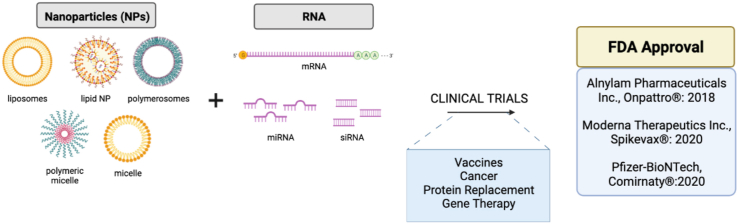
The clinical application of nanoparticles (NPs) to deliver RNA for therapy has progressed rapidly since the FDA approval of Onpattro® in 2018 for the treatment of polyneuropathy associated with hereditary transthyretin amyloidosis. The emergency use authorization or approval and widespread global use of two mRNA-NP based vaccines developed by Moderna Therapeutics Inc. and Pfizer-BioNTech in 2021 has highlighted the translatability of NP technology for RNA delivery. Furthermore, in clinical trials, a wide variety of NP formulations have been found to extend the half-life of RNA molecules such as microRNA, small interfering RNA, and messenger RNA, with limited safety issues. In this review, we discuss the NP formulations that are already used in the clinic to deliver therapeutic RNA and highlight examples of RNA-NPs which are currently under evaluation for human use. We also detail NP formulations that failed to progress through clinical trials, in hopes of guiding future successful translation of nanomedicine-based RNA therapeutics into the clinic.
自2018年美国食品药品监督管理局(FDA)批准Onpattro®用于治疗与遗传性转甲状腺素蛋白淀粉样变性相关的多发性神经病以来,纳米颗粒(NPs)用于递送RNA进行治疗的临床应用进展迅速。2021年,Moderna Therapeutics公司和辉瑞 - BioNTech公司开发的两种基于mRNA - NP的疫苗获得紧急使用授权或批准并在全球广泛使用,这突出了NP技术在RNA递送方面的可转化性。此外,在临床试验中,已发现多种NP制剂可延长RNA分子(如微小RNA、小干扰RNA和信使RNA)的半衰期,且安全性问题有限。在这篇综述中,我们讨论了已用于临床递送治疗性RNA的NP制剂,并重点介绍了目前正在进行人体使用评估的RNA - NPs实例。我们还详细介绍了未能通过临床试验的NP制剂,希望为未来基于纳米医学的RNA疗法成功转化为临床应用提供指导。