School of Public Health, Xinjiang Medical University, Urumqi, China.
Department of Microbiology, School of Basic Medical Sciences, Xinjiang Medical University, Urumqi, China.
Front Endocrinol (Lausanne). 2022 Mar 2;13:861760. doi: 10.3389/fendo.2022.861760. eCollection 2022.
Hyperuricemia (HUA) is a metabolic anomaly with an increased incidence rate, causing a global medical burden. Several studies have confirmed that obesity and insulin resistance (IR) are the risk factors for HUA. Reports on the predictive power of different obesity indices for HUA are limited. This study aimed to compare the association between different general, abdominal, and visceral obesity indices and markers of the IR-triglyceride glucose (TyG) index with serum uric acid (SUA) and to assess the ability of these indices to predict HUA.
A total of 2243 participants were recruited from Barkol County Hospital and surrounding township hospitals in Xinjiang. Obesity indices, including the atherogenic index of plasma, cardiometabolic index, visceral adiposity index, lipid accumulation product index, a body shape index, body roundness index, waist circumference, waist-to-height ratio, body mass index, and TyG index, were divided into four quartiles. Moreover, partial correlations and logistic regression were used to analyze the association between these indices and SUA. The area under the curve (AUC) and receiver operating characteristic curves were used to analyze the predictive value of these indices for HUA.
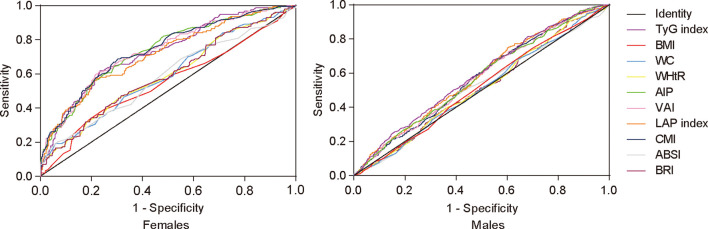
After controlling for confounding variables, the association between the TyG index and HUA was stronger than that between the obesity indices in both males and females. The odds ratios (ORs) for HUA in the highest quartile of the TyG index were 2.098 (95% confidence interval, 1.555-2.831) in males and 7.788 (95% CI, 3.581-16.937) in females. For males, the AIP, CMI, VAI, LAP index, and TyG index were able to discriminate HUA, and the TyG index showed the highest AUC value of 0.586 (95% CI, 0.557-0.614; < 0.001). For females, all indices, except BMI, can discriminate HUA. Moreover, the visceral obesity index CMI showed the highest AUC value of 0.737 (95% CI, 0.691-0.782; < 0.001). Meanwhile, the TyG index had a relatively high AUC value of 0.728 (95% CI, 0.682-0.773; < 0.001).
The TyG index was significantly related to HUA and was superior to obesity indices in identifying HUA in the medical checkup population in Xinjiang, China.
高尿酸血症(HUA)是一种发病率不断上升的代谢异常,导致全球医疗负担加重。多项研究证实,肥胖和胰岛素抵抗(IR)是 HUA 的危险因素。关于不同肥胖指数对 HUA 的预测能力的报告有限。本研究旨在比较不同一般、腹部和内脏肥胖指数与甘油三酯葡萄糖(TyG)指数之间的关系,并评估这些指数预测 HUA 的能力。
本研究共纳入 2243 名来自新疆巴克尔县医院及周边乡镇医院的参与者。肥胖指数包括血浆致动脉粥样硬化指数、心脏代谢指数、内脏脂肪指数、脂积指数、体质量指数、腰围身高比、体质量指数和 TyG 指数等,分为四等份。此外,采用偏相关和逻辑回归分析这些指数与 SUA 的关系。曲线下面积(AUC)和接收者操作特征曲线用于分析这些指数对 HUA 的预测价值。
在校正混杂因素后,男性和女性 TyG 指数与 HUA 的相关性均强于肥胖指数。TyG 指数最高四分位组的 HUA 比值比(OR)为男性 2.098(95%置信区间,1.555-2.831),女性 7.788(95%可信区间,3.581-16.937)。对于男性,AIP、CMI、VAI、LAP 指数和 TyG 指数均能鉴别 HUA,TyG 指数 AUC 值最高,为 0.586(95%CI,0.557-0.614;<0.001)。对于女性,除 BMI 外,所有指数均能鉴别 HUA。此外,内脏肥胖指数 CMI 的 AUC 值最高,为 0.737(95%CI,0.691-0.782;<0.001)。同时,TyG 指数的 AUC 值也相对较高,为 0.728(95%CI,0.682-0.773;<0.001)。
TyG 指数与 HUA 显著相关,在中国新疆体检人群中识别 HUA 的能力优于肥胖指数。