Department of Emergency and Critical Care Medicine, University of Tsukuba Hospital, Tsukuba, Ibaraki, Japan.
Department of Medicine, Icahn School of Medicine at Mount Sinai, Mount Sinai Beth Israel, New York, NY, USA.
Mycopathologia. 2022 Jun;187(2-3):271-289. doi: 10.1007/s11046-022-00627-8. Epub 2022 Mar 21.
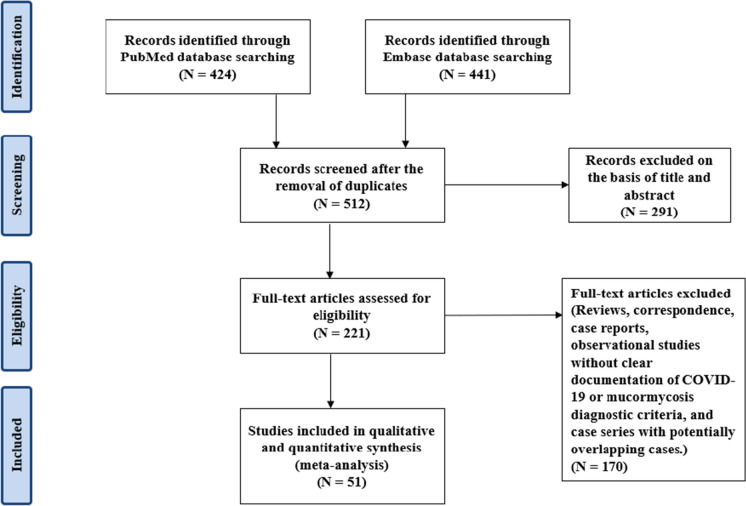
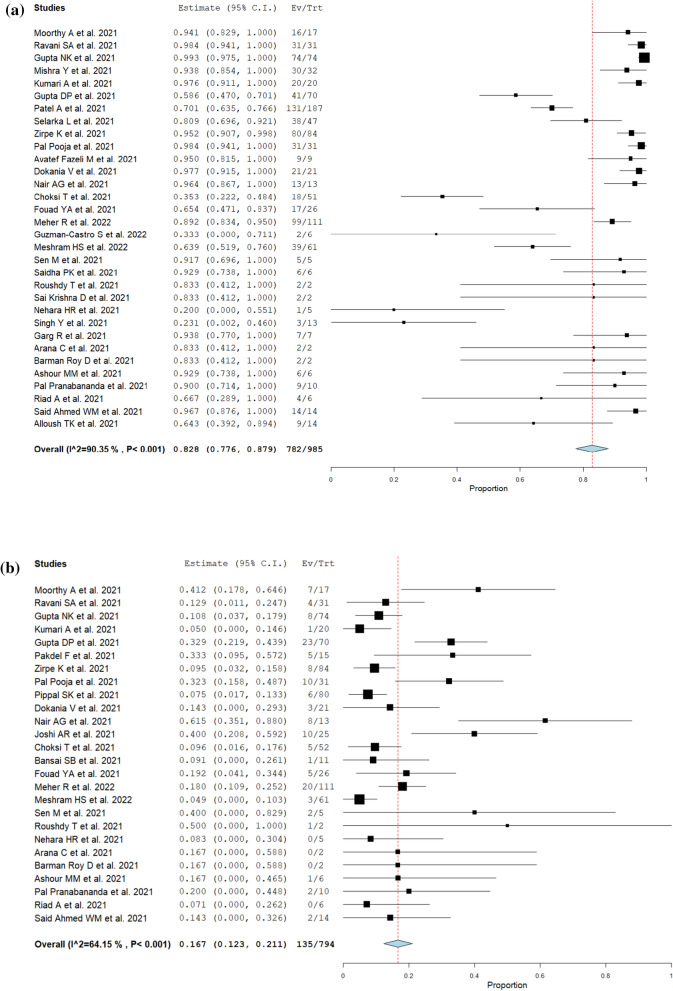
The recent increase of COVID-19-associated mucormycosis (CAM) has been commanding global attention. However, basic epidemiologic characteristics have not firmly been established. In this systematic review and meta-analysis, we sought to determine the clinical manifestations, potential risk factors, and outcomes of CAM. Observational studies reporting CAM were searched with PubMed and EMBASE databases in January 2022. We collected data on comorbidities and treatment for COVID-19, and performed a one-group meta-analysis on the frequency of orbital exenteration procedure and mortality of CAM using a random-effect model. Fifty-one observational studies, including a total of 2,312 patients with proven CAM, were identified. Among the 51 studies, 37 were conducted in India, 8 in Egypt, and 6 in other countries. The most common comorbidity was diabetes mellitus (82%). While 57% required oxygenation, 77% received systemic corticosteroids. Among CAM, 97% were rhino-orbital-cerebral (ROCM), and 2.7% were pulmonary mucormycosis. Usual presentations were headache (54%), periorbital swelling/pain (53%), facial swelling/pain (43%), ophthalmoplegia (42%), proptosis (41%), and nasal discharge/congestion (36%). Regarding the outcomes, orbital exenteration was performed in 17% (95% CI: 12-21%, I = 83%) of the COVID-19-associated ROCM patients. The mortality of CAM was 29% (95% CI; 22-36%, I = 92%). In conclusion, this systematic review and meta-analysis indicated that the most prevalent type of CAM was ROCM, and most CAM patients had diabetes mellitus and received systemic glucocorticoids. Clinicians in the endemic areas should have a high index of suspicion for this invasive fungal complication of COVID-19 when a diabetic patient who received high-dose systemic glucocorticoids developed rhino-orbital symptoms.
最近 COVID-19 相关的毛霉菌病(CAM)的发病率有所增加,引起了全球关注。然而,其基本的流行病学特征尚未得到明确确立。在本次系统评价和荟萃分析中,我们旨在确定 CAM 的临床表现、潜在的危险因素和结局。我们于 2022 年 1 月在 PubMed 和 EMBASE 数据库中检索了报告 CAM 的观察性研究。我们收集了与 COVID-19 相关的合并症和治疗数据,并使用随机效应模型对 CAM 的眼眶内容剜除术的频率和死亡率进行了单组荟萃分析。确定了 51 项观察性研究,共纳入了 2312 例确诊的 CAM 患者。其中 37 项研究在印度进行,8 项在埃及进行,6 项在其他国家进行。最常见的合并症是糖尿病(82%)。57%的患者需要吸氧,77%的患者接受了全身皮质类固醇治疗。在 CAM 中,97%为鼻-眶-脑(ROCM),2.7%为肺毛霉菌病。常见的表现是头痛(54%)、眶周肿胀/疼痛(53%)、面部肿胀/疼痛(43%)、眼肌麻痹(42%)、眼球突出(41%)和鼻分泌物/充血(36%)。关于结局,COVID-19 相关 ROCM 患者中有 17%(95%CI:12-21%,I=83%)行眼眶内容剜除术。CAM 的死亡率为 29%(95%CI:22-36%,I=92%)。总之,本次系统评价和荟萃分析表明,最常见的 CAM 类型是 ROCM,大多数 CAM 患者患有糖尿病并接受了全身糖皮质激素治疗。当糖尿病患者接受大剂量全身糖皮质激素治疗后出现鼻-眶症状时,流行地区的临床医生应高度怀疑这种 COVID-19 的侵袭性真菌感染并发症。