Concordia Institute for Information Systems Engineering (CIISE), Concordia University, Montreal, Canada.
Department of Electrical and Computer Engineering, University of Toronto, Toronto, Canada.
Sci Rep. 2022 Mar 22;12(1):4827. doi: 10.1038/s41598-022-08796-8.
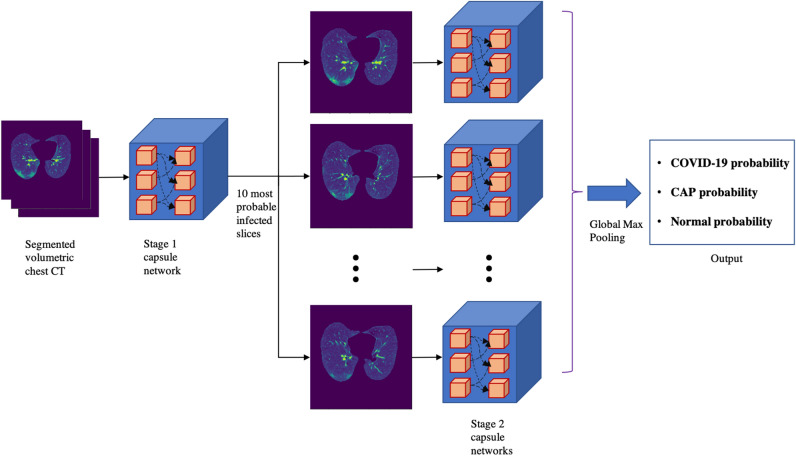
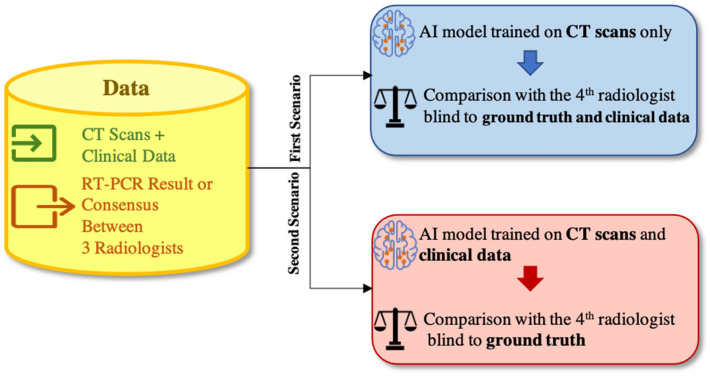
Reverse transcription-polymerase chain reaction is currently the gold standard in COVID-19 diagnosis. It can, however, take days to provide the diagnosis, and false negative rate is relatively high. Imaging, in particular chest computed tomography (CT), can assist with diagnosis and assessment of this disease. Nevertheless, it is shown that standard dose CT scan gives significant radiation burden to patients, especially those in need of multiple scans. In this study, we consider low-dose and ultra-low-dose (LDCT and ULDCT) scan protocols that reduce the radiation exposure close to that of a single X-ray, while maintaining an acceptable resolution for diagnosis purposes. Since thoracic radiology expertise may not be widely available during the pandemic, we develop an Artificial Intelligence (AI)-based framework using a collected dataset of LDCT/ULDCT scans, to study the hypothesis that the AI model can provide human-level performance. The AI model uses a two stage capsule network architecture and can rapidly classify COVID-19, community acquired pneumonia (CAP), and normal cases, using LDCT/ULDCT scans. Based on a cross validation, the AI model achieves COVID-19 sensitivity of [Formula: see text], CAP sensitivity of [Formula: see text], normal cases sensitivity (specificity) of [Formula: see text], and accuracy of [Formula: see text]. By incorporating clinical data (demographic and symptoms), the performance further improves to COVID-19 sensitivity of [Formula: see text], CAP sensitivity of [Formula: see text], normal cases sensitivity (specificity) of [Formula: see text] , and accuracy of [Formula: see text]. The proposed AI model achieves human-level diagnosis based on the LDCT/ULDCT scans with reduced radiation exposure. We believe that the proposed AI model has the potential to assist the radiologists to accurately and promptly diagnose COVID-19 infection and help control the transmission chain during the pandemic.
逆转录-聚合酶链反应(RT-PCR)目前是 COVID-19 诊断的金标准。然而,它可能需要数天才能提供诊断结果,且假阴性率相对较高。影像学,特别是胸部计算机断层扫描(CT),可以辅助诊断和评估这种疾病。然而,研究表明,标准剂量 CT 扫描会给患者带来显著的辐射负担,特别是那些需要多次扫描的患者。在这项研究中,我们考虑使用低剂量和超低剂量(LDCT 和 ULDCT)扫描方案,将辐射暴露降低到单次 X 射线的水平,同时保持可接受的诊断分辨率。由于在大流行期间可能无法广泛获得胸部放射学专业知识,因此我们使用收集的 LDCT/ULDCT 扫描数据集开发了一种基于人工智能(AI)的框架,以研究 AI 模型是否可以提供人类水平性能的假设。AI 模型使用两阶段胶囊网络架构,可以使用 LDCT/ULDCT 扫描快速分类 COVID-19、社区获得性肺炎(CAP)和正常病例。基于交叉验证,AI 模型的 COVID-19 灵敏度为[公式:见文本],CAP 灵敏度为[公式:见文本],正常病例灵敏度(特异性)为[公式:见文本],准确性为[公式:见文本]。通过纳入临床数据(人口统计学和症状),性能进一步提高到 COVID-19 灵敏度为[公式:见文本],CAP 灵敏度为[公式:见文本],正常病例灵敏度(特异性)为[公式:见文本],准确性为[公式:见文本]。该 AI 模型基于低剂量和超低剂量 CT 扫描实现了具有降低辐射暴露的人类水平诊断。我们相信,所提出的 AI 模型有可能协助放射科医生准确、及时地诊断 COVID-19 感染,并有助于在大流行期间控制传播链。