Li Kai, Lv Lin, Shao Dandan, Xie Youtao, Cao Yunzhen, Zheng Xuebin
Key Laboratory of Inorganic Coating Materials CAS, Shanghai Institute of Ceramics, Chinese Academy of Sciences, 1295 Dingxi Road, Shanghai 200050, China.
Center of Materials Science and Optoelectronics Engineering, University of Chinese Academy of Sciences, 19 Yuquan Road, Beijing 100049, China.
J Funct Biomater. 2022 Mar 14;13(1):31. doi: 10.3390/jfb13010031.
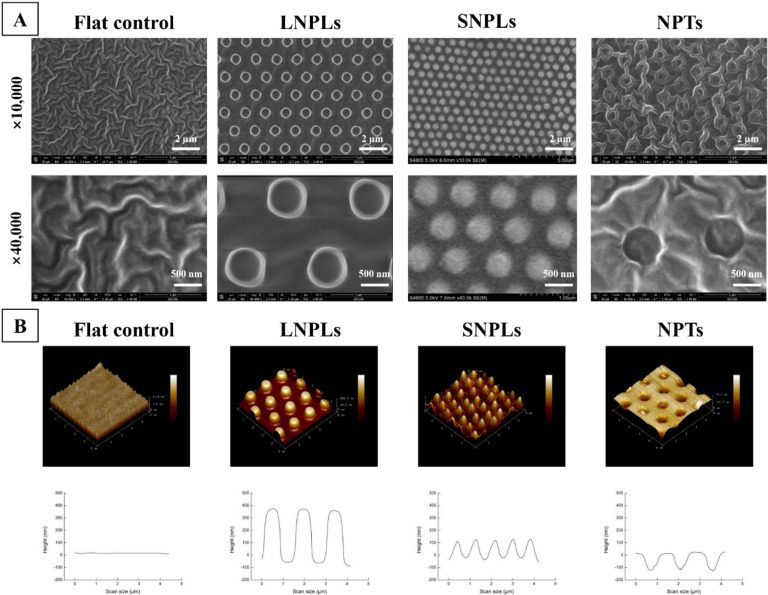
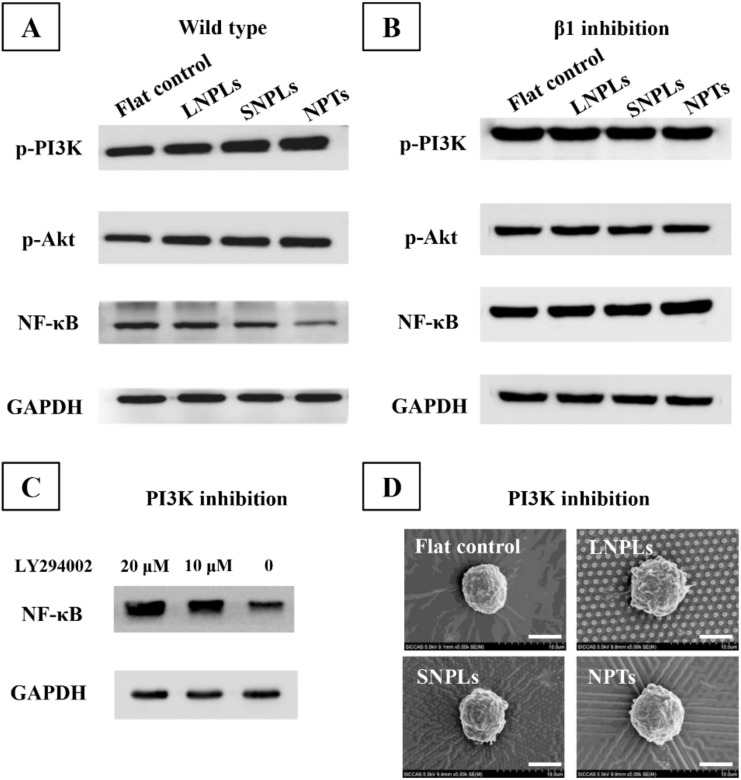
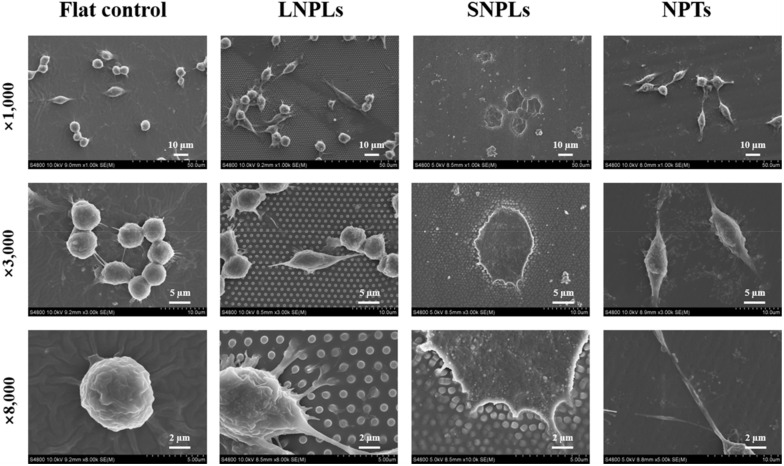
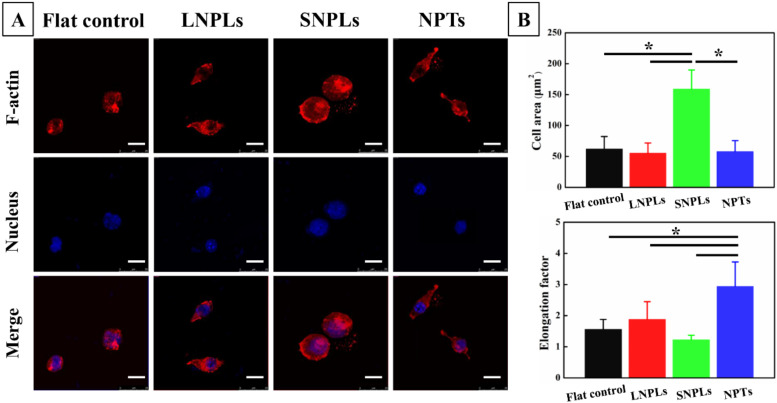
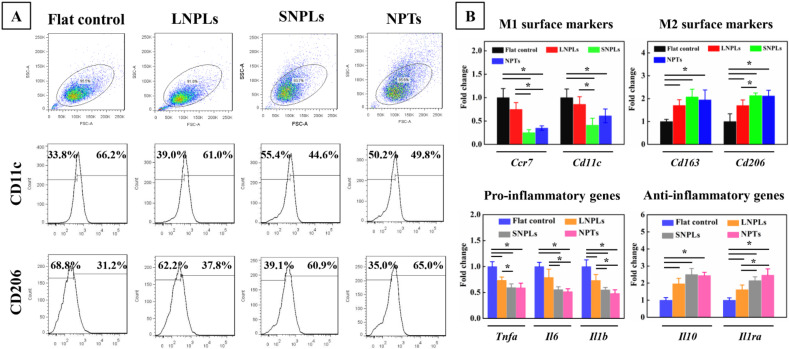
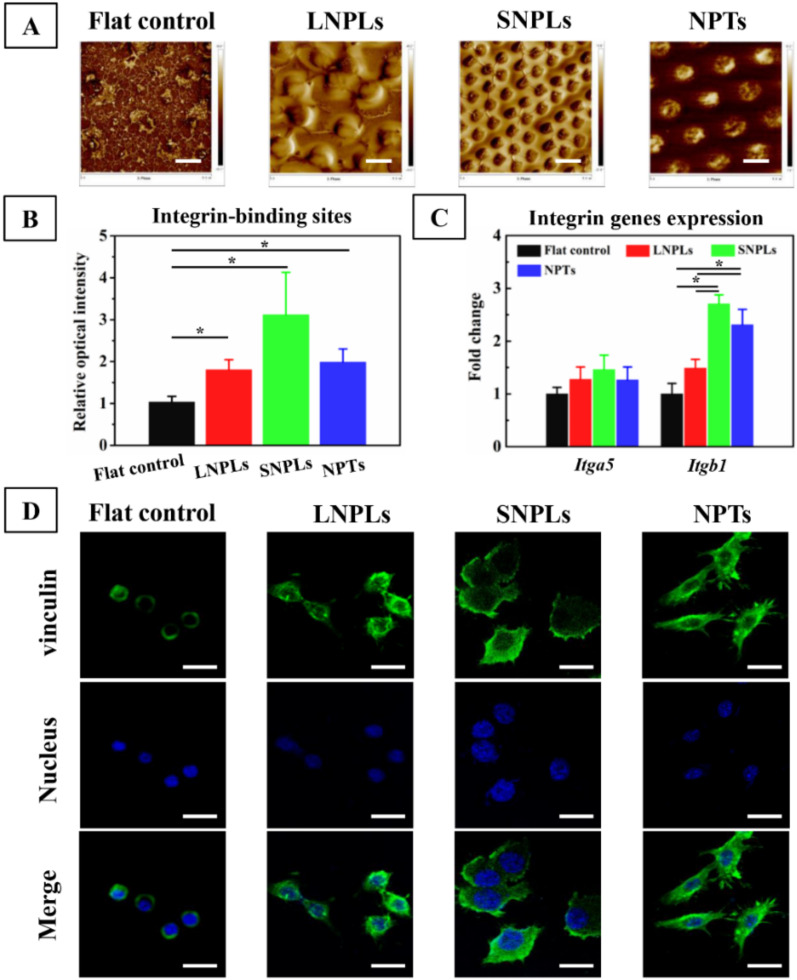
Physical features on the biomaterial surface are known to affect macrophage cell shape and phenotype, providing opportunities for the design of novel "immune-instructive" topographies to modulate foreign body response. The work presented here employed nanopatterned polydimethylsiloxane substrates with well-characterized nanopillars and nanopits to assess RAW264.7 macrophage response to feature size. Macrophages responded to the small nanopillars (SNPLs) substrates (450 nm in diameter with average 300 nm edge-edge spacing), resulting in larger and well-spread cell morphology. Increasing interpillar distance to 800 nm in the large nanopillars (LNPLs) led to macrophages exhibiting morphologies similar to being cultured on the flat control. Macrophages responded to the nanopits (NPTs with 150 nm deep and average 800 nm edge-edge spacing) by a significant increase in cell elongation. Elongation and well-spread cell shape led to expression of anti-inflammatory/pro-healing (M2) phenotypic markers and downregulated expression of inflammatory cytokines. SNPLs and NPTs with high availability of integrin binding region of fibronectin facilitated integrin β1 expression and thus stored focal adhesion formation. Increased integrin β1 expression in macrophages on the SNPLs and NTPs was required for activation of the PI3K/Akt pathway, which promoted macrophage cell spreading and negatively regulated NF-κB activation as evidenced by similar globular cell shape and higher level of NF-κB expression after PI3K blockade. These observations suggested that alterations in macrophage cell shape from surface nanotopographies may provide vital cues to orchestrate macrophage phenotype.
已知生物材料表面的物理特征会影响巨噬细胞的形状和表型,这为设计新型“免疫指导”拓扑结构以调节异物反应提供了机会。本文所展示的工作采用了具有特征明确的纳米柱和纳米坑的纳米图案化聚二甲基硅氧烷基底,以评估RAW264.7巨噬细胞对特征尺寸的反应。巨噬细胞对小纳米柱(SNPLs)基底(直径450 nm,平均边缘间距300 nm)有反应,导致细胞形态更大且铺展良好。将大纳米柱(LNPLs)中的柱间距离增加到800 nm,会使巨噬细胞呈现出与在平坦对照上培养时相似的形态。巨噬细胞对纳米坑(深度150 nm,平均边缘间距800 nm的NPTs)的反应是细胞伸长显著增加。伸长且铺展良好的细胞形状导致抗炎/促愈合(M2)表型标志物的表达,并下调炎性细胞因子的表达。具有高可用性纤连蛋白整合素结合区域的SNPLs和NPTs促进了整合素β1的表达,从而促进了粘着斑的形成。SNPLs和NTPs上巨噬细胞中整合素β1表达的增加是PI3K/Akt途径激活所必需的,该途径促进巨噬细胞的铺展并负向调节NF-κB的激活,PI3K阻断后类似的球状细胞形状和更高水平的NF-κB表达证明了这一点。这些观察结果表明,表面纳米拓扑结构引起的巨噬细胞形状改变可能为协调巨噬细胞表型提供重要线索。