Institute of Theoretical Physics, São Paulo State University, São Paulo, Brazil; Big Data Institute, Li Ka Shing Centre for Health Information and Discovery, Nuffield Department of Medicine, University of Oxford, Oxford, UK; Observatório COVID-19 BR, Brazil.
Institute of Theoretical Physics, São Paulo State University, São Paulo, Brazil; Observatório COVID-19 BR, Brazil.
Epidemics. 2022 Jun;39:100551. doi: 10.1016/j.epidem.2022.100551. Epub 2022 Mar 12.
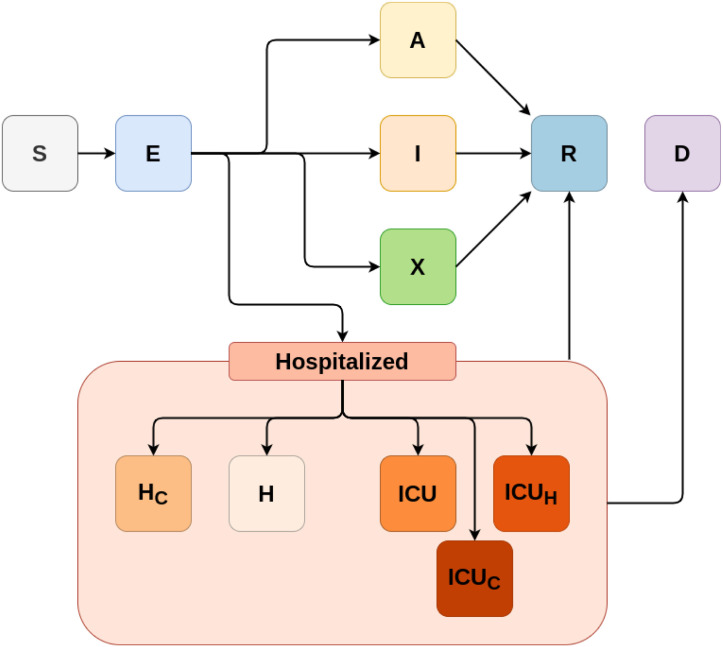
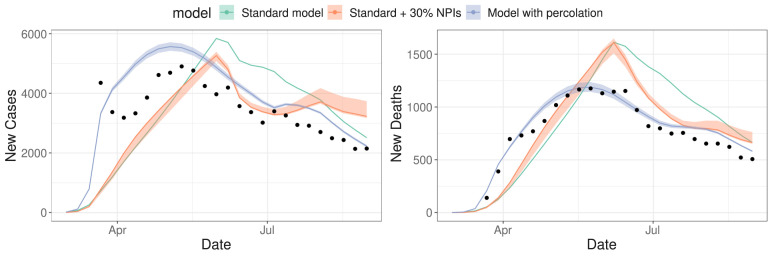
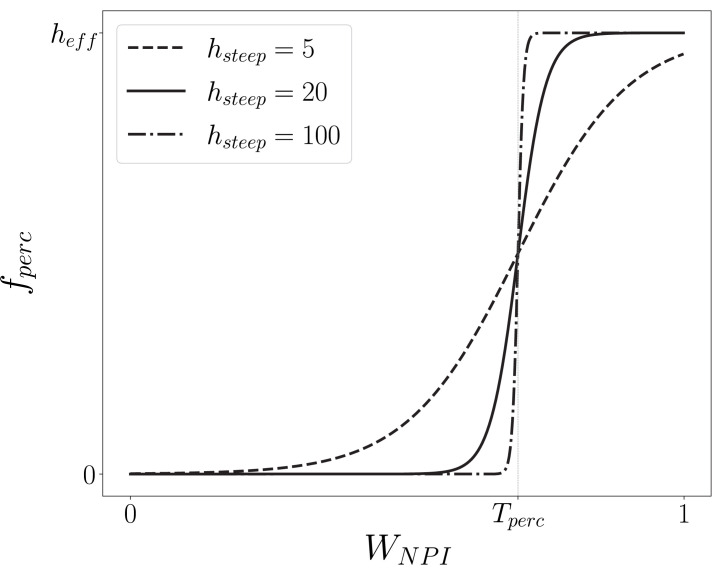
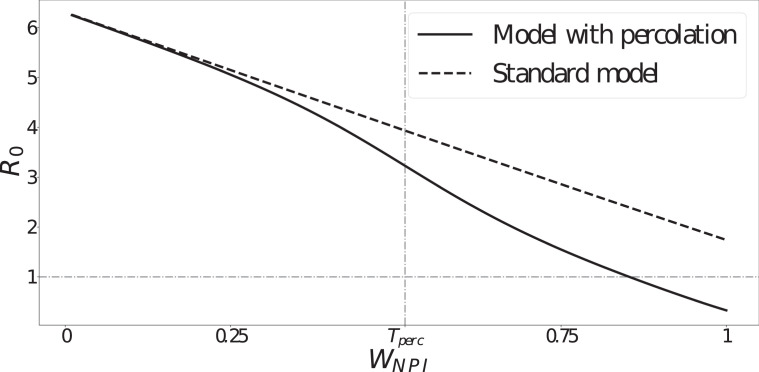
Since the emergence of the novel coronavirus disease 2019 (COVID-19), mathematical modelling has become an important tool for planning strategies to combat the pandemic by supporting decision-making and public policies, as well as allowing an assessment of the effect of different intervention scenarios. A proliferation of compartmental models were developed by the mathematical modelling community in order to understand and make predictions about the spread of COVID-19. While compartmental models are suitable for simulating large populations, the underlying assumption of a well-mixed population might be problematic when considering non-pharmaceutical interventions (NPIs) which have a major impact on the connectivity between individuals in a population. Here we propose a modification to an extended age-structured SEIR (susceptible-exposed-infected-recovered) framework, with dynamic transmission modelled using contact matrices for various settings in Brazil. By assuming that the mitigation strategies for COVID-19 affect the connections among different households, network percolation theory predicts that the connectivity among all households decreases drastically above a certain threshold of removed connections. We incorporated this emergent effect at population level by modulating home contact matrices through a percolation correction function, with the few additional parameters fitted to hospitalisation and mortality data from the city of São Paulo. Our model with percolation effects was better supported by the data than the same model without such effects. By allowing a more reliable assessment of the impact of NPIs, our improved model provides a better description of the epidemiological dynamics and, consequently, better policy recommendations.
自 2019 年新型冠状病毒病(COVID-19)出现以来,数学建模已成为通过支持决策和公共政策来规划抗击大流行策略的重要工具,并且可以评估不同干预方案的效果。为了理解和预测 COVID-19 的传播,数学建模界开发了大量的房室模型。虽然房室模型适合模拟大人群,但在考虑对人群中个体之间的连通性有重大影响的非药物干预措施(NPIs)时,人群混合良好的假设可能存在问题。在这里,我们对扩展的年龄结构 SEIR(易感性-暴露-感染-恢复)框架进行了修改,该框架使用接触矩阵对巴西的各种情况进行了动态传播建模。通过假设 COVID-19 的缓解策略会影响不同家庭之间的联系,网络渗流理论预测,在去除一定数量的连接后,所有家庭之间的连通性会急剧下降。我们通过渗流校正函数来调节家庭接触矩阵,将人群水平上的这种新兴效应纳入其中,仅需几个额外的参数即可拟合来自圣保罗市的住院和死亡率数据。与没有这种效果的相同模型相比,具有渗流效果的模型得到了更多数据的支持。通过允许更可靠地评估 NPIs 的影响,我们改进的模型提供了对流行病学动态的更好描述,从而提供了更好的政策建议。