• 文献检索
  • 文档翻译
  • 深度研究
  • 学术资讯
  • Suppr Zotero 插件Zotero 插件
  • 邀请有礼
  • 套餐&价格
  • 历史记录
应用&插件
Suppr Zotero 插件Zotero 插件浏览器插件Mac 客户端Windows 客户端微信小程序
定价
高级版会员购买积分包购买API积分包
服务
文献检索文档翻译深度研究API 文档MCP 服务
关于我们
关于 Suppr公司介绍联系我们用户协议隐私条款
关注我们

Suppr 超能文献

核心技术专利:CN118964589B侵权必究
粤ICP备2023148730 号-1Suppr @ 2026

文献检索

告别复杂PubMed语法,用中文像聊天一样搜索,搜遍4000万医学文献。AI智能推荐,让科研检索更轻松。

立即免费搜索

文件翻译

保留排版,准确专业,支持PDF/Word/PPT等文件格式,支持 12+语言互译。

免费翻译文档

深度研究

AI帮你快速写综述,25分钟生成高质量综述,智能提取关键信息,辅助科研写作。

立即免费体验

数学建模与预测新冠疫情中的传播动力学——抗击疫情的下一步举措

Mathematical modeling and the transmission dynamics in predicting the Covid-19 - What next in combating the pandemic.

作者信息

Anirudh A

机构信息

Birla Institute of Technology and Science Pilani, Hyderabad, Shameer Pet, Telangana, 500078, India.

出版信息

Infect Dis Model. 2020 Jun 30;5:366-374. doi: 10.1016/j.idm.2020.06.002. eCollection 2020.

DOI:10.1016/j.idm.2020.06.002
PMID:32666005
原文链接:https://pmc.ncbi.nlm.nih.gov/articles/PMC7335626/
Abstract

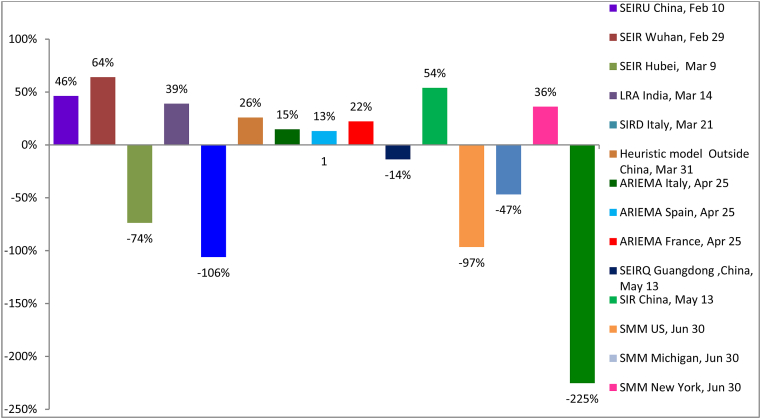
Mathematical predictions in combating the epidemics are yet to reach its perfection. The rapid spread, the ways, and the procedures involved in containment of a pandemic demand the earliest understanding in finding solutions in line with the habitual, physiological, biological, and environmental aspects of life with better computerised mathematical modeling and predictions. Epidemiology models are key tools in public health management programs despite having a high level of uncertainty in each one of these models. This paper describes the outcome and the challenges of SIR, SEIR, SEIRU, SIRD, SLIAR, ARIMA, SIDARTHE, etc models used in prediction of spread, peak, and reduction of Covid-19 cases.

摘要

对抗疫情的数学预测尚未达到完美。大流行病的快速传播、传播方式以及控制过程,需要通过更好的计算机化数学建模和预测,尽早从与生活的习惯、生理、生物和环境方面相符的角度来理解并找到解决方案。流行病学模型是公共卫生管理项目中的关键工具,尽管这些模型中的每一个都存在高度不确定性。本文描述了用于预测新冠疫情病例传播、峰值和减少情况的SIR、SEIR、SEIRU、SIRD、SLIAR、ARIMA、SIDARTHE等模型的结果和挑战。
https://cdn.ncbi.nlm.nih.gov/pmc/blobs/170b/7338618/a99f38ea6c7d/gr1.jpg

相似文献

1
Mathematical modeling and the transmission dynamics in predicting the Covid-19 - What next in combating the pandemic.数学建模与预测新冠疫情中的传播动力学——抗击疫情的下一步举措
Infect Dis Model. 2020 Jun 30;5:366-374. doi: 10.1016/j.idm.2020.06.002. eCollection 2020.
2
SEIAQRDT model for the spread of novel coronavirus (COVID-19): A case study in India.新型冠状病毒(COVID-19)传播的SEIAQRDT模型:以印度为例的研究
Appl Intell (Dordr). 2021;51(5):2818-2837. doi: 10.1007/s10489-020-01929-4. Epub 2020 Nov 13.
3
Measuring the worldwide spread of COVID-19 using a comprehensive modeling method.使用综合建模方法衡量 COVID-19 的全球传播。
BMC Med Inform Decis Mak. 2023 Sep 15;21(Suppl 9):384. doi: 10.1186/s12911-023-02213-4.
4
Uncertainty Modeling of a Modified SEIR Epidemic Model for COVID-19.一种针对新冠肺炎的改进型SEIR流行病模型的不确定性建模
Biology (Basel). 2022 Aug 2;11(8):1157. doi: 10.3390/biology11081157.
5
Application of Mathematical Modeling in Prediction of COVID-19 Transmission Dynamics.数学建模在预测新型冠状病毒肺炎传播动力学中的应用
Arab J Sci Eng. 2022;47(8):10163-10186. doi: 10.1007/s13369-021-06419-4. Epub 2022 Jan 7.
6
Four Challenges Associated With Current Mathematical Modeling Paradigm of Infectious Diseases and Call for a Shift.当前传染病数学建模范式面临的四大挑战及转变的呼吁。
Open Forum Infect Dis. 2020 Aug 7;7(8):ofaa333. doi: 10.1093/ofid/ofaa333. eCollection 2020 Aug.
7
Modeling the transmission dynamics of COVID-19 epidemic: a systematic review.新冠疫情传播动力学建模:一项系统综述
J Biomed Res. 2020 Oct 30;34(6):422-430. doi: 10.7555/JBR.34.20200119.
8
The Signature Features of COVID-19 Pandemic in a Hybrid Mathematical Model-Implications for Optimal Work-School Lockdown Policy.混合数学模型中 COVID-19 大流行的标志性特征——对最佳工作-学校封锁政策的启示
Adv Theory Simul. 2021 May;4(5):2000298. doi: 10.1002/adts.202000298. Epub 2021 Mar 25.
9
Key Challenges in Modelling an Epidemic - What have we Learned from the COVID-19 Epidemic so Far.疫情建模中的关键挑战——到目前为止我们从新冠疫情中学到了什么。
Zdr Varst. 2020 Jun 25;59(3):117-119. doi: 10.2478/sjph-2020-0015. eCollection 2020 Sep.
10
Prediction of Epidemic Disease Dynamics on the Infection Risk Using Machine Learning Algorithms.使用机器学习算法基于感染风险预测流行病动态
SN Comput Sci. 2022;3(1):47. doi: 10.1007/s42979-021-00902-3. Epub 2021 Nov 5.

引用本文的文献

1
Determining Hopf Bifurcation for Epidemic Model by Quantifier Elimination (QE).通过量词消去法(QE)确定流行病模型的霍普夫分岔
Acta Inform Med. 2025;33(2):162-169. doi: 10.5455/aim.2025.33.162-169.
2
Dynamic hierarchical state space forecasting.动态分层状态空间预测。
Stat Med. 2024 Jun 15;43(13):2655-2671. doi: 10.1002/sim.10097. Epub 2024 May 1.
3
Application of Quantifier Elimination in Epidemiology.量词消去法在流行病学中的应用。

本文引用的文献

1
Lockdown, one, two, none, or smart. Modeling containing covid-19 infection. A conceptual model.封控、一、二、无或精准。包含新冠病毒感染的建模。概念模型。
Sci Total Environ. 2020 Aug 15;730:138917. doi: 10.1016/j.scitotenv.2020.138917. Epub 2020 Apr 22.
2
Estimation of COVID-19 prevalence in Italy, Spain, and France.估算意大利、西班牙和法国的 COVID-19 流行率。
Sci Total Environ. 2020 Aug 10;729:138817. doi: 10.1016/j.scitotenv.2020.138817. Epub 2020 Apr 22.
3
Real-time forecasts and risk assessment of novel coronavirus (COVID-19) cases: A data-driven analysis.
Acta Inform Med. 2023;32(1):71-75. doi: 10.5455/aim.2024.32.71-75.
4
Role of immigration and emigration on the spread of COVID-19 in a multipatch environment: a case study of India.移民和迁移对多斑块环境中 COVID-19 传播的作用:以印度为例的案例研究。
Sci Rep. 2023 Jun 29;13(1):10546. doi: 10.1038/s41598-023-37192-z.
5
Demand forecasting model for time-series pharmaceutical data using shallow and deep neural network model.使用浅层和深层神经网络模型的时间序列药物数据需求预测模型
Neural Comput Appl. 2023;35(2):1945-1957. doi: 10.1007/s00521-022-07889-9. Epub 2022 Oct 6.
6
Percolation across households in mechanistic models of non-pharmaceutical interventions in SARS-CoV-2 disease dynamics.在 SARS-CoV-2 疾病动力学的非药物干预机制模型中,家庭间的渗滤。
Epidemics. 2022 Jun;39:100551. doi: 10.1016/j.epidem.2022.100551. Epub 2022 Mar 12.
7
Comparative study of a mathematical epidemic model, statistical modeling, and deep learning for COVID-19 forecasting and management.用于 COVID-19 预测与管理的数学流行病模型、统计建模和深度学习的比较研究。
Socioecon Plann Sci. 2022 Mar;80:101249. doi: 10.1016/j.seps.2022.101249. Epub 2022 Jan 29.
8
A Novel Predictor for Micro-Scale COVID-19 Risk Modeling: An Empirical Study from a Spatiotemporal Perspective.一种新型的 COVID-19 微观风险建模预测因子:基于时空视角的实证研究。
Int J Environ Res Public Health. 2021 Dec 16;18(24):13294. doi: 10.3390/ijerph182413294.
9
Prediction of asymptomatic COVID-19 infections based on complex network.基于复杂网络的无症状新冠病毒感染预测
Optim Control Appl Methods. 2021 Oct 21. doi: 10.1002/oca.2806.
10
Modeling and Prediction of the Covid-19 Cases With Deep Assessment Methodology and Fractional Calculus.采用深度评估方法和分数阶微积分对新冠疫情病例进行建模与预测。
IEEE Access. 2020 Sep 4;8:164012-164034. doi: 10.1109/ACCESS.2020.3021952. eCollection 2020.
新型冠状病毒(COVID-19)病例的实时预测与风险评估:一项数据驱动的分析。
Chaos Solitons Fractals. 2020 Jun;135:109850. doi: 10.1016/j.chaos.2020.109850. Epub 2020 Apr 30.
4
Population flow drives spatio-temporal distribution of COVID-19 in China.人口流动驱动中国 COVID-19 的时空分布。
Nature. 2020 Jun;582(7812):389-394. doi: 10.1038/s41586-020-2284-y. Epub 2020 Apr 29.
5
A COVID-19 epidemic model with latency period.一种具有潜伏期的新冠疫情模型。
Infect Dis Model. 2020 Apr 28;5:323-337. doi: 10.1016/j.idm.2020.03.003. eCollection 2020.
6
Mathematical modeling of COVID-19 transmission dynamics with a case study of Wuhan.基于武汉案例研究的新冠病毒传播动力学数学建模
Chaos Solitons Fractals. 2020 Jun;135:109846. doi: 10.1016/j.chaos.2020.109846. Epub 2020 Apr 27.
7
Mathematic modeling of COVID-19 in the United States.美国的 COVID-19 数学建模。
Emerg Microbes Infect. 2020 Dec;9(1):827-829. doi: 10.1080/22221751.2020.1760146.
8
Real-time estimation and prediction of mortality caused by COVID-19 with patient information based algorithm.基于患者信息算法的实时估计和预测 COVID-19 死亡率。
Sci Total Environ. 2020 Jul 20;727:138394. doi: 10.1016/j.scitotenv.2020.138394. Epub 2020 Apr 8.
9
Prediction for the spread of COVID-19 in India and effectiveness of preventive measures.预测 COVID-19 在印度的传播情况和预防措施的效果。
Sci Total Environ. 2020 Aug 1;728:138762. doi: 10.1016/j.scitotenv.2020.138762. Epub 2020 Apr 20.
10
Evaluation and prediction of the COVID-19 variations at different input population and quarantine strategies, a case study in Guangdong province, China.评估和预测不同输入人群和隔离策略下的 COVID-19 变异:以中国广东省为例的案例研究。
Int J Infect Dis. 2020 Jun;95:231-240. doi: 10.1016/j.ijid.2020.04.010. Epub 2020 Apr 22.