Department of Engineering Mathematics, University of Bristol, University Walk, Bristol BS8 1TW, UK.
School of Mathematical Sciences, Queen Mary University of London, Mile End Road, London E1 4NS, UK.
Philos Trans R Soc Lond B Biol Sci. 2021 Jul 19;376(1829):20200284. doi: 10.1098/rstb.2020.0284. Epub 2021 May 31.
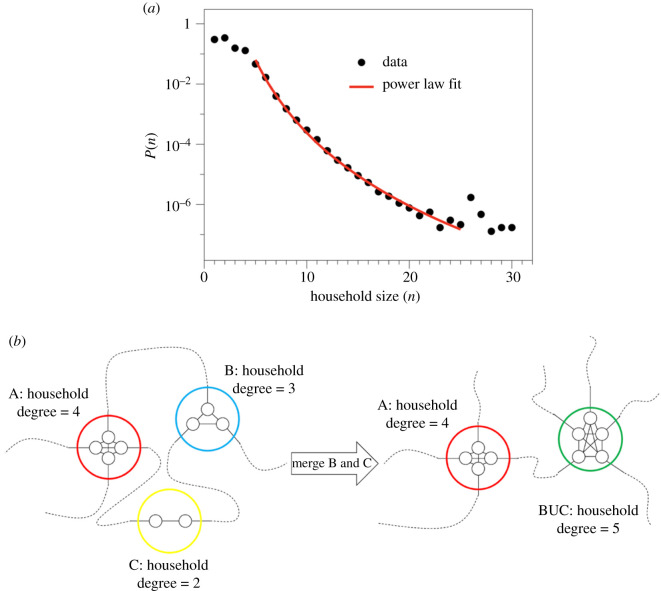
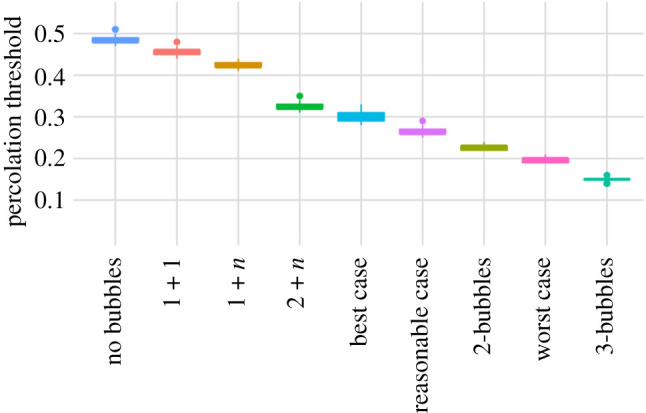
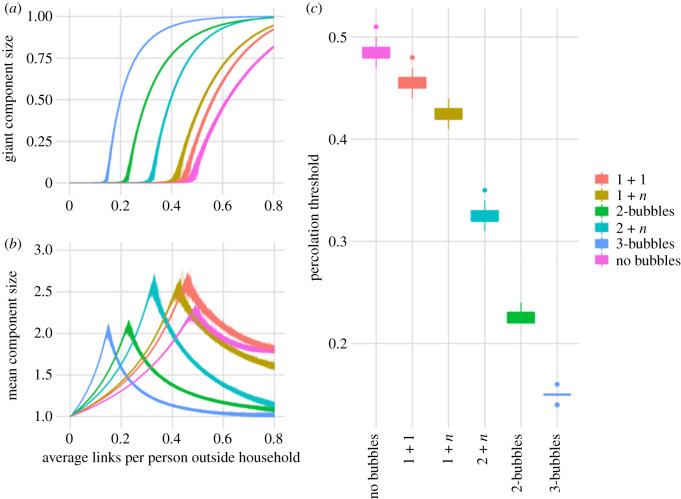
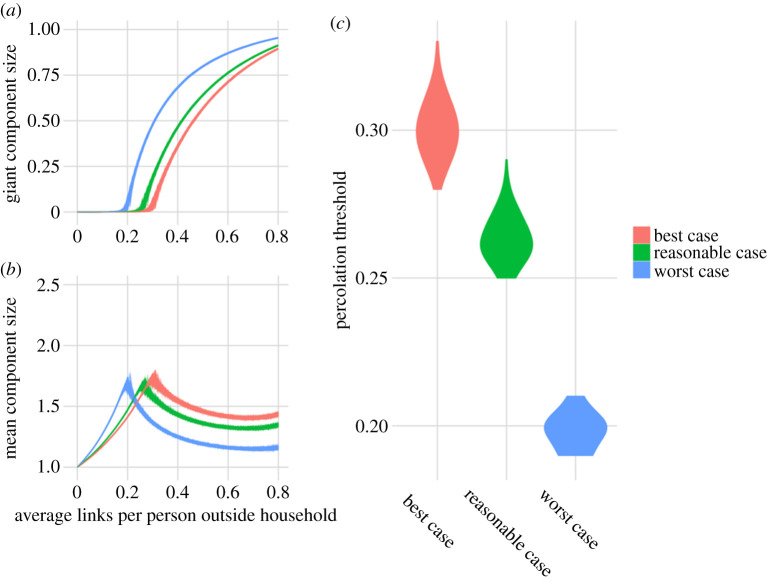
In the era of social distancing to curb the spread of COVID-19, bubbling is the combining of two or more households to create an exclusive larger group. The impact of bubbling on COVID-19 transmission is challenging to quantify because of the complex social structures involved. We developed a network description of households in the UK, using the configuration model to link households. We explored the impact of bubbling scenarios by joining together households of various sizes. For each bubbling scenario, we calculated the percolation threshold, that is, the number of connections per individual required for a giant component to form, numerically and theoretically. We related the percolation threshold to the household reproduction number. We find that bubbling scenarios in which single-person households join with another household have a minimal impact on network connectivity and transmission potential. Ubiquitous scenarios where all households form a bubble are likely to lead to an extensive transmission that is hard to control. The impact of plausible scenarios, with variable uptake and heterogeneous bubble sizes, can be mitigated with reduced numbers of contacts outside the household. Bubbling of households comes at an increased risk of transmission; however, under certain circumstances risks can be modest and could be balanced by other changes in behaviours. This article is part of the theme issue 'Modelling that shaped the early COVID-19 pandemic response in the UK'.
在为遏制 COVID-19 传播而实施社交隔离的时代,聚群是指两个或多个家庭组合成一个更大的专属群体。由于涉及复杂的社会结构,聚群对 COVID-19 传播的影响难以量化。我们使用配置模型对英国家庭进行了网络描述,以链接家庭。我们通过将不同规模的家庭组合在一起,探索了聚群场景的影响。对于每个聚群场景,我们通过数值和理论计算了渗流阈值,即形成一个巨团所需的每个个体的连接数。我们将渗流阈值与家庭繁殖数联系起来。我们发现,单人家庭与另一个家庭聚群的场景对网络连接性和传播潜力的影响最小。普遍情况下,所有家庭都形成一个泡泡,很可能导致广泛的传播,难以控制。通过减少家庭以外的接触次数,可以减轻具有不同参与率和异质泡泡大小的合理场景的影响。家庭聚群会增加传播风险;但是,在某些情况下,风险可以适度降低,并且可以通过改变其他行为来平衡风险。本文是主题为“塑造英国 COVID-19 大流行早期应对措施的建模”的一部分。