Jeong Joo Hee, Kang Sora, Lee Hak Seung, Lee Min Sung, Son Jeong Min, Kwon Joon-Myung, Lee Hyoung Seok, Choi Yun Young, Kim So Ree, Cho Dong-Hyuk, Kim Yun Gi, Kim Mi-Na, Shim Jaemin, Park Seong-Mi, Kim Young-Hoon, Choi Jong-Il
Division of Cardiology, Department of Internal Medicine, Korea University College of Medicine, Korea University Anam Hospital, 73 Goryeodae-ro, Seongbuk-gu, Seoul 02841, Republic of Korea.
Medical Research Team, Medical AI Co., Seoul, Republic of Korea.
Eur Heart J Digit Health. 2024 Aug 19;5(6):683-691. doi: 10.1093/ehjdh/ztae062. eCollection 2024 Nov.
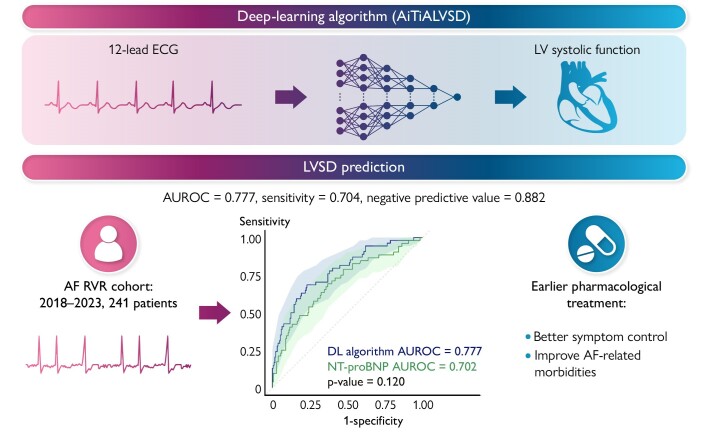
Although evaluation of left ventricular ejection fraction (LVEF) is crucial for deciding the rate control strategy in patients with atrial fibrillation (AF), real-time assessment of LVEF is limited in outpatient settings. We aimed to investigate the performance of artificial intelligence-based algorithms in predicting LV systolic dysfunction (LVSD) in patients with AF and rapid ventricular response (RVR).
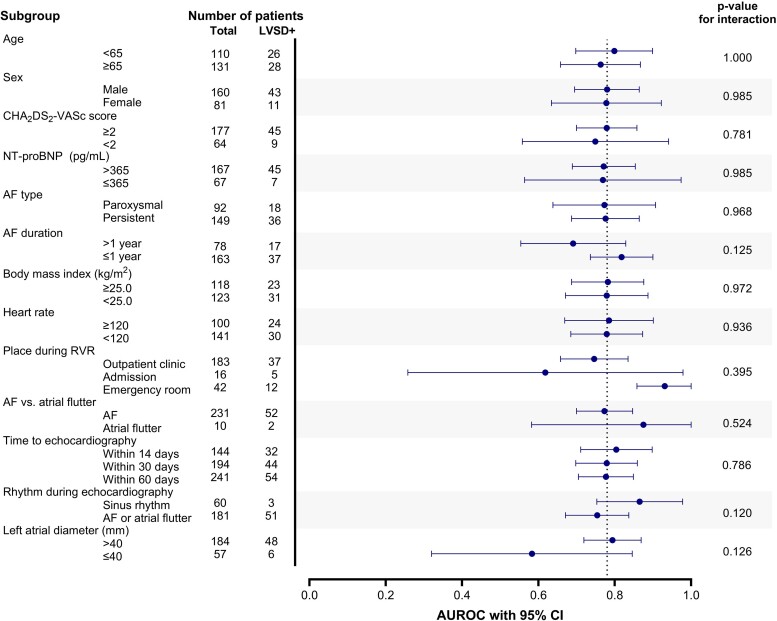
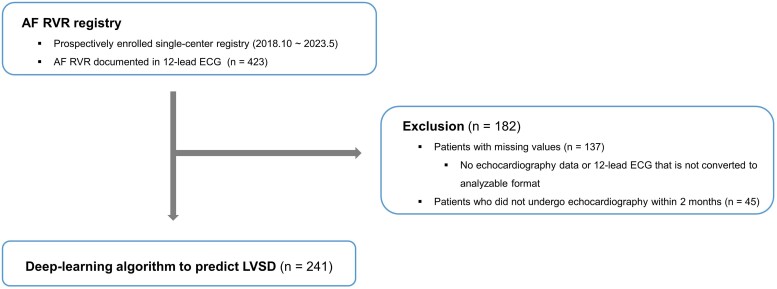
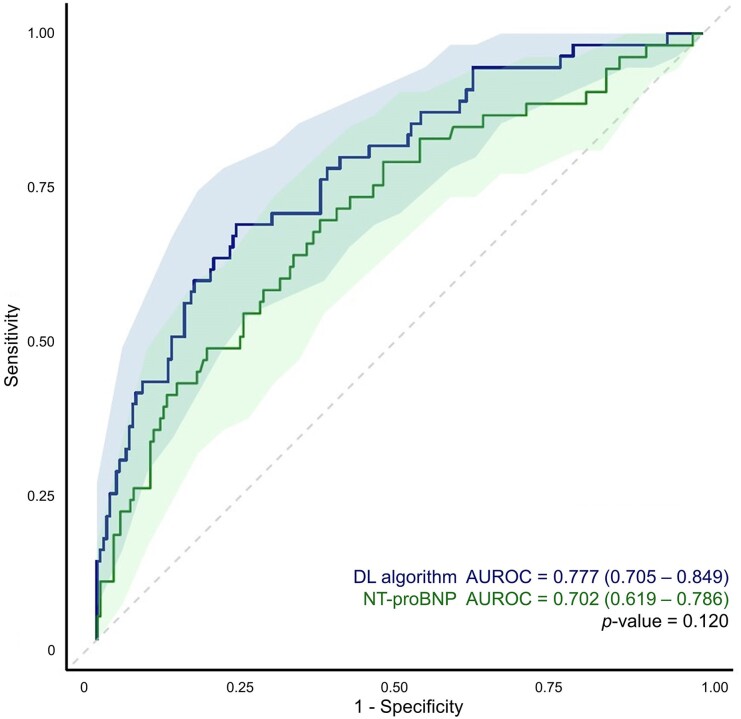
This study is an external validation of a pre-existing deep learning algorithm based on residual neural network architecture. Data were obtained from a prospective cohort of AF with RVR at a single centre between 2018 and 2023. Primary outcome was the detection of LVSD, defined as a LVEF ≤ 40%, assessed using 12-lead electrocardiography (ECG). Secondary outcome involved predicting LVSD using 1-lead ECG (Lead I). Among 423 patients, 241 with available echocardiography data within 2 months were evaluated, of whom 54 (22.4%) were confirmed to have LVSD. Deep learning algorithm demonstrated fair performance in predicting LVSD [area under the curve (AUC) 0.78]. Negative predictive value for excluding LVSD was 0.88. Deep learning algorithm resulted competent performance in predicting LVSD compared with N-terminal prohormone of brain natriuretic peptide (AUC 0.78 vs. 0.70, = 0.12). Predictive performance of the deep learning algorithm was lower in Lead I (AUC 0.68); however, negative predictive value remained consistent (0.88).
Deep learning algorithm demonstrated competent performance in predicting LVSD in patients with AF and RVR. In outpatient setting, use of artificial intelligence-based algorithm may facilitate prediction of LVSD and earlier choice of drug, enabling better symptom control in AF patients with RVR.
虽然评估左心室射血分数(LVEF)对于确定心房颤动(AF)患者的心率控制策略至关重要,但在门诊环境中对LVEF进行实时评估存在局限性。我们旨在研究基于人工智能的算法在预测AF合并快速心室率(RVR)患者左心室收缩功能障碍(LVSD)方面的性能。
本研究是对基于残差神经网络架构的现有深度学习算法进行外部验证。数据来自2018年至2023年在单一中心的AF合并RVR前瞻性队列。主要结局是检测LVSD,定义为LVEF≤40%,采用12导联心电图(ECG)进行评估。次要结局包括使用单导联心电图(I导联)预测LVSD。在423例患者中,对241例在2个月内有可用超声心动图数据的患者进行了评估,其中54例(22.4%)被证实患有LVSD。深度学习算法在预测LVSD方面表现良好[曲线下面积(AUC)为0.78]。排除LVSD的阴性预测值为0.88。与脑钠肽前体N末端(AUC分别为0.78和0.70,P = 0.12)相比,深度学习算法在预测LVSD方面表现良好。深度学习算法在I导联中的预测性能较低(AUC为0.68);然而,阴性预测值保持一致(0.88)。
深度学习算法在预测AF合并RVR患者的LVSD方面表现良好。在门诊环境中,使用基于人工智能的算法可能有助于预测LVSD并更早选择药物,从而更好地控制AF合并RVR患者的症状。