School of Occupational Therapy, Hebrew University of Jerusalem, Jerusalem 91240, Israel.
Int J Environ Res Public Health. 2022 Mar 8;19(6):3157. doi: 10.3390/ijerph19063157.
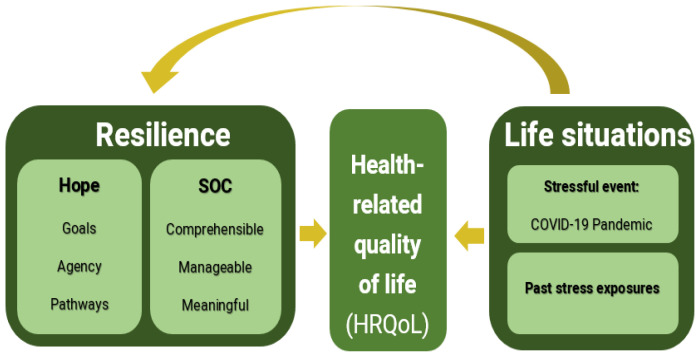
This study aimed to examine health-related quality of life of adolescents before and during the COVID-19 outbreak, and its relationship to resilience embodied in hope and a sense of coherence. Typically developed adolescents between the ages of 13 to 18 participated in the study; 84 were recruited before the pandemic outbreak and 64 in March to April 2020 during the worldwide outbreak. The participants completed the Pediatric Quality of Life Inventory, Sense of Coherence Scale, and Children’s Hope Scale. During the outbreak, adolescents reported higher physical health-related quality of life scores (F(1146) = 3.710, p < 0.05, η² = 0.027) and lower school health-related quality of life scores (F(1146) = 5.748, p < 0.05, η2 = 0.028), compared to adolescents during the pre-outbreak period. Furthermore, adolescents during the outbreak reported a significantly (p < 0.05) higher sense of coherence but no difference in levels of hope. Finally, the results of multiple linear regression indicated that resilience factors (hope and sense of coherence) contributed to the prediction of health-related quality of life, independent of socio-demographic variables. Hope and a sense of coherence were both found to positively impact one core aspect of health, which highlights the importance of addressing resilience factors in educational and therapeutic settings for adolescents thus that they are better able to adapt to stressful events such as pandemics.
本研究旨在探讨青少年在 COVID-19 爆发前后的健康相关生活质量及其与希望和一致性感体现的韧性之间的关系。本研究招募了年龄在 13 至 18 岁之间的典型青少年;84 名青少年在大流行爆发前招募,64 名在 2020 年 3 月至 4 月期间在全球大流行期间招募。参与者完成了儿科生活质量量表、一致性感量表和儿童希望量表。在大流行期间,与大流行前时期相比,青少年报告的身体健康相关生活质量评分更高(F(1146) = 3.710,p < 0.05,η² = 0.027),而学校健康相关生活质量评分更低(F(1146) = 5.748,p < 0.05,η² = 0.028)。此外,在大流行期间,青少年的一致性感显著(p < 0.05)更高,但希望水平没有差异。最后,多元线性回归的结果表明,韧性因素(希望和一致性感)独立于社会人口统计学变量,对健康相关生活质量的预测有贡献。希望和一致性感都对健康的一个核心方面产生积极影响,这突出了在教育和治疗环境中解决韧性因素的重要性,以便青少年能够更好地适应大流行等压力事件。