Department of Rehabilitation and Physiotherapy, University of Medical Sciences, 60-545 Poznań, Poland.
Department of Organization and Management in Healthcare, University of Medical Sciences, 60-545 Poznań, Poland.
Int J Environ Res Public Health. 2022 Mar 12;19(6):3368. doi: 10.3390/ijerph19063368.
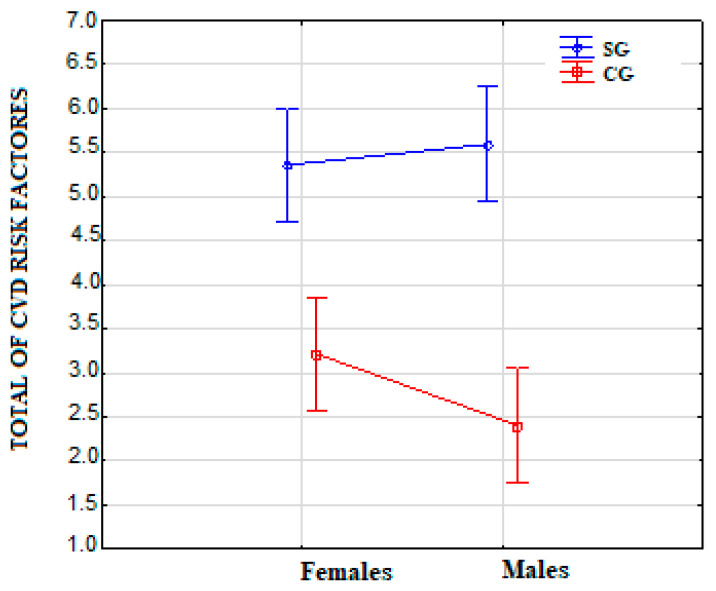
Background: Patients after undergoing ischemic stroke have a high risk of further cardiovascular disease (CVD) incidents. Monitoring risk factors is critical to prevent the recurrence of CVD. Objective: The aim of the study was to determine differences in the incidence of risk factors for CVD in a post-ischemic stroke patient group (SG) compared to the control group, which had not undergone ischemic stroke (CG), and to characterize them using the ICF (International Classification of Functioning, Disability and Health) classification system. Materials and Methods: The incidence of risk factors for recurrent CVD events were retrospectively analyzed in 55 patients in SG and 55 patients in CG. The results were translated into categories from the ICF classification system. Results: Atrial fibrillation (p = 0.013), carotid artery stenosis > 50% (p < 0.001), LDL > 71 mg/dL (p < 0.001), heart rate > 80/min (p = 0.007), taking NOAC (p = 0.008) and NSAIDs (p < 0.001) as well as nicotinism (p = 0.001) were significantly more common in SG compared to CG. The value of the distribution of the total incidence of CVD risk factors were observed to be higher for SG than for CG. In SG, both for males (p < 0.001) and females (p < 0.001) more risk factors for recurrent CVD incidents were observed compared to CG. Conclusions: Patients in SG differ in the occurrence of risk factors for CVD event compared to CG. The use of a single tool, such as the ICF assessment sheet, can be useful in assessing and analyzing risk factors for recurrent CVD events. This may help to reduce the risk of subsequent CVD events in secondary prevention.
发生缺血性脑卒中的患者存在发生心血管疾病(CVD)事件的较高风险。监测风险因素对于预防 CVD 复发至关重要。目的:本研究旨在比较缺血性脑卒中后患者组(SG)和未发生缺血性脑卒中的对照组(CG) CVD 风险因素的发生率差异,并使用国际功能、残疾和健康分类(ICF)系统对其进行特征描述。材料与方法:回顾性分析了 55 例 SG 患者和 55 例 CG 患者的 CVD 复发风险因素发生率。结果被转化为 ICF 分类系统的类别。结果:SG 中心房颤动(p = 0.013)、颈动脉狭窄>50%(p < 0.001)、LDL>71mg/dL(p < 0.001)、心率>80/min(p = 0.007)、服用 NOAC(p = 0.008)和 NSAIDs(p < 0.001)以及尼古丁依赖(p = 0.001)的发生率明显高于 CG。SG 中 CVD 风险因素总发生率的分布值高于 CG。在 SG 中,男性(p < 0.001)和女性(p < 0.001)发生 CVD 复发风险因素的比例均高于 CG。结论:SG 患者发生 CVD 事件的风险因素与 CG 不同。使用单一工具(如 ICF 评估表)可以有助于评估和分析 CVD 复发风险因素。这可能有助于降低二级预防中随后 CVD 事件的风险。