Public Health Research Centre, NOVA National School of Public Health, Universidade NOVA de Lisboa, 1600-560 Lisbon, Portugal.
Comprehensive Health Research Center (CHRC), 1169-056 Lisbon, Portugal.
Int J Environ Res Public Health. 2022 Mar 19;19(6):3683. doi: 10.3390/ijerph19063683.
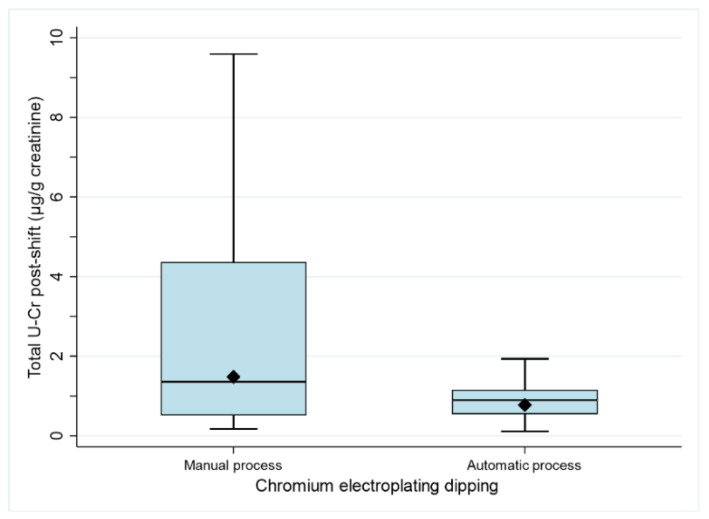
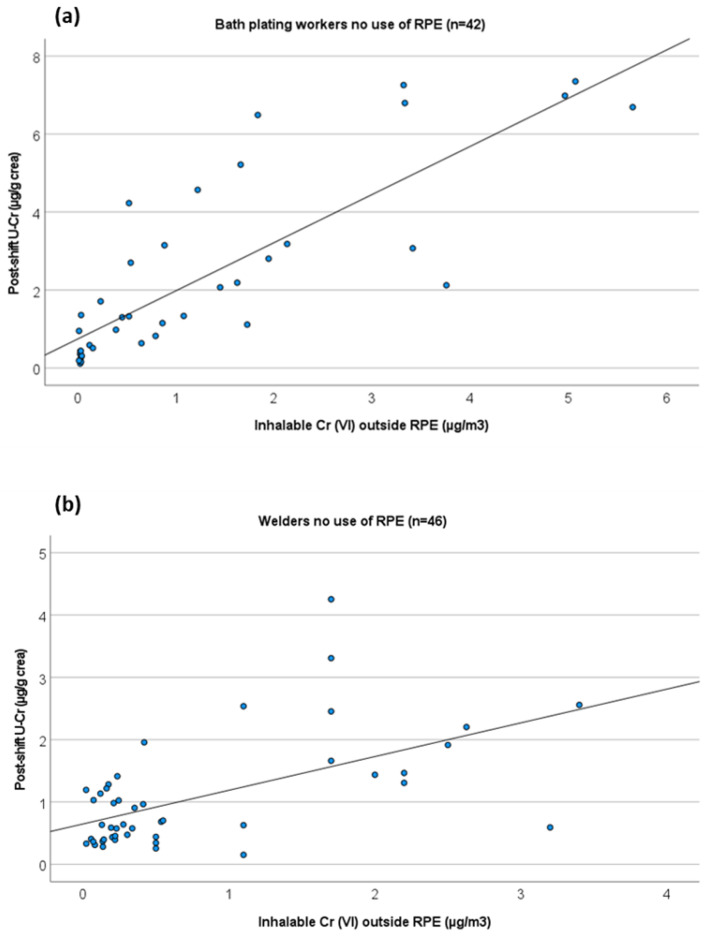
Work-related exposures in industrial processing of chromate (chrome plating, surface treatment and welding) raise concern regarding the health risk of hexavalent chromium (Cr(VI)). In this study, performed under the HBM4EU project, we focused on better understanding the determinants of exposure and recognising how risk management measures (RMMs) contribute to a reduction in exposure. HBM and occupational hygiene data were collected from 399 workers and 203 controls recruited in nine European countries. Urinary total chromium (U-Cr), personal inhalable and respirable dust of Cr and Cr(VI) and Cr from hand wipes were collected. Data on the RMMs were collected by questionnaires. We studied the association between different exposure parameters and the use of RMMs. The relationship between exposure by inhalation and U-Cr in different worker groups was analysed using regression analysis and found a strong association. Automatisation of Cr electroplating dipping explained lower exposure levels in platers. The use of personal protective equipment resulted in lower U-Cr levels in welding, bath plating and painting. An effect of wearing gloves was observed in machining. An effect of local exhaust ventilation and training was observed in welding. Regression analyses showed that in platers, exposure to air level of 5 µg/m corresponds to U-Cr level of 7 µg/g creatinine. In welders, the same inhalation exposure resulted in lower U-Cr levels reflecting toxicokinetic differences of different chromium species.
在铬酸盐(镀铬、表面处理和焊接)的工业加工过程中,与工作相关的暴露引起了人们对六价铬(Cr(VI))健康风险的关注。在 HBM4EU 项目的框架下,我们进行了这项研究,旨在更好地了解暴露的决定因素,并认识到风险管理措施(RMMs)如何有助于减少暴露。从九个欧洲国家招募了 399 名工人和 203 名对照者,收集了 HBM 和职业卫生数据。收集了尿总铬(U-Cr)、个人可吸入和可呼吸的 Cr 和 Cr(VI)粉尘以及手部擦拭物中的 Cr。通过问卷调查收集了有关 RMMs 的数据。我们研究了不同暴露参数与 RMMs 使用之间的关系。使用回归分析研究了不同工人群体中吸入暴露与 U-Cr 之间的关系,发现两者之间存在很强的关联。Cr 电镀浸镀的自动化解释了电镀工的较低暴露水平。在焊工、镀槽电镀工和喷漆工中,使用个人防护设备会导致 U-Cr 水平降低。在机械加工中观察到戴手套的效果。在焊工中观察到局部排气通风和培训的效果。回归分析表明,在电镀工中,空气水平为 5 µg/m 时的暴露相当于 U-Cr 水平为 7 µg/g 肌酐。在焊工中,相同的吸入暴露导致 U-Cr 水平较低,反映了不同铬物种的毒代动力学差异。