Narzisi Antonio, Fabbri-Destro Maddalena, Crifaci Giulia, Scatigna Stefano, Maugeri Federica, Berloffa Stefano, Fantozzi Pamela, Prato Adriana, Muccio Rosy, Valente Elena, Viglione Valentina, Pecchini Edoardo, Pelagatti Susanna, Rizzo Renata, Milone Annarita, Barone Rita, Masi Gabriele
Department of Child Psychiatry and Psychopharmacology, IRCCS Stella Maris Foundation, 56128 Pisa, Italy.
Institute of Neuroscience, National Research Council (CNR), 43125 Parma, Italy.
J Clin Med. 2022 Mar 17;11(6):1668. doi: 10.3390/jcm11061668.
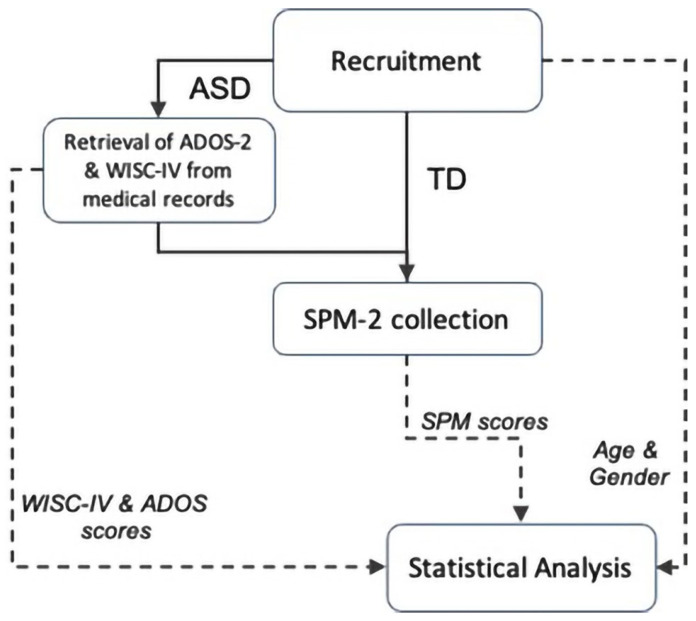
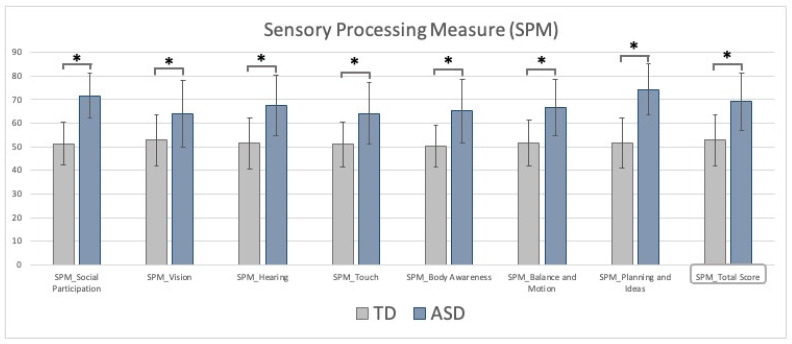
Background: Sensory reactivity is considered one of the diagnostic criteria for Autism Spectrum Disorders (ASD) and has been associated with poorer functional outcomes, behavioral difficulties, and autism severity across the lifespan. The characterization of the sensory processing in ASD has thus become crucial to identify the sensory and motor features influencing the development of personal autonomy. Objectives: The present study has two aims: (1) to compare the sensory processing between school-aged children with ASD and typically developing peers (TD); (2) to evaluate whether, within the ASD sample, the cognitive level and reported sensory symptoms explain the scores exhibited at the Sensory Processing Measure (SPM-2). Methods: The SPM-2 test was administered to the parents of 105 children with ASD and 70 TD. The ASD group was further subdivided into two groups, namely high and low functioning based on their cognitive level (High Functioning (HF), IQ > 80; Low Functioning (LF), IQ < 80). Results: ASD children exhibited higher scores throughout the SPM-2 total score and its multiple subscales. Within ASD, while HF and LF children did not differ in terms of the SPM-2 total score, a significant difference was found for the hearing, social participation, and balance and motion subscales. Conclusions: Aside from classical knowledge that the ASD population suffers from sensory processing disorders, we revealed that different sensory patterns are associated with high or low cognitive functioning. Beyond its neurobiological interest, such knowledge may be of fundamental importance for individualizing psychoeducational interventions in preschool- and school-aged children and later developmental stages.
感觉反应性被认为是自闭症谱系障碍(ASD)的诊断标准之一,并且与较差的功能结局、行为困难以及一生中的自闭症严重程度相关。因此,对ASD患者感觉加工的特征进行描述,对于识别影响个人自主性发展的感觉和运动特征至关重要。目的:本研究有两个目的:(1)比较ASD学龄儿童与发育正常同龄人(TD)之间的感觉加工情况;(2)评估在ASD样本中,认知水平和报告的感觉症状是否能解释感觉加工测量(SPM-2)中表现出的分数。方法:对105名ASD儿童和70名TD儿童的家长进行SPM-2测试。根据认知水平,ASD组进一步分为两组,即高功能组(HF,智商>80)和低功能组(LF,智商<80)。结果:ASD儿童在SPM-2总分及其多个子量表上得分更高。在ASD组内,虽然HF和LF儿童在SPM-2总分上没有差异,但在听力、社会参与以及平衡和运动子量表上存在显著差异。结论:除了ASD人群存在感觉加工障碍这一经典认知外,我们还发现不同的感觉模式与高或低认知功能相关。除了其神经生物学意义外,这些知识对于在学龄前和学龄儿童以及后期发育阶段进行个性化心理教育干预可能具有至关重要的意义。