Division of COVID Containment, Philadelphia Department of Health, 1101 Market Street, Philadelphia, PA, 19107, USA.
Epidemiology, Oregon Health & Science University - Portland State University, School of Public Health, Portland, OR, 97239, USA.
J Community Health. 2022 Aug;47(4):577-587. doi: 10.1007/s10900-022-01081-9. Epub 2022 Mar 25.
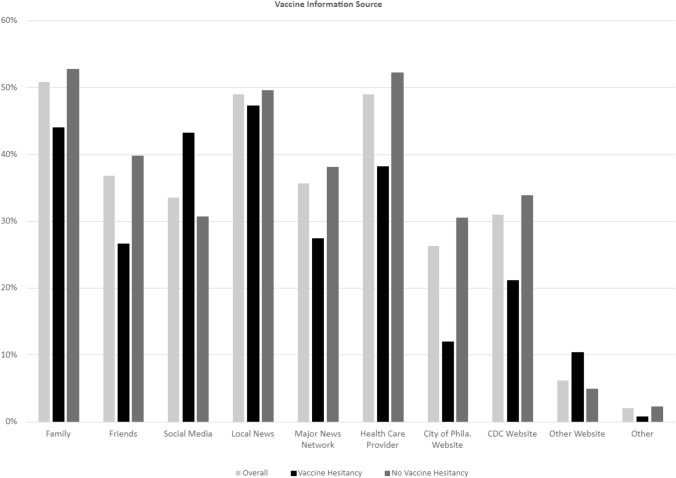
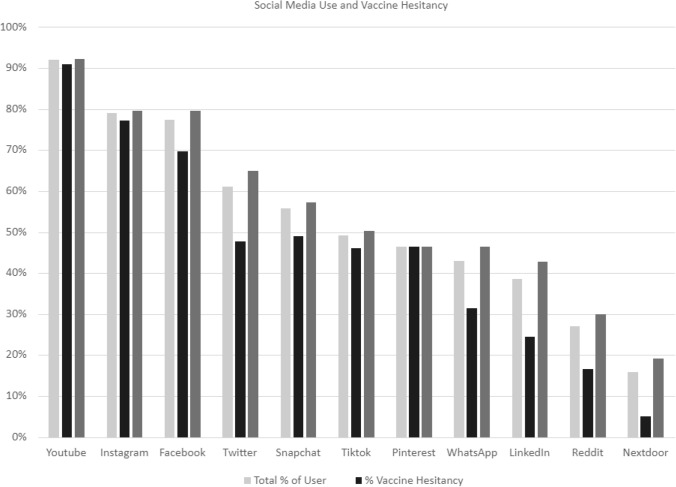
There has been a surge in vaccine hesitancy following the Coronavirus pandemic. This study measured the prevalence of and identified factors associated with vaccine hesitancy and social media use. An online survey was administered (n = 1050) between May and July 2021. Chi-square tests were used to examine bivariate associations with vaccine hesitancy (partially vaccinated and unvaccinated participants). Logistic regression was used to identify associations between social media use and vaccine hesitancy. Chi-square tests showed women (69.7% vs 28.2% men, p = .002), African American participants (52.3% vs 17.8% white, p < .001), high school diploma (54.4% vs 38.6% college degree, p < .001), political unaffiliated (15.8% vs 14.5% republican, p < .001), Muslim (10.0% vs 0% Jewish, p < .001), and never married/single (53.9% vs 17.0% married, p < .001) were more likely to be vaccine hesitant. Controlling for all demographic variables (age, race, gender, and education), more frequent use of social media for reading news was associated with lower vaccine hesitancy (OR 0.35, 99% CI 0.20, 0.63, p < 0.001). However, using social media as a source of vaccine information without any other trusted source (health department, doctor, CDC,) was associated with higher odds of being vaccine hesitant (OR 2.00, 99% CI 1.15, 3.46, p = 0.001). People who use social media without referencing trusted sources may be particularly vulnerable to disinformation or vaccine hesitant persons are more likely exposed to non-trusted social media sites as their only information source.
在冠状病毒大流行之后,疫苗犹豫情绪激增。本研究旨在测量疫苗犹豫和社交媒体使用的流行率,并确定与之相关的因素。我们于 2021 年 5 月至 7 月间进行了一项在线调查(n=1050)。卡方检验用于检查与疫苗犹豫相关的双变量关联(部分接种和未接种的参与者)。逻辑回归用于确定社交媒体使用与疫苗犹豫之间的关联。卡方检验显示,女性(69.7%比 28.2%的男性,p=0.002)、非裔美国人(52.3%比 17.8%的白人,p<0.001)、高中文凭(54.4%比 38.6%的大学学位,p<0.001)、政治无党派(15.8%比 14.5%的共和党,p<0.001)、穆斯林(10.0%比 0%的犹太人,p<0.001)、未婚/单身(53.9%比 17.0%的已婚,p<0.001)的人更有可能对疫苗犹豫不决。控制所有人口统计学变量(年龄、种族、性别和教育)后,更频繁地使用社交媒体阅读新闻与较低的疫苗犹豫率相关(OR 0.35,99%CI 0.20,0.63,p<0.001)。然而,仅使用社交媒体作为疫苗信息来源,而没有其他可信来源(如卫生部门、医生、疾病预防控制中心),则与更高的疫苗犹豫几率相关(OR 2.00,99%CI 1.15,3.46,p=0.001)。那些不参考可信来源而使用社交媒体的人可能特别容易受到虚假信息的影响,或者疫苗犹豫者更有可能接触到不可信的社交媒体网站,作为他们唯一的信息来源。