Suntronwong Nungruthai, Yorsaeng Ritthideach, Puenpa Jiratchaya, Auphimai Chompoonut, Thongmee Thanunrat, Vichaiwattana Preeyaporn, Kanokudom Sitthichai, Duangchinda Thaneeya, Chantima Warangkana, Pakchotanon Pattarakul, Assawakosri Suvichada, Nilyanimit Pornjarim, Klinfueng Sirapa, Wongsrisang Lakkhana, Srimuan Donchida, Thatsanatorn Thaksaporn, Sudhinaraset Natthinee, Wanlapakorn Nasamon, Poovorawan Yong
Center of Excellence in Clinical Virology, Faculty of Medicine, Chulalongkorn University, Bangkok 10330, Thailand.
Molecular Biology of Dengue and Flaviviruses Research Team, National Center for Genetic Engineering and Biotechnology (BIOTEC), National Science and Development Agency, NSTDA, Pathum Thani 12120, Thailand.
Vaccines (Basel). 2022 Mar 3;10(3):391. doi: 10.3390/vaccines10030391.
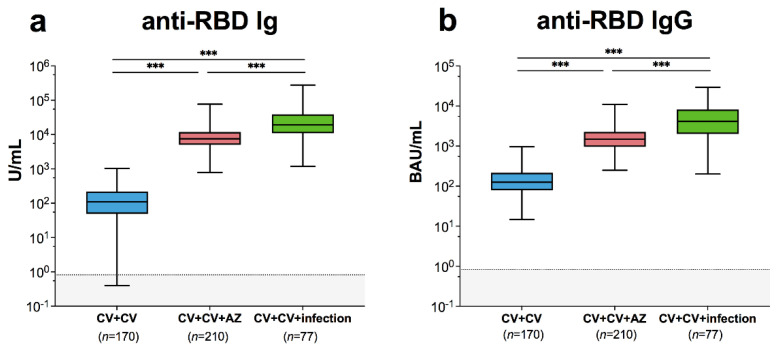
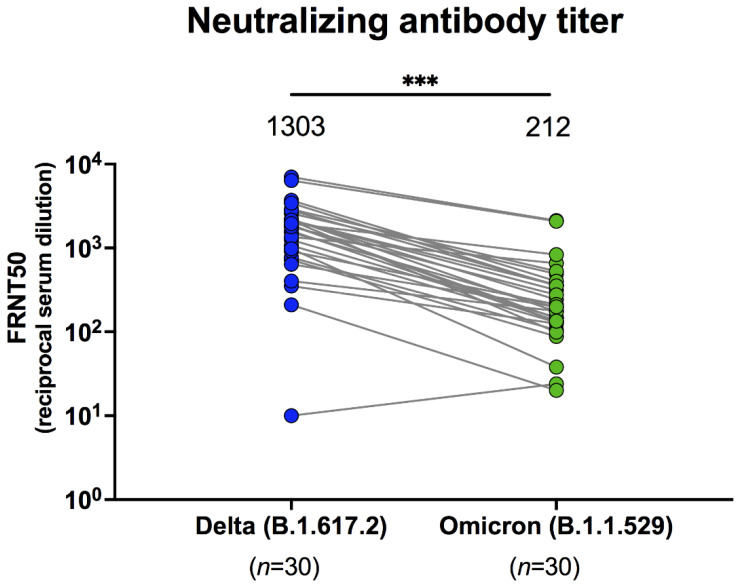
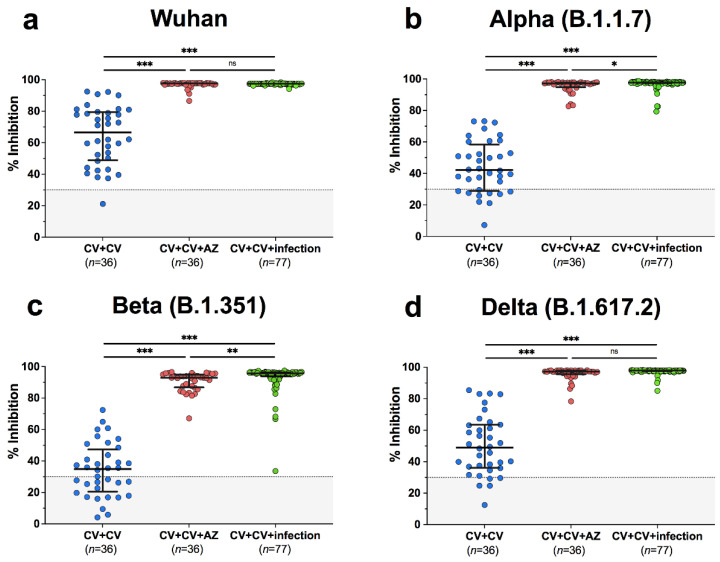
The emergence of severe acute respiratory syndrome coronavirus 2 (SARS-CoV-2) variants and the waning of immunity in vaccinated individuals is resulting in increased numbers of SARS-CoV-2 breakthrough infections. This study investigated binding antibody responses and neutralizing activities against SARS-CoV-2 variants, in patients with COVID-19 who had been fully vaccinated with CoronaVac ( = 77), individuals who had been fully vaccinated with CoronaVac but had not contracted COVID-19 ( = 170), and individuals who had received AZD1222 as a third vaccination ( = 210). Breakthrough infection was generally detected approximately 88 days after the second CoronaVac vaccination (interquartile range 68-100 days). Blood samples were collected at a median of 34 days after infection. Binding antibody levels in sera from patients with breakthrough infection were significantly higher than those in individuals who had received AZD1222 as a third vaccination. However, neutralizing activities against wild-type and variants, including alpha (B.1.1.7), beta (B.1.351), and delta (B.1.617.2), were comparable in patients with breakthrough infections and individuals who received a third vaccination with AZD1222, which exceeds 90%. Omicron (B.1.1.529) was neutralized less effectively by serum from breakthrough infection patients, with a 6.3-fold reduction compared to delta variants. The study suggests that breakthrough infection after two doses of an inactivated vaccine can induce neutralizing antibodies against omicron. Further investigation is needed to assess the long-term persistence of antibodies against the omicron variant.
严重急性呼吸综合征冠状病毒2(SARS-CoV-2)变体的出现以及接种疫苗个体免疫力的减弱,导致SARS-CoV-2突破性感染病例数增加。本研究调查了已完全接种科兴疫苗的新冠肺炎患者( = 77)、已完全接种科兴疫苗但未感染新冠肺炎的个体( = 170)以及接受AZD1222作为第三次疫苗接种的个体( = 210)针对SARS-CoV-2变体的结合抗体反应和中和活性。突破性感染通常在第二次接种科兴疫苗后约88天被检测到(四分位间距为68 - 100天)。在感染后中位数34天采集血样。突破性感染患者血清中的结合抗体水平显著高于接受AZD1222作为第三次疫苗接种的个体。然而,突破性感染患者和接受第三次接种AZD1222的个体对野生型和包括阿尔法(B.1.1.7)、贝塔(B.1.351)和德尔塔(B.1.617.2)在内的变体的中和活性相当,后者超过90%。奥密克戎(B.1.1.529)被突破性感染患者血清中和的效果较差,与德尔塔变体相比降低了6.3倍。该研究表明,两剂灭活疫苗后的突破性感染可诱导针对奥密克戎的中和抗体。需要进一步研究以评估针对奥密克戎变体抗体的长期持久性。