Concha Luis, Resende Pires Ana Luiza, Moraes Angela Maria, Mas-Hernández Elizabeth, Berres Stefan, Hernandez-Montelongo Jacobo
Department of Physical and Mathematical Sciences, Catholic University of Temuco, Temuco 4813302, Chile.
School of Chemical Engineering, University of Campinas, Campinas 13083-852, Brazil.
Polymers (Basel). 2022 Mar 10;14(6):1109. doi: 10.3390/polym14061109.
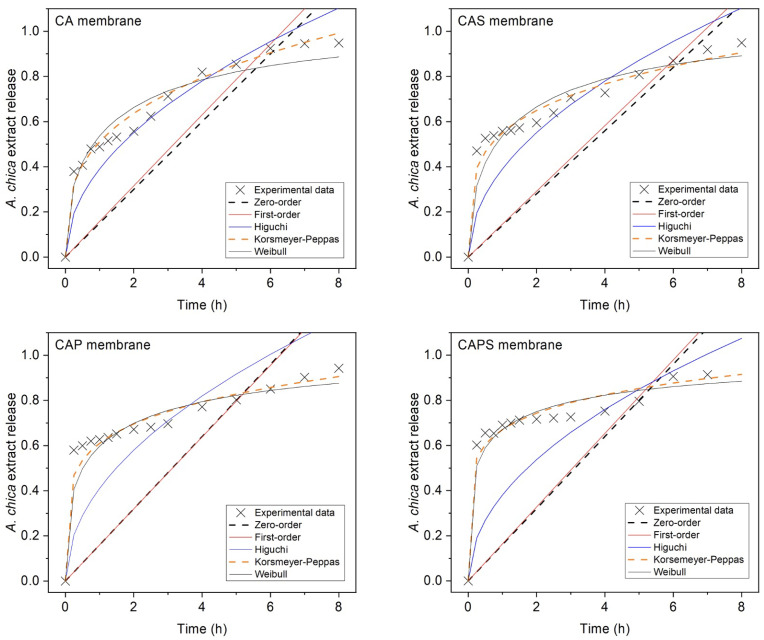
This work focuses on the mathematical analysis of the controlled release of a standardized extract of from chitosan/alginate (C/A) membranes, which can be used for the treatment of skin lesions. Four different types of C/A membranes were tested: a dense membrane (CA), a dense and flexible membrane (CAS), a porous membrane (CAP) and a porous and flexible membrane (CAPS). The extract release profiles were obtained experimentally in vitro using PBS at 37 °C and pH 7. Experimental data of release kinetics were analyzed using five classical models from the literature: Zero Order, First Order, Higuchi, Korsmeyer-Peppas and Weibull functions. Results for the Korsmeyer-Peppas model showed that the release of extract from four membrane formulations was by a diffusion through a partially swollen matrix and through a water filled network mesh; however, the Weibull model suggested that non-porous membranes (CA and CAS) had fractal geometry and that porous membranes (CAP and CAPS) have highly disorganized structures. Nevertheless, by applying an explicit optimization method that employs a cost function to determine the model parameters that best fit to experimental data, the results indicated that the Weibull model showed the best simulation for the release profiles from the four membranes: CA, CAS and CAP presented Fickian diffusion through a polymeric matrix of fractal geometry, and only the CAPS membrane showed a highly disordered matrix. The use of this cost function optimization had the significant advantage of higher fitting sensitivity.
这项工作聚焦于壳聚糖/藻酸盐(C/A)膜对标准化提取物的控释数学分析,该膜可用于治疗皮肤损伤。测试了四种不同类型的C/A膜:致密膜(CA)、致密且柔韧的膜(CAS)、多孔膜(CAP)和多孔且柔韧的膜(CAPS)。使用37℃、pH值为7的磷酸盐缓冲盐水(PBS)在体外通过实验获得提取物释放曲线。利用文献中的五个经典模型对释放动力学实验数据进行分析:零级、一级、Higuchi、Korsmeyer-Peppas和Weibull函数。Korsmeyer-Peppas模型的结果表明,四种膜制剂中提取物的释放是通过部分溶胀的基质和充满水的网络网孔进行扩散;然而,Weibull模型表明无孔膜(CA和CAS)具有分形几何结构,而多孔膜(CAP和CAPS)具有高度无序的结构。尽管如此,通过应用一种明确的优化方法,该方法采用成本函数来确定最符合实验数据的模型参数,结果表明Weibull模型对四种膜(CA、CAS和CAP)的释放曲线显示出最佳模拟:CA、CAS和CAP呈现通过分形几何聚合物基质的菲克扩散,只有CAPS膜显示出高度无序的基质。使用这种成本函数优化具有更高拟合灵敏度的显著优势。