Department of Nephrology, First Medical Center of Chinese, PLA General Hospital, Nephrology Institute of the Chinese People's Liberation Army, State Key Laboratory of Kidney Diseases, National Clinical Research Center for Kidney Diseases, Beijing Key Laboratory of Kidney Disease Research, No. 28 Fuxing Road, Beijing, 100853, China.
Medical Big Data Research Center, Medical Innovation Research Division of Chinese People's Liberation, Army General Hospital, National Engineering Laboratory for Medical Big Data Application Technology, No. 28 Fuxing Road, Beijing, 100853, China.
J Transl Med. 2022 Mar 26;20(1):143. doi: 10.1186/s12967-022-03339-1.
Established prediction models of Diabetic kidney disease (DKD) are limited to the analysis of clinical research data or general population data and do not consider hospital visits. Construct a 3-year diabetic kidney disease risk prediction model in patients with type 2 diabetes mellitus (T2DM) using machine learning, based on electronic medical records (EMR).
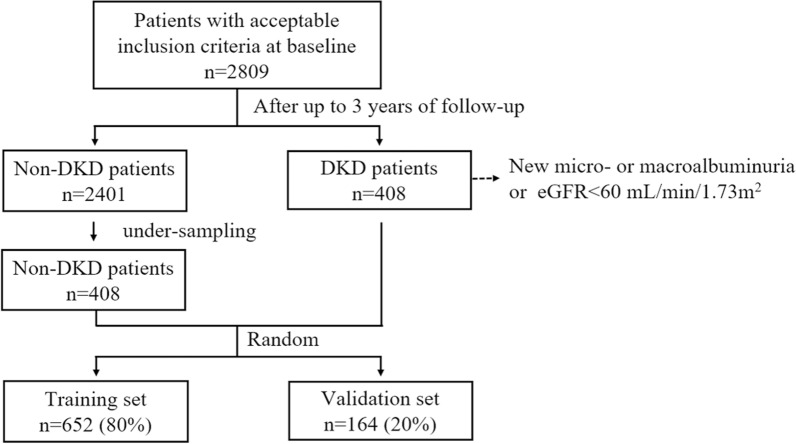
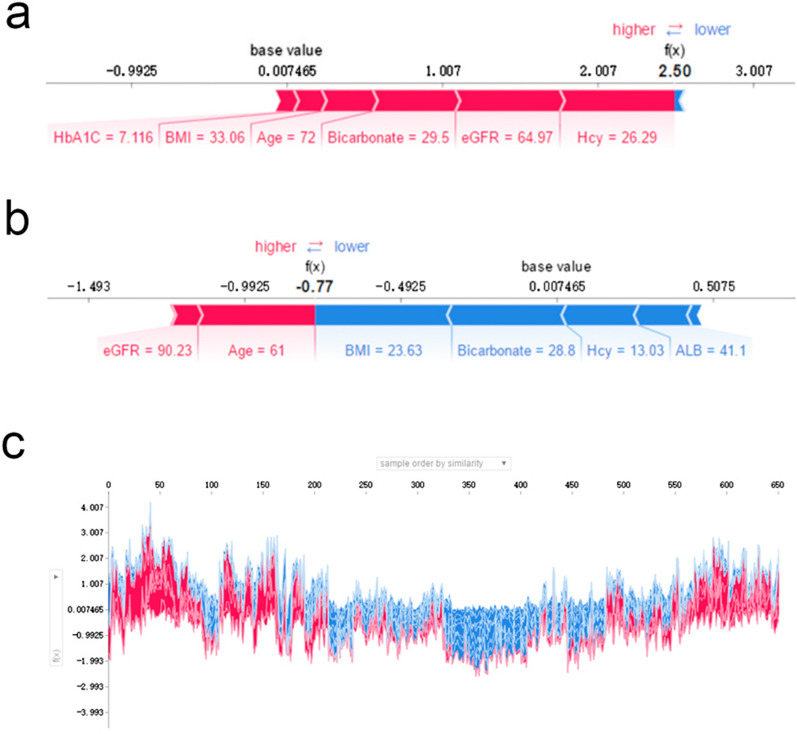
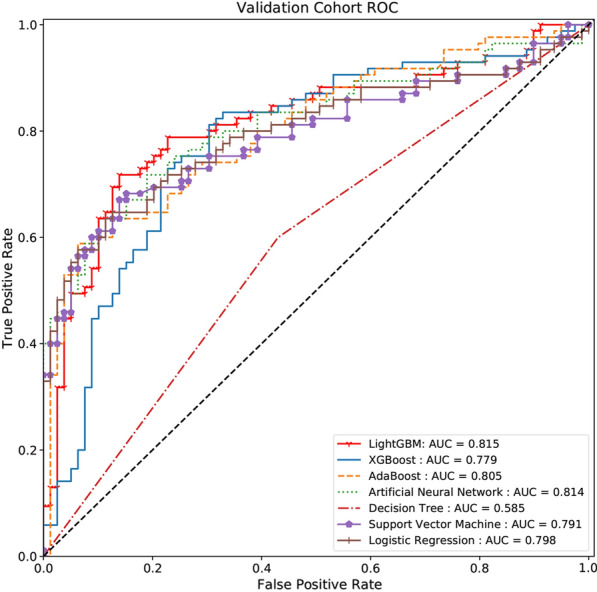
Data from 816 patients (585 males) with T2DM and 3 years of follow-up at the PLA General Hospital. 46 medical characteristics that are readily available from EMR were used to develop prediction models based on seven machine learning algorithms (light gradient boosting machine [LightGBM], eXtreme gradient boosting, adaptive boosting, artificial neural network, decision tree, support vector machine, logistic regression). Model performance was evaluated using the area under the receiver operating characteristic curve (AUC). Shapley additive explanation (SHAP) was used to interpret the results of the best performing model.
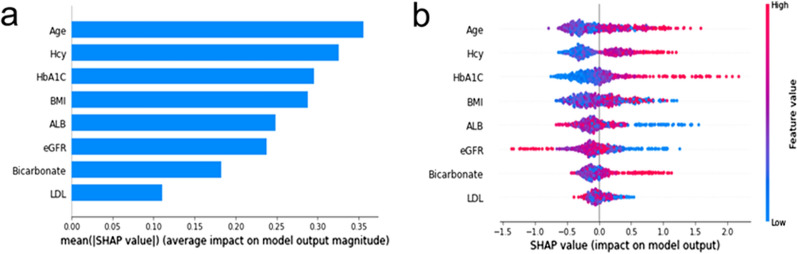
The LightGBM model had the highest AUC (0.815, 95% CI 0.747-0.882). Recursive feature elimination with random forest and SHAP plot based on LightGBM showed that older patients with T2DM with high homocysteine (Hcy), poor glycemic control, low serum albumin (ALB), low estimated glomerular filtration rate (eGFR), and high bicarbonate had an increased risk of developing DKD over the next 3 years.
This study constructed a 3-year DKD risk prediction model in patients with T2DM and normo-albuminuria using machine learning and EMR. The LightGBM model is a tool with potential to facilitate population management strategies for T2DM care in the EMR era.
已建立的糖尿病肾病(DKD)预测模型仅限于对临床研究数据或一般人群数据的分析,而不考虑就诊情况。本研究旨在基于电子病历(EMR),使用机器学习构建一个适用于 2 型糖尿病(T2DM)患者的 3 年糖尿病肾病风险预测模型。
本研究纳入了 816 例(585 例男性)在解放军总医院就诊的 T2DM 患者,随访 3 年。共纳入 46 项可从 EMR 中获取的临床特征,采用 7 种机器学习算法(LightGBM、极端梯度提升、自适应提升、人工神经网络、决策树、支持向量机和逻辑回归)构建预测模型。采用受试者工作特征曲线下面积(AUC)评估模型性能。采用 Shapley 加性解释(SHAP)解释最优模型的结果。
LightGBM 模型的 AUC 最高(0.815,95%CI 0.747-0.882)。基于 LightGBM 的随机森林递归特征消除和 SHAP 图显示,年龄较大、同型半胱氨酸(Hcy)水平较高、血糖控制较差、血清白蛋白(ALB)水平较低、估算肾小球滤过率(eGFR)较低、碳酸氢盐水平较高的 T2DM 患者在未来 3 年内发生 DKD 的风险增加。
本研究使用机器学习和 EMR 构建了一个适用于 T2DM 伴正常白蛋白尿患者的 3 年 DKD 风险预测模型。LightGBM 模型有望成为 EMR 时代 T2DM 管理策略的有效工具。