Department of Biopharmacy, School of Life Science, Jilin University, Changchun, 130012, China.
School of Medicine, Keele University, Staffordshire, ST5 5BG, UK.
Appl Microbiol Biotechnol. 2022 Apr;106(7):2433-2444. doi: 10.1007/s00253-022-11888-0. Epub 2022 Mar 31.
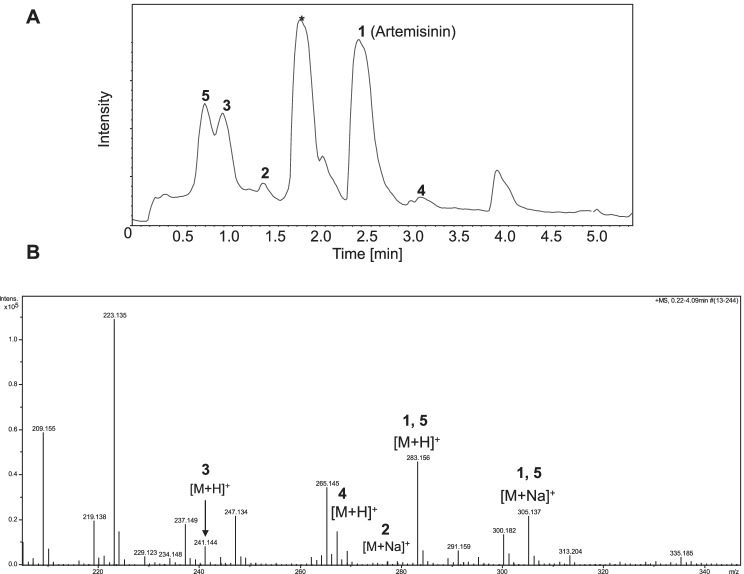
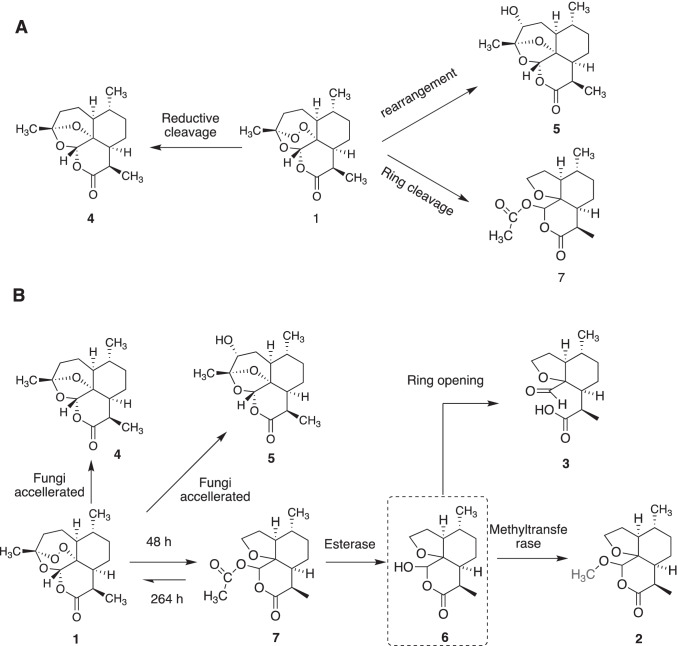
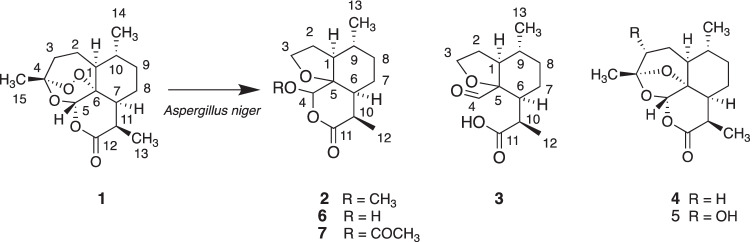
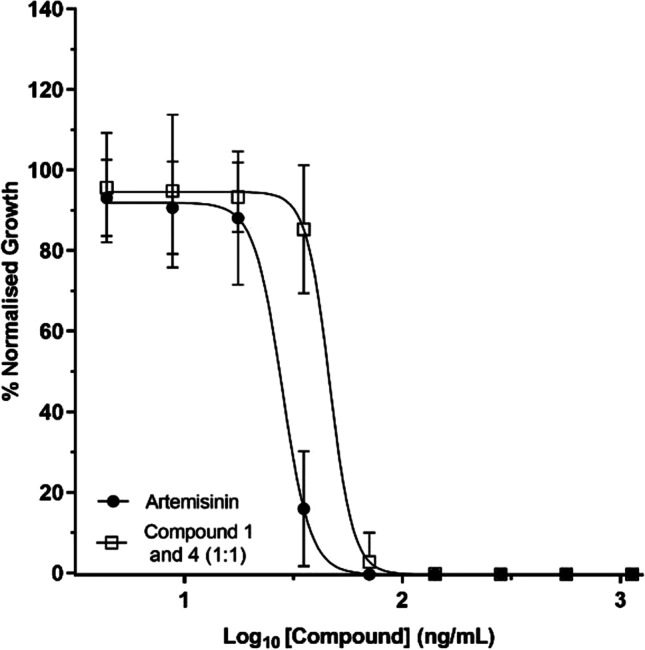
Artemisinin is a component part of current frontline medicines for the treatment of malaria. The aim of this study is to make analogues of artemisinin using microbial transformation and evaluate their in vitro antimalarial activity. A panel of microorganisms were screened for biotransformation of artemisinin (1). The biotransformation products were extracted, purified and isolated using silica gel column chromatography and semi-preparative HPLC. Spectroscopic methods including LC-HRMS, GC-MS, FT-IR, 1D and 2D NMR were used to elucidate the structure of the artemisinin metabolites.H NMR spectroscopy was further used to study the time-course biotransformation. The antiplasmodial activity (IC) of the biotransformation products of 1 against intraerythrocytic cultures of Plasmodium falciparum were determined using bioluminescence assays. A filamentous fungus Aspergillus niger CICC 2487 was found to possess the best efficiency to convert artemisinin (1) to a novel derivative, 4-methoxy-9,10-dimethyloctahydrofuro-(3,2-i)-isochromen-11(4H)-one (2) via ring rearrangement and further degradation, along with three known derivatives, compound (3), deoxyartemisinin (4) and 3-hydroxy-deoxyartemisinin (5). Kinetic study of the biotransformation of artemisinin indicated the formation of artemisinin G as a key intermediate which could be hydrolyzed and methylated to form the new compound 2. Our study shows that the anti-plasmodial potency of compounds 2, 3, 4 and 5 were ablated compared to 1, which attributed to the loss of the unique peroxide bridge in artemisinin (1). This is the first report of microbial degradation and ring rearrangement of artemisinin with subsequent hydrolysis and methoxylation by A.niger. KEY POINTS: • Aspergillus niger CICC 2487 was found to be efficient for biotransformation of artemisinin • A novel and unusual artemisinin derivative was isolated and elucidated • The peroxide bridge in artemisinin is crucial for its high antimalarial potency • The pathway of biotransformation involves the formation of artemisinin G as a key intermediate.
青蒿素是目前治疗疟疾的一线药物的组成部分。本研究旨在通过微生物转化来合成青蒿素的类似物,并评估它们的体外抗疟活性。筛选了一组微生物对青蒿素(1)进行生物转化。采用硅胶柱层析和半制备 HPLC 提取、纯化和分离生物转化产物。采用 LC-HRMS、GC-MS、FT-IR、1D 和 2D NMR 等光谱方法阐明了青蒿素代谢物的结构。1H NMR 光谱进一步用于研究时程生物转化。采用生物发光测定法测定 1 的生物转化产物对恶性疟原虫红细胞内培养物的抗疟活性(IC)。发现丝状真菌黑曲霉 CICC 2487 具有将青蒿素(1)转化为新型衍生物 4-甲氧基-9,10-二甲基八氢呋喃-[3,2-i]-异色满-11(4H)-酮(2)的最佳效率,通过环重排和进一步降解,以及三种已知衍生物,化合物(3)、去氧青蒿素(4)和 3-羟基去氧青蒿素(5)。青蒿素生物转化的动力学研究表明,青蒿素 G 的形成是关键中间体,它可以水解并甲基化为形成新化合物 2。我们的研究表明,与 1 相比,化合物 2、3、4 和 5 的抗疟效力被削弱,这归因于青蒿素(1)中独特过氧化物桥的缺失。这是首次报道黑曲霉通过微生物降解和环重排以及随后的水解和甲氧基化作用对青蒿素进行转化。关键点:
发现黑曲霉 CICC 2487 对青蒿素的生物转化效率高
分离并阐明了一种新型和不寻常的青蒿素衍生物
青蒿素中的过氧化物桥对于其高抗疟效力至关重要
生物转化途径涉及青蒿素 G 的形成作为关键中间体。