Eldem Ece, Barve Aatmika, Sallin Olivier, Foucras Sandrine, Annoni Jean-Marie, Schmid Adrien W, Alberi Auber Lavinia
Department of Medicine, Faculty of Science, University of Fribourg, Fribourg, Switzerland.
Swiss Integrative Center for Human Health, Fribourg, Switzerland.
J Alzheimers Dis Rep. 2022 Feb 2;6(1):31-41. doi: 10.3233/ADR-210056. eCollection 2022.
Alzheimer's disease (AD) remains to date an incurable disease with a long asymptomatic phase. Early diagnosis in peripheral biofluids has emerged as key for identifying subjects at risk and developing therapeutics and preventative approaches.
We apply proteomics discovery to identify salivary diagnostic biomarkers for AD, which are suitable for self-sampling and longitudinal biomonitoring during aging.
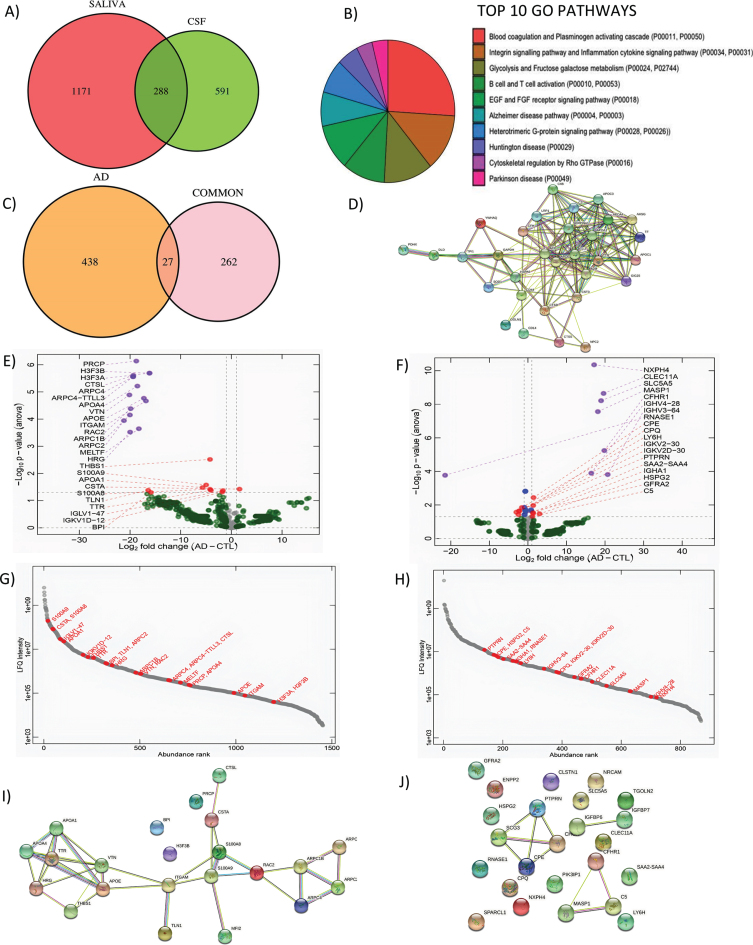
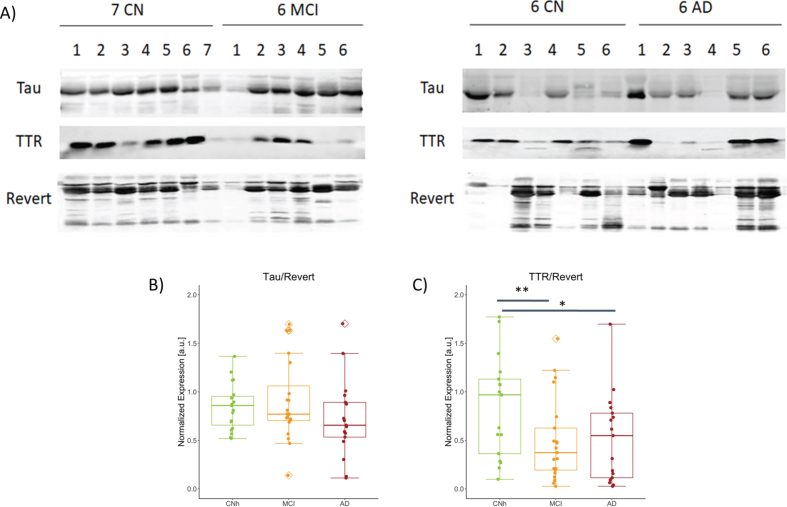
57 participants were recruited for the study and were categorized into Cognitively normal (CNh) ( = 19), mild cognitive impaired (MCI) ( = 21), and Alzheimer's disease (AD) ( = 17). On a subset of subjects, 3 CNh and 3 mild AD, shot-gun filter aided sample preparation (FASP) proteomics and liquid chromatography mass spectroscopy (LC-MS/MS) was employed in saliva and cerebrospinal fluid (CSF) to identify neural-derived proteins. The protein level of salivary Transthyretin (TTR) was validated using western blot analysis across groups.
We found that 19.8% of the proteins in saliva are shared with CSF. When we compared the saliva and CSF proteome, 24 hits were decreased with only one protein expressed more. Among the differentially expressed proteins, TTR with reported function in amyloid misfolding, shows a significant drop in AD samples, confirmed by western blot showing a 0.5-fold reduction in MCI and AD compared to CNh.
A reduction in salivary TTR appears with the onset of cognitive symptoms. More in general, the proteomic profiling of saliva shows a plethora of biomarkers worth pursuing as non-invasive hallmarks of dementia in the preclinical stage.
阿尔茨海默病(AD)至今仍是一种无法治愈的疾病,存在较长的无症状期。在外周生物流体中进行早期诊断已成为识别高危人群以及开发治疗和预防方法的关键。
我们应用蛋白质组学发现来鉴定AD的唾液诊断生物标志物,这些标志物适用于衰老过程中的自我采样和纵向生物监测。
招募了57名参与者进行研究,并将其分为认知正常(CNh)组(n = 19)、轻度认知障碍(MCI)组(n = 21)和阿尔茨海默病(AD)组(n = 17)。在一部分受试者中,对3名CNh和3名轻度AD患者,采用鸟枪法滤膜辅助样品制备(FASP)蛋白质组学和液相色谱质谱联用(LC-MS/MS)技术分析唾液和脑脊液(CSF),以鉴定神经源性蛋白。通过蛋白质免疫印迹分析验证各组唾液中转甲状腺素(TTR)的蛋白水平。
我们发现唾液中19.8%的蛋白质与脑脊液共有。比较唾液和脑脊液蛋白质组时,有24种蛋白质表达减少,只有一种蛋白质表达增加。在差异表达的蛋白质中,TTR在淀粉样蛋白错误折叠中具有已知功能,在AD样本中显著下降,蛋白质免疫印迹证实,与CNh相比,MCI和AD组中TTR减少了0.5倍。
随着认知症状的出现,唾液TTR水平降低。总体而言,唾液蛋白质组分析显示出大量有价值的生物标志物,有望作为临床前阶段痴呆的非侵入性标志。