Department of Computerized Tomography, Jincheng People's Hospital (Jincheng Hospital Affiliated to Changzhi Medical College), No. 456 Wenchang East Street, Jincheng, 048026 Shanxi, China.
Comput Math Methods Med. 2022 Mar 22;2022:2864170. doi: 10.1155/2022/2864170. eCollection 2022.
To explore the value of artificial intelligence (AI) film reading system based on deep learning in the diagnosis of non-small-cell lung cancer (NSCLC) and the significance of curative effect monitoring.
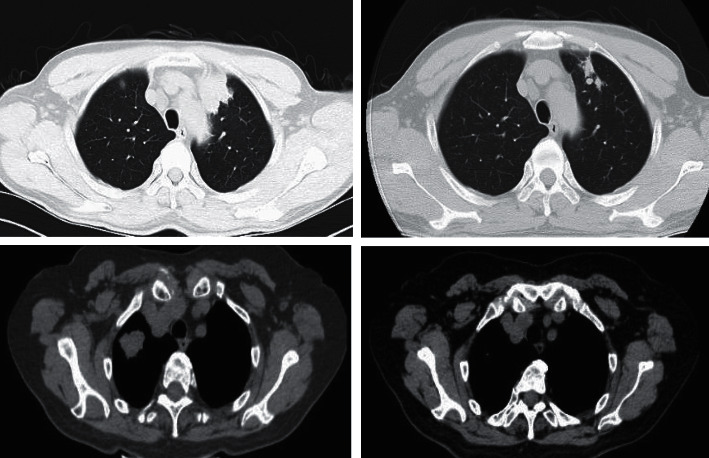
We retrospectively selected 104 suspected NSCLC cases from the self-built chest CT pulmonary nodule database in our hospital, and all of them were confirmed by pathological examination. The lung CT images of the selected patients were introduced into the AI reading system of pulmonary nodules, and the recording software automatically identified the nodules, and the results were compared with the results of the original image report. The nodules detected by the AI software and film readers were evaluated by two chest experts and recorded their size and characteristics. Comparison of calculation sensitivity, false positive rate evaluation of the NSCLC software, and physician's efficiency of nodule detection whether there was a significant difference between the two groups.
The sensitivity, specificity, accuracy, positive predictive rate, and false positive rate of NSCLC diagnosed by radiologists were 72.94% (62/85), 92.06% (58/63), 81.08% (62+58/148), 92.53% (62/67), and 7.93% (5/63), respectively. The sensitivity, specificity, accuracy, positive prediction rate, and false positive rate of AI film reading system in the diagnosis of NSCLC were 94.12% (80/85), 77.77% (49/63), 87.161% (80 + 49/148), 85.11% (80/94), and 22.22% (14/63), respectively. Compared with radiologists, the sensitivity and false positive rate of artificial intelligence film reading system in the diagnosis of NSCLC were higher ( < 0.05). The sensitivity, specificity, accuracy, positive prediction rate, and negative prediction rate of artificial intelligence film reading system in evaluating the efficacy of patients with NSCLC were 87.50% (63/72), 69.23% (9/13), 84.70% (63 + 9)/85, 94.02% (63/67), and 50% (9/18), respectively.
The AI film reading system based on deep learning has higher sensitivity for the diagnosis of NSCLC than radiologists and can be used as an auxiliary detection tool for doctors to screen for NSCLC, but its false positive rate is relatively high. Attention should be paid to identification. Meanwhile, the AI film reading system based on deep learning also has a certain guiding significance for the diagnosis and treatment monitoring of NSCLC.
探讨基于深度学习的人工智能(AI)阅片系统在非小细胞肺癌(NSCLC)诊断中的价值及其在疗效监测中的意义。
回顾性选取我院自建胸部 CT 肺结节数据库中 104 例疑似 NSCLC 患者,所有患者均经病理检查证实。将所选患者的肺部 CT 图像输入医院自主研发的 AI 肺结节阅片系统,记录软件自动识别结节,并将结果与原始图像报告进行对比。由两名胸部专家对 AI 软件和读片医生检测到的结节进行评估,并记录其大小和特征。比较两组 NSCLC 软件的计算灵敏度、假阳性率评价以及医生检测结节的效率是否有显著差异。
放射科医生诊断 NSCLC 的灵敏度、特异度、准确度、阳性预测率和假阳性率分别为 72.94%(62/85)、92.06%(58/63)、81.08%(62+58/148)、92.53%(62/67)和 7.93%(5/63)。人工智能阅片系统诊断 NSCLC 的灵敏度、特异度、准确度、阳性预测率和假阳性率分别为 94.12%(80/85)、77.77%(49/63)、87.161%(80+49/148)、85.11%(80/94)和 22.22%(14/63)。与放射科医生相比,人工智能阅片系统在诊断 NSCLC 方面的灵敏度和假阳性率更高(<0.05)。人工智能阅片系统评价 NSCLC 患者疗效的灵敏度、特异度、准确度、阳性预测率和阴性预测率分别为 87.50%(63/72)、69.23%(9/13)、84.70%(63+9)/85、94.02%(63/67)和 50%(9/18)。
基于深度学习的人工智能阅片系统对 NSCLC 的诊断灵敏度高于放射科医生,可以作为医生筛查 NSCLC 的辅助检测工具,但假阳性率较高,应注意鉴别。同时,基于深度学习的人工智能阅片系统对 NSCLC 的诊断和治疗监测也具有一定的指导意义。