Finci Iris, Siebenbaum Remo, Richtzenhain Josephin, Edwards Angelika, Rau Carina, Ehrhardt Jonas, Koiou Linda, Joggerst Brigitte, Brockmann Stefan O
Baden-Württemberg State Health Office, Stuttgart, Germany.
European Programme for Intervention Epidemiology Training (EPIET), ECDC, Stockholm, Sweden.
Euro Surveill. 2022 Mar;27(13). doi: 10.2807/1560-7917.ES.2022.27.13.2100354.
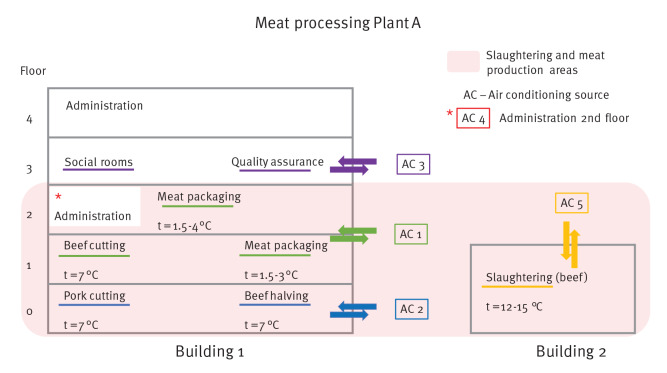
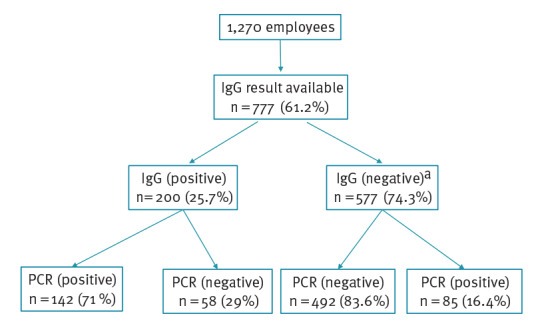
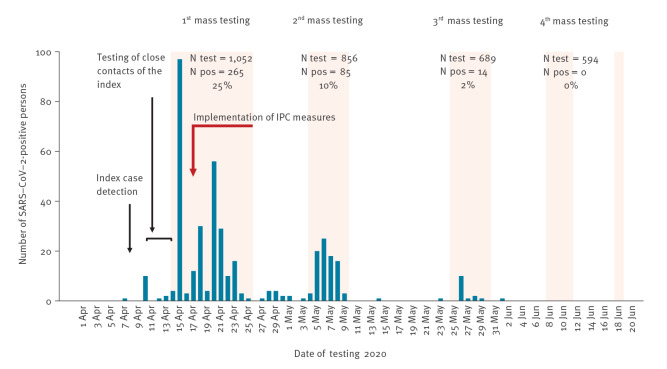
Meat processing plants have been prominent hotspots for coronavirus disease (COVID-19) outbreaks around the world. We describe infection prevention measures and risk factors for infection spread at a meat processing plant in Germany with a COVID-19 outbreak from April to June 2020. We analysed a cohort of all employees and defined cases as employees with either a PCR or ELISA positive result. Of 1,270 employees, 453 (36%) had evidence of SARS-CoV-2 infection. The highest attack rates were observed in meat processing and slaughtering areas. Multivariable analysis revealed that being a subcontracted employee (adjusted risk ratio (aRR)): 1.43, 95% CI: 1.06-1.96), working in the meat cutting area (aRR: 2.44, 95% CI: 1.45-4.48), working in the slaughtering area (aRR: 2.35, 95% CI: 1.32-4.45) and being a veterinary inspector (aRR: 4.77, 95% CI: 1.16-23.68) increased infection risk. Sharing accommodation or transportation were not identified as risk factors for infection. Our results suggest that workplace was the main risk factor for infection spread. These results highlight the importance of implementing preventive measures targeting meat processing plants. Face masks, distancing, staggering breaks, increased hygiene and regular testing for SARS-CoV2 helped limit this outbreak, as the plant remained open throughout the outbreak.
肉类加工厂一直是全球冠状病毒病(COVID-19)疫情的突出热点地区。我们描述了德国一家肉类加工厂在2020年4月至6月期间发生COVID-19疫情时的感染预防措施和感染传播的风险因素。我们分析了所有员工组成的队列,并将病例定义为PCR或ELISA检测结果呈阳性的员工。在1270名员工中,453人(36%)有感染严重急性呼吸综合征冠状病毒2(SARS-CoV-2)的证据。在肉类加工和屠宰区域观察到最高的感染率。多变量分析显示,作为分包员工(调整风险比(aRR):1.43,95%置信区间(CI):1.06 - 1.96)、在肉类切割区域工作(aRR:2.44,95% CI:1.45 - 4.48)、在屠宰区域工作(aRR:2.35,95% CI:1.32 - 4.45)以及作为兽医检查员(aRR:4.77,95% CI:1.16 - 23.68)会增加感染风险。共用住宿或交通工具未被确定为感染风险因素。我们的结果表明,工作场所是感染传播的主要风险因素。这些结果凸显了针对肉类加工厂实施预防措施的重要性。口罩、保持社交距离、错开休息时间、加强卫生以及定期进行SARS-CoV-2检测有助于控制此次疫情,因为该工厂在疫情期间一直保持运营。