Baylor Scott and White Research Institute, Dallas, TX, USA.
Department of Surgery, Health Systems Science, Baylor University Medical Center, Dallas, TX, USA.
Qual Life Res. 2022 Sep;31(9):2819-2836. doi: 10.1007/s11136-022-03125-y. Epub 2022 Apr 2.
Psychometric validity/reliability of 10-item and 2-item abbreviations of the Connor-Davidson Resilience Scale (CD-RISC-10; CD-RISC-2) was investigated via item response theory and classic approaches.
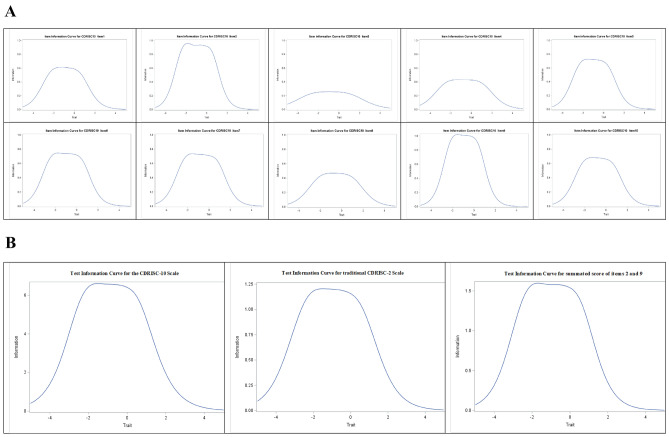
We sampled 5023 adult American participants in a June/July 2020 survey on the COVID-19 pandemic's psychological effects. Our questionnaire incorporated the CD-RISC-10 with other validated measures. CD-RISC-10 items were ranked on item-to-scale correlations, loadings on a one-factor confirmatory factor analysis model, and item slope/threshold parameters plus information curves from a unidimensional graded response model. Concurrent validity of the highest ranked item pair was evaluated vis-à-vis the CD-RISC-10 and CD-RISC-2. Internal consistency, based on average variance extracted (AVE) and multiple reliability coefficients, was also compared. Convergent/divergent validity was tested by correlating anxiety, depression, fear of COVID-19, anxiety sensitivity, coping, and personality measures with both scales and the highest ranked item pair. Binary agreement/classification indexes assessed inter-rater reliability.
Items 2 and 9 from CD-RISC-10 ranked the highest. Reliability coefficients were > 0.93, > 0.72, and > 0.82 for the CD-RISC-10, CD-RISC-2, vs summation of items 2 and 9. AVEs were 0.66, 0.67, and 0.77. CD-RISC abbreviations and the summation of items 2 and 9 correlated negatively with anxiety (> - 0.43), depression (> - 0.42), and fear of COVID-19 (> - 0.34); positively with emotional stability (> 0.53) and conscientiousness (> 0.40). Compared to the CD-RISC-2, summative scores of items 2 and 9 more efficiently classified/discriminated high resilience on the CD-RISC-10.
We confirmed construct validity/reliability of copyrighted CD-RISC abbreviations. The CD-RISC-10's items 2 and 9 were psychometrically more salient than the CD-RISC-2.
通过项目反应理论和经典方法研究 10 项和 2 项康纳-戴维森韧性量表(CD-RISC-10;CD-RISC-2)缩写的心理测量效度/信度。
我们在 2020 年 6 月/7 月对 COVID-19 大流行心理影响的调查中抽取了 5023 名美国成年参与者。我们的问卷纳入了 CD-RISC-10 及其他经验证的测量方法。根据项目与量表的相关性、单因素验证性因素分析模型的载荷、单维渐进反应模型的项目斜率/阈值参数和信息曲线对 CD-RISC-10 项目进行排序。通过与 CD-RISC-10 和 CD-RISC-2 相比,评估最高排名项目对的同时效度。还基于平均方差提取(AVE)和多个可靠性系数比较了内部一致性。通过与焦虑、抑郁、对 COVID-19 的恐惧、焦虑敏感性、应对和人格测量相关,来测试两种量表和最高排名项目对的收敛/发散效度。二分类一致性/分类指数评估了评分者间的可靠性。
CD-RISC-10 的第 2 项和第 9 项排名最高。CD-RISC-10、CD-RISC-2 和第 2 项和第 9 项的总和的可靠性系数分别为 >0.93、>0.72 和>0.82。AVE 分别为 0.66、0.67 和 0.77。CD-RISC 缩写和第 2 项和第 9 项的总和与焦虑(>-0.43)、抑郁(>-0.42)和对 COVID-19 的恐惧(>-0.34)呈负相关;与情绪稳定性(>0.53)和尽责性(>0.40)呈正相关。与 CD-RISC-2 相比,第 2 项和第 9 项的总和评分更有效地对 CD-RISC-10 进行了高韧性分类/区分。
我们证实了受版权保护的 CD-RISC 缩写的结构效度/信度。CD-RISC-10 的第 2 项和第 9 项项目在心理测量学上比 CD-RISC-2 更突出。