Department of Nursing Midwifery and Health, 373117Northumbria University, Newcastle-Upon-Tyne, UK.
Al Buraimi University College, Al Buraimi, Oman.
Biol Res Nurs. 2022 Apr;24(2):172-185. doi: 10.1177/10998004211055866. Epub 2021 Dec 4.
The new coronavirus disease (COVID-19) carries a high risk of infection and has spread rapidly around the world. However, there are limited data about the clinical symptoms globally. The purpose of this systematic review and meta-analysis is to identify the prevalence of the clinical symptoms of patient with COVID-19.
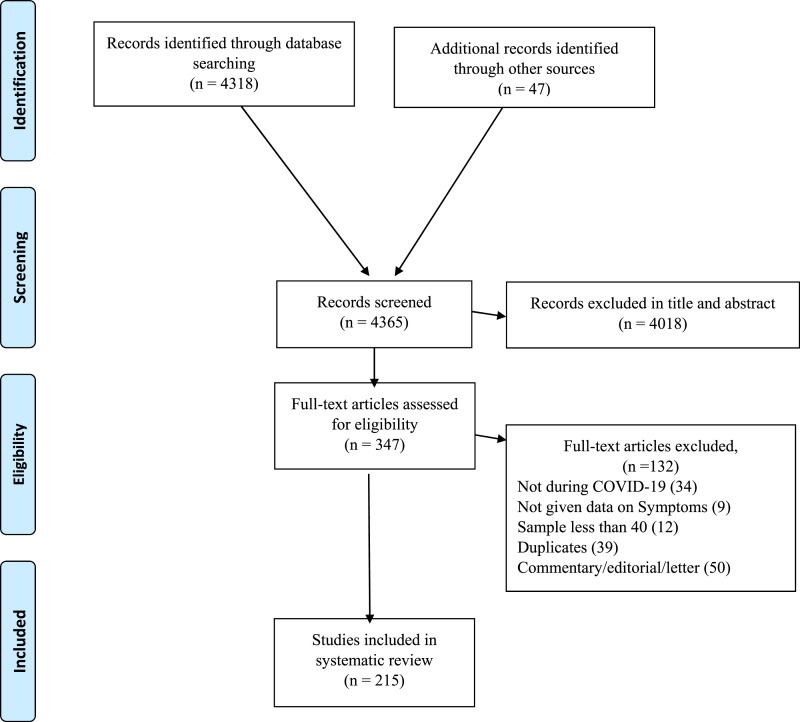
A systematic review and meta-analysis were carried out. The following databases were searched: PubMed, CINAHL, MEDLINE, EMBASE, PsycINFO, medRxiv, and Google Scholar, from December 1st, 2019 to January 1st, 2021. Prevalence rates were pooled with meta-analysis using a random-effects model. Heterogeneity was tested using I-squared (I) statistics.
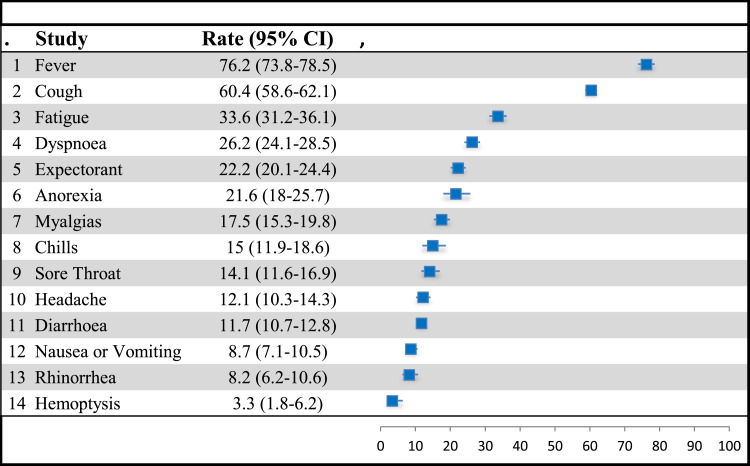
A total of 215 studies, involving 132,647 COVID-19 patients, met the inclusion criteria. The pooled prevalence of the four most common symptoms were fever 76.2% ( = 214; 95% CI 73.9-78.5); coughing 60.4% ( = 215; 95% CI 58.6-62.1); fatigue 33.6% ( = 175; 95% CI 31.2-36.1); and dyspnea 26.2% ( = 195; 95% CI 24.1-28.5). Other symptoms from highest to lowest in terms of prevalence include expectorant (22.2%), anorexia (21.6%), myalgias (17.5%), chills (15%), sore throat (14.1%), headache (11.7%), nausea or vomiting (8.7%), rhinorrhea (8.2%), and hemoptysis (3.3%). In subgroup analyses by continent, it was found that four symptoms have a slight prevalence variation-fever, coughing, fatigue, and diarrhea.
This meta-analysis found the most prevalent symptoms of COVID-19 patients were fever, coughing, fatigue, and dyspnea. This knowledge might be beneficial for the effective treatment and control of the COVID-19 outbreak. Additional studies are required to distinguish between symptoms during and after, in patients with COVID-19.
新型冠状病毒病(COVID-19)具有很高的感染风险,在全球范围内迅速传播。然而,全球关于其临床症状的数据有限。本系统回顾和荟萃分析的目的是确定 COVID-19 患者的临床症状发生率。
进行了系统回顾和荟萃分析。检索了以下数据库:PubMed、CINAHL、MEDLINE、EMBASE、PsycINFO、medRxiv 和 Google Scholar,时间范围为 2019 年 12 月 1 日至 2021 年 1 月 1 日。使用随机效应模型对荟萃分析进行了汇总。使用 I 平方(I)统计量测试异质性。
共有 215 项研究,涉及 132647 名 COVID-19 患者,符合纳入标准。最常见的四种症状的汇总患病率为发热 76.2%( = 214;95% CI 73.9-78.5);咳嗽 60.4%( = 215;95% CI 58.6-62.1);乏力 33.6%( = 175;95% CI 31.2-36.1);呼吸困难 26.2%( = 195;95% CI 24.1-28.5)。根据流行率从高到低排列的其他症状依次为咳痰(22.2%)、厌食(21.6%)、肌痛(17.5%)、寒战(15%)、咽痛(14.1%)、头痛(11.7%)、恶心或呕吐(8.7%)、流涕(8.2%)和咯血(3.3%)。按大洲进行亚组分析发现,发热、咳嗽、乏力和腹泻四种症状的患病率略有差异。
本荟萃分析发现 COVID-19 患者最常见的症状是发热、咳嗽、乏力和呼吸困难。这些知识可能有助于有效治疗和控制 COVID-19 疫情。需要进一步研究以区分 COVID-19 患者在感染期间和感染后出现的症状。