Department of Community Medicine, Faculty of Health Science, National Research Center in Complementary and Alternative Medicine, NAFKAM, UiT The Arctic University of Norway, 9037, Tromsø, Norway.
Science and Health Library, UiT, The Arctic University of Norway, Hansine Hansens veg 19, 9019, Tromsø, Norway.
BMC Complement Med Ther. 2022 Apr 2;22(1):97. doi: 10.1186/s12906-022-03537-w.
Dealing with the symptom burden of cancer diagnosis and treatment has led parents to seek different self-management strategies including Alternative and Complementary Medicine (CAM). The aim of this study was to perform a systematic review and meta-analysis about the use and effect of CAM modalities to treat adverse effects of conventional cancer treatment among children and young adults.
Six scientific research databases were used to identify randomized controlled trials (RCTs) from 1990 to September 2020. Included studies investigated the use of CAM to treat cancer treatment related adverse effects in children and young adults compared to controls.
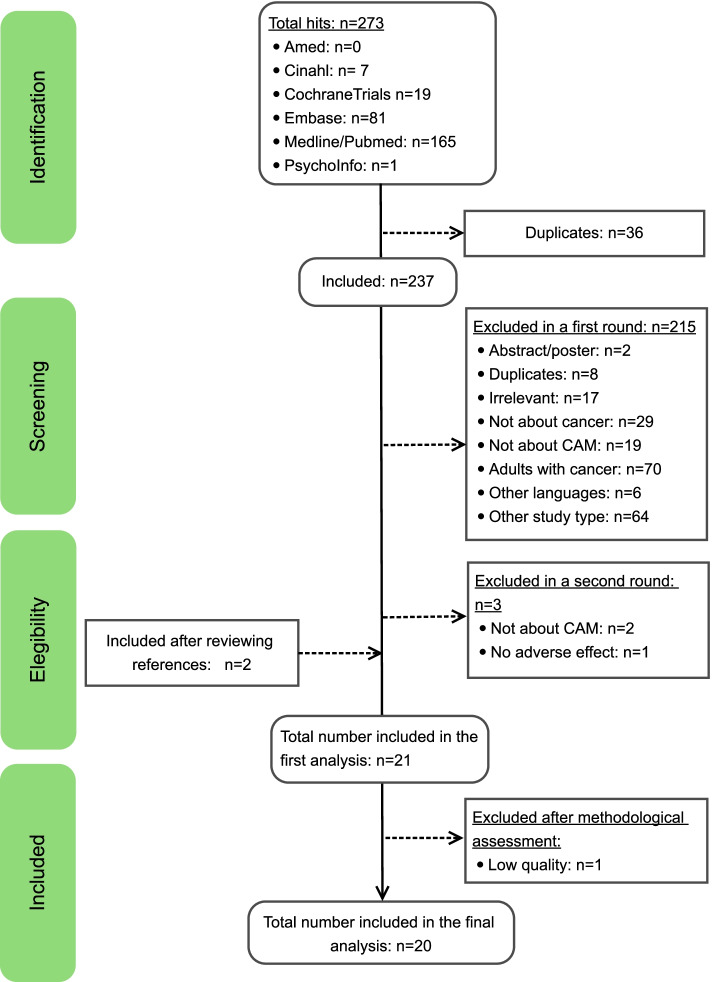
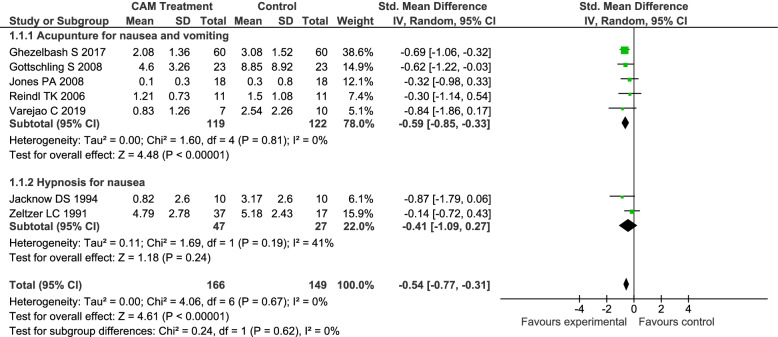
Twenty RCTs comprising 1,069 participants were included in this review. The included studies investigated acupuncture, mind-body therapies, supplements, and vitamins for chemotherapy-induced nausea and vomiting (CINV), oral mucositis, and anxiety among children and young adults who underwent conventional cancer treatment. Seven studies (315 participants) were included in the meta-analysis. The overall effect of CAM (including acupuncture and hypnosis only) on chemotherapy-induced nausea and/or vomiting and controls was statistically significant with a standard mean difference of -0.54, 95% CI [-0.77, -0.31] I = 0% (p < 0.00001). There was a significant difference between acupuncture and controls (n = 5) for intensity and/or episodes of CINV with an SMD -0.59, 95% CI [-0.85, -0.33] (p < 0.00001). No significant difference was found between hypnosis and controls (n = 2) for severity or episodes of CINV with an SMD -0.41, 95% CI [-1.09, 0.27] I = 41% (p = 0.19).
Current evidence from this meta-analysis of randomized controlled trials shows that CAM, including acupuncture and hypnosis only, is effective in reducing chemotherapy-induced nausea and vomiting in children and young adults. More rigorous trials and long-term effects should be investigated if acupuncture and hypnosis are to be recommended for clinical use.
应对癌症诊断和治疗带来的症状负担,促使家长寻求不同的自我管理策略,包括替代和补充医学(CAM)。本研究旨在对从 1990 年至 2020 年 9 月的随机对照试验(RCT)进行系统评价和荟萃分析,以了解 CAM 模式在治疗儿童和青少年常规癌症治疗相关不良反应方面的使用情况和效果。
使用六个科学研究数据库从 1990 年至 2020 年 9 月,以识别针对接受常规癌症治疗的儿童和青少年的癌症治疗相关不良反应,使用 CAM 治疗的 RCT。
本综述纳入了 20 项 RCT,共 1069 名参与者。纳入的研究调查了针对接受常规癌症治疗的儿童和青少年,CAM 用于治疗化疗引起的恶心和呕吐(CINV)、口腔粘膜炎和焦虑的使用情况。有 7 项研究(315 名参与者)纳入荟萃分析。CAM(包括针刺和催眠)对 CINV 和对照组的总体效果具有统计学意义,标准均数差为-0.54,95%置信区间[-0.77,-0.31]I=0%(p<0.00001)。针刺与对照组(n=5)在 CINV 的强度和/或发作方面存在显著差异,SMD-0.59,95%置信区间[-0.85,-0.33](p<0.00001)。催眠与对照组(n=2)在 CINV 的严重程度或发作方面无显著差异,SMD-0.41,95%置信区间[-1.09,0.27]I=41%(p=0.19)。
本荟萃分析中对随机对照试验的当前证据表明,CAM,包括针刺和催眠,可有效减少儿童和青少年的 CINV。如果要推荐针刺和催眠用于临床应用,应进行更严格的试验和长期效果研究。