Department of Nephrology, Princess Alexandra Hospital, Brisbane, Australia.
Department of Renal Medicine, Tan Tock Seng Hospital, Singapore.
Kidney360. 2020 Sep 14;1(11):1259-1269. doi: 10.34067/KID.0002732020. eCollection 2020 Nov 25.
An autologous arteriovenous fistula (AVF) is the preferred hemodialysis vascular access, but successful creation is hampered by high rates of AVF failure. This study aimed to evaluate patient and surgical factors associated with AVF failure to improve vascular access selection and outcomes.
This is a analysis of all participants of FAVOURED, a multicenter, double-blind, multinational, randomized, placebo-controlled trial evaluating the effect of fish oil and/or aspirin in preventing AVF failure in patients receiving hemodialysis. The primary outcome of AVF failure was a composite of fistula thrombosis and/or abandonment and/or cannulation failure at 12 months post-AVF creation, and secondary outcomes included individual outcome components. Patient data (demographics, comorbidities, medications, and laboratory data) and surgical factors (surgical expertise, anesthetic, intraoperative heparin use) were examined using multivariable logistic regression analyses to evaluate associations with AVF failure.
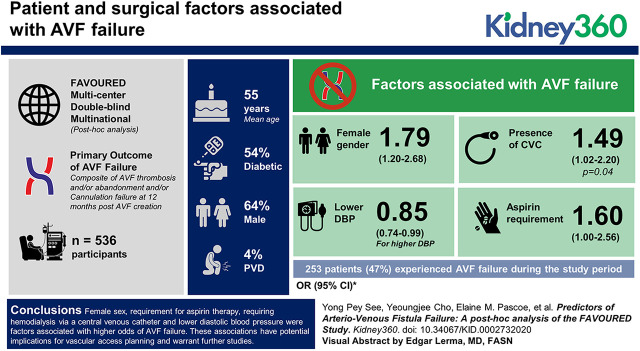
Of 536 participants, 253 patients (47%) experienced AVF failure during the study period. The mean age was 55±14.4 years, 64% were male, 45% were diabetic, and 4% had peripheral vascular disease. Factors associated with AVF failure included female sex (odds ratio [OR], 1.79; 95% confidence interval [CI], 1.20 to 2.68), lower diastolic BP (OR for higher DBP, 0.85; 95% CI, 0.74 to 0.99), presence of central venous catheter (OR, 1.49; 95% CI, 1.02 to 2.20; =0.04), and aspirin requirement (OR, 1.60; 95% CI, 1.00 to 2.56).
Female sex, requirement for aspirin therapy, requiring hemodialysis a central venous catheter, and lower diastolic BP were factors associated with higher odds of AVF failure. These associations have potential implications for vascular access planning and warrant further studies.
自体动静脉瘘(AVF)是首选的血液透析血管通路,但由于 AVF 失败率高,成功建立受到阻碍。本研究旨在评估与 AVF 失败相关的患者和手术因素,以改善血管通路选择和结果。
这是一项对 FAVOURED 所有参与者的 分析,FAVOURED 是一项多中心、双盲、多国、随机、安慰剂对照试验,评估鱼油和/或阿司匹林对预防接受血液透析的患者 AVF 失败的影响。AVF 失败的主要结局是在 AVF 建立后 12 个月时瘘管血栓形成和/或放弃和/或穿刺失败的复合结局,次要结局包括单个结局成分。使用多变量逻辑回归分析检查患者数据(人口统计学、合并症、药物和实验室数据)和手术因素(手术专业知识、麻醉、术中肝素使用),以评估与 AVF 失败的关联。
在 536 名参与者中,253 名患者(47%)在研究期间发生 AVF 失败。平均年龄为 55±14.4 岁,64%为男性,45%为糖尿病患者,4%患有外周血管疾病。与 AVF 失败相关的因素包括女性(比值比[OR],1.79;95%置信区间[CI],1.20 至 2.68)、较低的舒张压(较高 DBP 的 OR,0.85;95%CI,0.74 至 0.99)、存在中心静脉导管(OR,1.49;95%CI,1.02 至 2.20;=0.04)和需要阿司匹林治疗(OR,1.60;95%CI,1.00 至 2.56)。
女性、需要阿司匹林治疗、需要中心静脉导管和较低的舒张压是与 AVF 失败几率增加相关的因素。这些关联对血管通路规划具有潜在影响,需要进一步研究。