Collier Claudia A, Mendiondo Christian, Raghavan Shreya
Department of Biomedical Engineering, Texas A&M University, Emerging Technologies Building, 3120 TAMU, College Station, TX, 77843, USA.
Department of Nanomedicine, Houston Methodist Research Institute, Houston, TX, USA.
J Biol Eng. 2022 Apr 4;16(1):9. doi: 10.1186/s13036-022-00289-6.
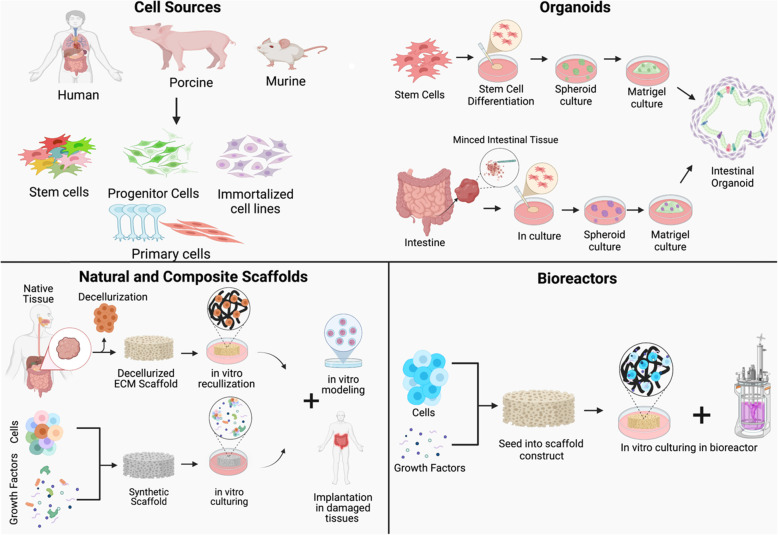
The gastrointestinal (GI) tract is imperative for multiple functions including digestion, nutrient absorption, and timely waste disposal. The central feature of the gut is peristalsis, intestinal motility, which facilitates all of its functions. Disruptions in GI motility lead to sub-optimal GI function, resulting in a lower quality of life in many functional GI disorders. Over the last two decades, tissue engineering research directed towards the intestine has progressed rapidly due to advances in cell and stem-cell biology, integrative physiology, bioengineering and biomaterials. Newer biomedical tools (including optical tools, machine learning, and nuanced regenerative engineering approaches) have expanded our understanding of the complex cellular communication within the GI tract that lead to its orchestrated physiological function. Bioengineering therefore can be utilized towards several translational aspects: (i) regenerative medicine to remedy/restore GI physiological function; (ii) in vitro model building to mimic the complex physiology for drug and pharmacology testing; (iii) tool development to continue to unravel multi-cell communication networks to integrate cell and organ-level physiology. Despite the significant strides made historically in GI tissue engineering, fundamental challenges remain including the quest for identifying autologous human cell sources, enhanced scaffolding biomaterials to increase biocompatibility while matching viscoelastic properties of the underlying tissue, and overall biomanufacturing. This review provides historic perspectives for how bioengineering has advanced over time, highlights newer advances in bioengineering strategies, and provides a realistic perspective on the path to translation.
胃肠道对于多种功能至关重要,包括消化、营养吸收和及时的废物处理。肠道的核心特征是蠕动,即肠道运动,它促进了肠道的所有功能。胃肠道运动的紊乱会导致胃肠道功能欠佳,从而在许多功能性胃肠道疾病中导致生活质量下降。在过去二十年中,由于细胞和干细胞生物学、整合生理学、生物工程和生物材料方面的进展,针对肠道的组织工程研究进展迅速。更新的生物医学工具(包括光学工具、机器学习和细微的再生工程方法)扩展了我们对胃肠道内导致其协调生理功能的复杂细胞通讯的理解。因此,生物工程可用于几个转化方面:(i)再生医学以补救/恢复胃肠道生理功能;(ii)体外模型构建以模拟复杂生理学用于药物和药理学测试;(iii)工具开发以继续揭示多细胞通讯网络以整合细胞和器官水平的生理学。尽管胃肠道组织工程在历史上取得了重大进展,但仍存在一些基本挑战,包括寻找自体人类细胞来源、增强支架生物材料以提高生物相容性同时匹配底层组织的粘弹性特性以及整体生物制造。本综述提供了生物工程如何随时间发展的历史观点,强调了生物工程策略的新进展,并对转化途径提供了现实的观点。