Centre d'Estudis Demogràfics, Edifici E-2, Carrer de Ca n'Altayò, Campus UAB, 08193, Bellaterra, Spain.
Int J Health Econ Manag. 2023 Jun;23(2):173-187. doi: 10.1007/s10754-022-09328-7. Epub 2022 Apr 6.
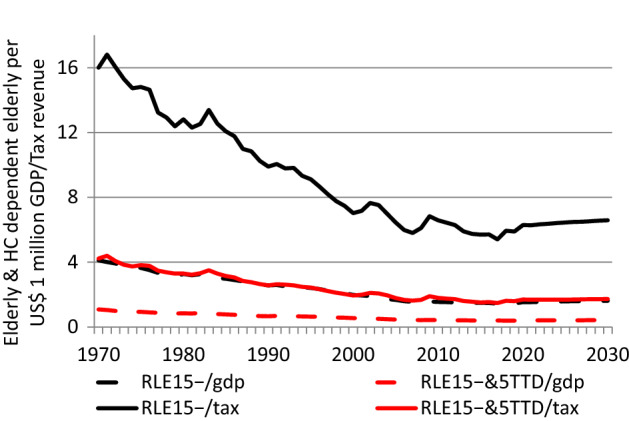
Public concern about the rising number of older dependent citizens is still based mainly on standard population aging indicators. This includes the old-age dependency ratio (OADR), which divides the state pension age population by the working age population. However, the OADR counts neither the dependent elderly nor those who provide for them. This paper builds on previous research to propose several alternative indicators, including the health care (HC) need-adjusted real elderly dependency ratio and the HC need-adjusted dependent population-to-tax rate. These indicators consider improvements in old-age survival and time to death in order to better define the health care needs of the dependent old-age population and to better approximate their financial burden. We define the old-age population dependent on health care as those above the age at which remaining life expectancy is 15 years or less and are expected to die within 5 years. We use data from the US to illustrate differences between the proposed new and standard measures. Results show that, as a share of the total population, the old-age population dependent on health care has virtually not changed since 1950. Moreover, increases in GDP and state tax revenue have outstripped population aging almost continuously since 1970, irrespective of the indicator used, and they are expected to continue to do so during the coming decade. The demand for health care services is therefore not being fueled by population aging but instead by other factors such as progress in medical knowledge and technology, costs of hospitalization, and the increasing use of long-term care facilities.
公众对老年人口不断增加的担忧主要仍基于标准的人口老龄化指标。这包括老年抚养比(OADR),即将领取养老金的人口除以劳动年龄人口。然而,OADR 既没有计入依赖老年人,也没有计入赡养他们的人。本文在前人研究的基础上提出了几个替代指标,包括医疗保健(HC)需求调整后的实际老年抚养比和医疗保健需求调整后的依赖人口与税率。这些指标考虑了老年人口生存和死亡时间的改善,以便更好地定义依赖老年人口的医疗保健需求,并更好地估计他们的财政负担。我们将依赖医疗保健的老年人口定义为预期寿命剩余 15 年或以下且预计在 5 年内死亡的人。我们使用美国的数据来说明拟议的新指标和标准指标之间的差异。结果表明,自 1950 年以来,作为总人口的一部分,依赖医疗保健的老年人口实际上没有变化。此外,自 1970 年以来,无论使用哪种指标,国内生产总值和州税收的增长几乎都在持续超过人口老龄化,预计在未来十年仍将如此。医疗保健服务的需求不是由人口老龄化推动的,而是由其他因素推动的,如医学知识和技术的进步、住院费用以及长期护理设施的使用增加。