Kitsaras George, Pretty Iain A, Allan Julia
Dental Health Unit, The University of Manchester, Manchester, UK.
Institute of Applied Health Sciences, University of Aberdeen, Aberdeen, UK.
Pilot Feasibility Stud. 2022 Apr 6;8(1):79. doi: 10.1186/s40814-022-01039-7.
Bedtime routines are highly recurrent family activities with implications for children's wellbeing, development and health.
The objective of this study is to co-develop and test in a feasibility, proof-of-concept study a bedtime routines intervention using text messages aimed at first-time parents with young children.
Fifty first-time parents with children aged 1-3 years were recruited for this study. Parents received a text message-based intervention for 7-consecutive nights which provided support and information on achieving optimal bedtime routines. Parents completed pre- and post-intervention questionnaires focusing on children's sleep, bedtime routines and parental mood disturbance. Feedback was provided at the end of the study.
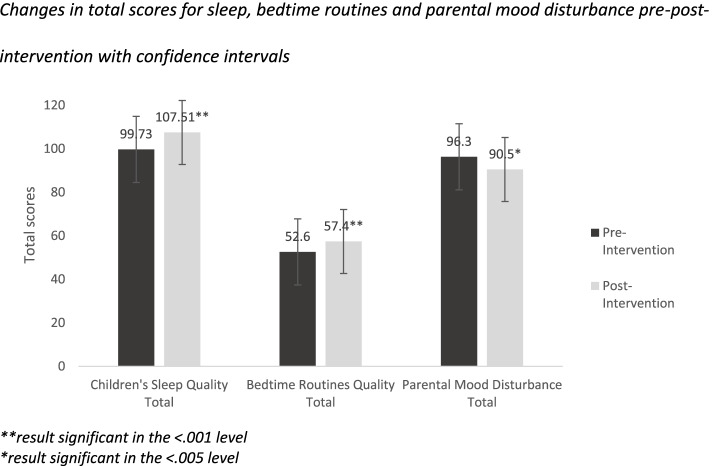
Recruitment target and high retention with 98%, or 49 out of 50 participants completing the study were achieved. Pre- and post-intervention, there were improvements in total children's sleep with children sleeping longer and having less disrupted sleep overall (MD = - 7.77 (SD = 17.91), t(48) = - 3.03, p = .004, CI (- 12.91, - 2.63) and in overall quality of bedtime routines (MD = - 5.00, SD = 7.01, t(48) = - 4.98, p < .001, CI (- 7.01, - 2.98). Parental mood disturbance decreased pre- to post-intervention (MD = 5.87, SD = 15.43, t(48) = 2.66), p = .010, CI (1.44, 10.30). Parents provided positive feedback about the intervention and valued the support that was provided to them.
Bedtime routines were successfully altered with short-term benefits for children's sleep and parental mood. Future research will need to utilize a more robust, longitudinal approach for a definite exploration of sustained changes in bedtime routines and their long-term implications for children and parents.
睡前常规是高度重复的家庭活动,对儿童的幸福、发展和健康具有重要意义。
本研究的目的是在一项可行性、概念验证研究中共同开发并测试一种针对有幼儿的初为人父母者的、使用短信的睡前常规干预措施。
招募了50名有1至3岁孩子的初为人父母者参与本研究。父母连续7个晚上收到基于短信的干预,该干预提供了关于实现最佳睡前常规的支持和信息。父母完成了干预前和干预后的问卷,重点关注孩子的睡眠、睡前常规和父母的情绪困扰。在研究结束时提供了反馈。
达到了招募目标,且保留率很高,50名参与者中有98%(即49名)完成了研究。干预前和干预后,儿童的总体睡眠情况有所改善,孩子睡眠时间更长,总体睡眠中断更少(MD = -7.77(标准差 = 17.91),t(48) = -3.03,p = 0.004,置信区间(-12.91,-2.63)),睡前常规的总体质量也有所改善(MD = -5.00,标准差 = 7.01,t(48) = -4.98,p < 0.001,置信区间(-7.01,-2.98))。干预前到干预后,父母的情绪困扰有所减少(MD = 5.87,标准差 = 15.43,t(48) = 2.66),p = 0.010,置信区间(1.44,10.30)。父母对干预给予了积极反馈,并重视所提供的支持。
睡前常规成功改变,对儿童睡眠和父母情绪有短期益处。未来的研究需要采用更有力的纵向研究方法,以明确探索睡前常规的持续变化及其对儿童和父母的长期影响。