
亚洲青少年主动上学出行率的描述性流行病学:来自 31 个国家的横断面研究。
Descriptive epidemiology of the prevalence of adolescent active travel to school in Asia: a cross-sectional study from 31 countries.
机构信息
MRC Epidemiology Unit, University of Cambridge, Cambridge, UK
Department of Epidemiology, Faculty of Public Health, Universitas Indonesia, Depok, Indonesia.
出版信息
BMJ Open. 2022 Apr 7;12(4):e057082. doi: 10.1136/bmjopen-2021-057082.
OBJECTIVE
This study aimed to examine the prevalence of adolescent active travel to school (ATS) across 31 countries and territories in Asia, overall and by age group, sex and body mass index (BMI) category.
DESIGN
Cross-sectional study.
SETTING
31 Asian countries.
PARTICIPANTS
152 368 adolescents aged 13-17 years with complete data for age, sex, measured weight and height and active travel to school from 31 Asian countries from the Global School-based student Health Survey (GSHS).
PRIMARY OUTCOME
Self-reported active travel to school categorised into passive (0 days) and active (1-7 days).
RESULTS
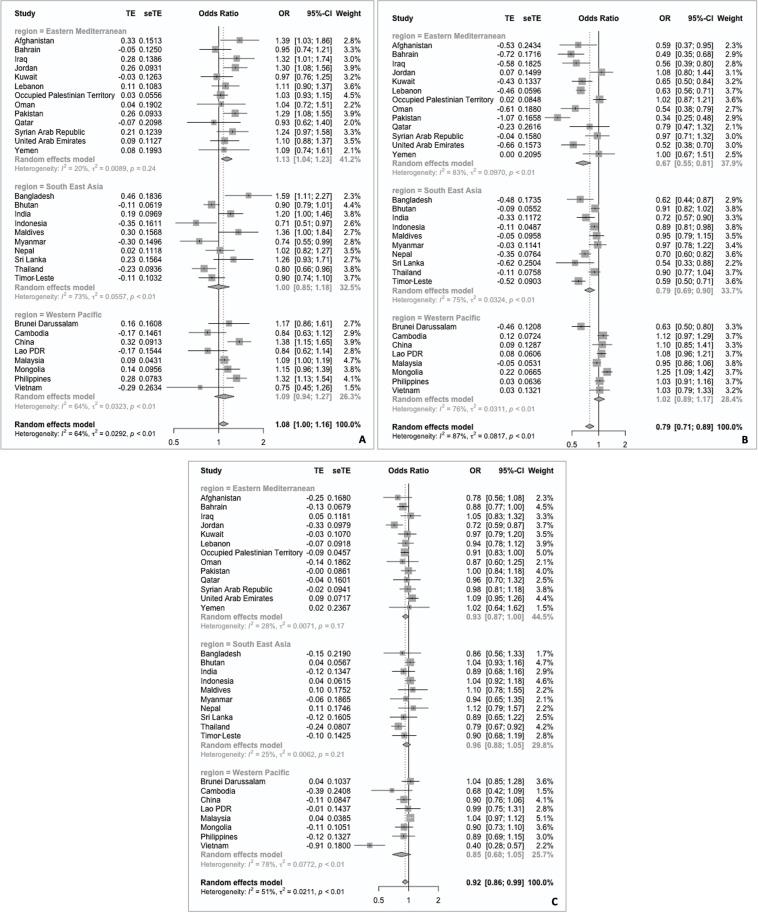
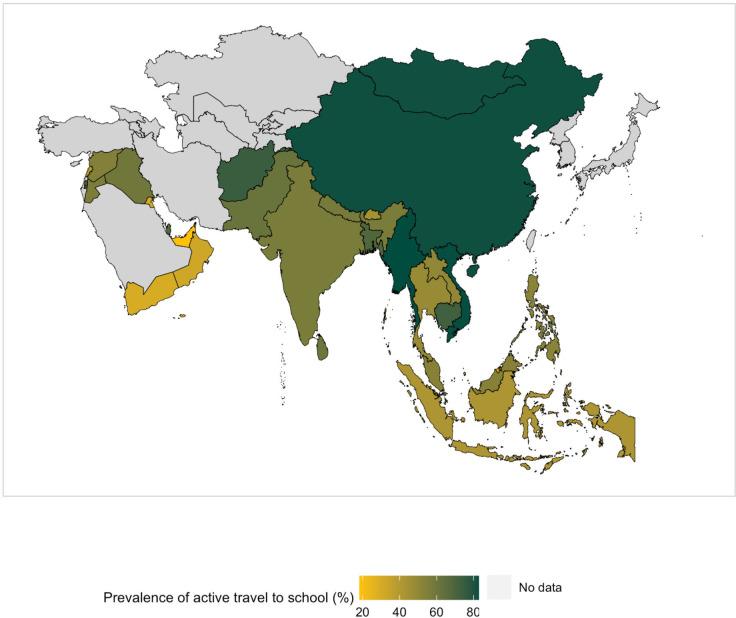
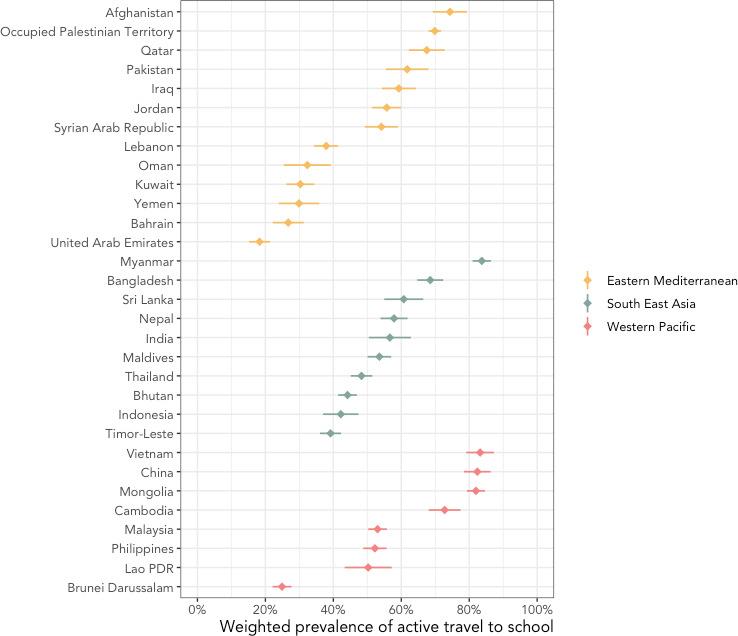
Overall prevalence of adolescent ATS in Asia based on random-effect meta-analysis was 55%, ranging from 18% (UAE) to 84% (Myanmar). There was limited subregional variation: 47% in the Eastern Mediterranean (EM), 56% in the South East Asia and 64% in the Western Pacific. Summarised by random-effect meta-analysis, being an older adolescent aged 16 years and older (vs younger age below 16 years: OR: 1.08; 95% CI: 1.00 to 1.16) was positively associated with ATS. This association was strongest in EM countries. Summarised by random-effect meta-analysis, females (vs males: OR: 0.79; 95% CI: 0.71 to 0.89) and adolescents with overweight/obesity (vs underweight and normal BMI: OR: 0.92; 95% CI: 0.86 to 0.99) were less likely to use ATS. Association with sex was strongest in EM countries. Heterogeneity was considerable in all meta-analyses.
CONCLUSION
The prevalence of adolescent ATS in Asia varies substantially. Overall, older and male adolescents, and adolescents with underweight and normal BMI category are more likely to actively travel to school. However, the main contributor to differences in ATS between and within regions remain unknown. Although there is substantial scope for improving ATS rates in Asia, any policy actions and interventions should be cognisant of local built, social and natural environmental contexts that may influence active travel behaviour.
目的
本研究旨在调查亚洲 31 个国家和地区青少年主动上学出行(ATS)的流行率,总体上按年龄组、性别和体重指数(BMI)类别进行分析。
设计
横断面研究。
设置
31 个亚洲国家。
参与者
来自全球学校学生健康调查(GSHS)的 31 个亚洲国家 13-17 岁的 152368 名青少年,他们有完整的年龄、性别、测量体重和身高以及主动上学出行的数据。
主要结果
根据随机效应荟萃分析,亚洲青少年 ATS 的总体流行率为 55%,范围从 18%(阿联酋)到 84%(缅甸)。亚区差异有限:东地中海(EM)区为 47%,东南亚为 56%,西太平洋为 64%。随机效应荟萃分析总结,年龄较大的青少年(16 岁及以上)(与年龄较小的青少年(16 岁以下)相比:OR:1.08;95%CI:1.00 至 1.16)与 ATS 呈正相关。这种关联在 EM 国家最为强烈。随机效应荟萃分析总结,女性(与男性相比:OR:0.79;95%CI:0.71 至 0.89)和超重/肥胖的青少年(与体重不足和正常 BMI 相比:OR:0.92;95%CI:0.86 至 0.99)不太可能使用 ATS。在 EM 国家,这种关联与性别最为强烈。所有荟萃分析的异质性都相当大。
结论
亚洲青少年 ATS 的流行率差异很大。总体而言,年龄较大的青少年和男性青少年,以及体重不足和正常 BMI 类别的青少年更有可能主动上学出行。然而,导致 ATS 在地区之间和地区内差异的主要因素仍不清楚。尽管亚洲有很大的空间来提高 ATS 率,但任何政策行动和干预措施都应考虑可能影响主动出行行为的当地建筑、社会和自然环境背景。
 Zotero 插件