Department of Archaeogenetics, Max Planck Institute for Evolutionary Anthropology, Leipzig, Germany.
Department of Archaeogenetics, Max Planck Institute for the Science of Human History, Jena, Germany.
Nat Ecol Evol. 2022 Jun;6(6):813-822. doi: 10.1038/s41559-022-01701-6. Epub 2022 Apr 7.
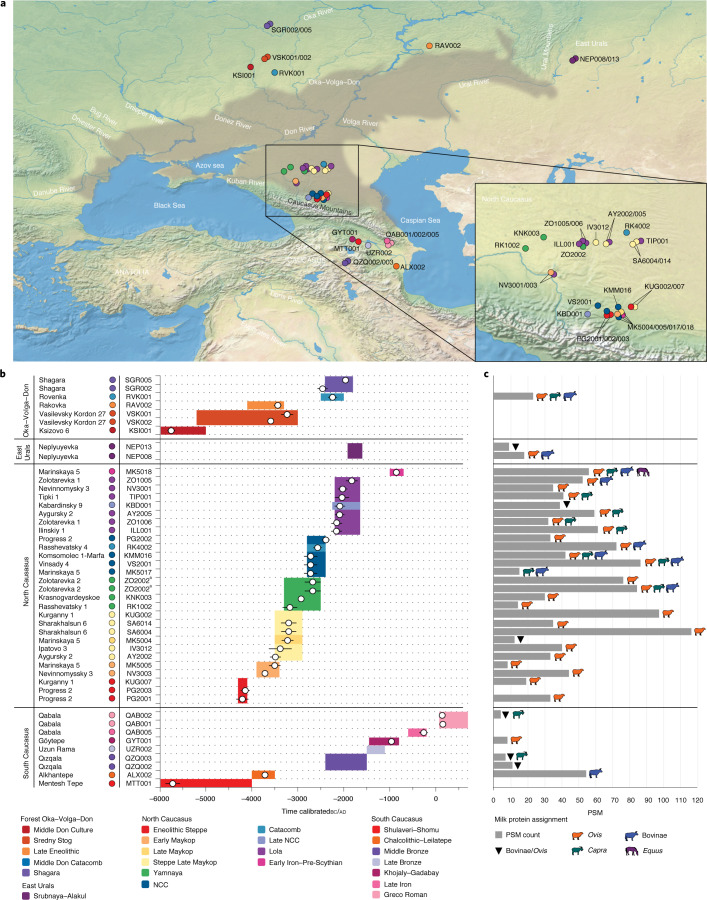
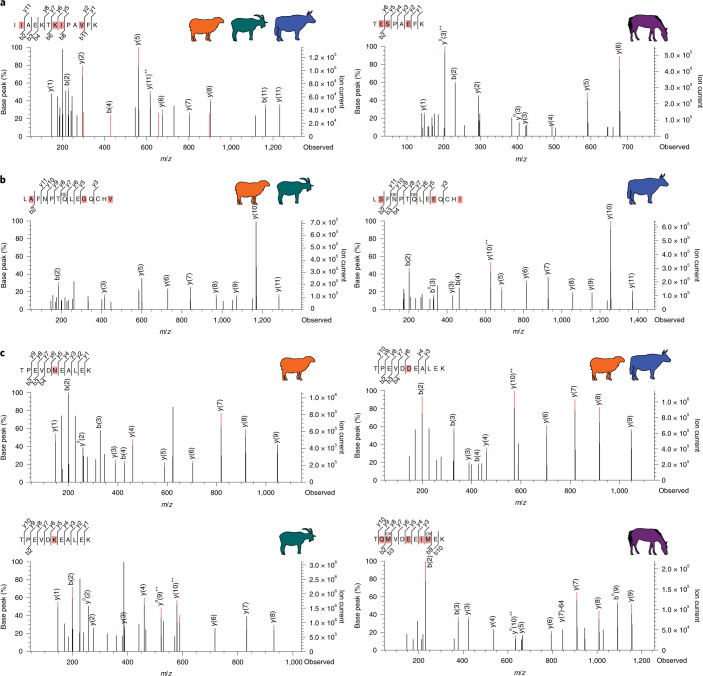
Archaeological and archaeogenetic evidence points to the Pontic-Caspian steppe zone between the Caucasus and the Black Sea as the crucible from which the earliest steppe pastoralist societies arose and spread, ultimately influencing populations from Europe to Inner Asia. However, little is known about their economic foundations and the factors that may have contributed to their extensive mobility. Here, we investigate dietary proteins within the dental calculus proteomes of 45 individuals spanning the Neolithic to Greco-Roman periods in the Pontic-Caspian Steppe and neighbouring South Caucasus, Oka-Volga-Don and East Urals regions. We find that sheep dairying accompanies the earliest forms of Eneolithic pastoralism in the North Caucasus. During the fourth millennium BC, Maykop and early Yamnaya populations also focused dairying exclusively on sheep while reserving cattle for traction and other purposes. We observe a breakdown in livestock specialization and an economic diversification of dairy herds coinciding with aridification during the subsequent late Yamnaya and North Caucasus Culture phases, followed by severe climate deterioration during the Catacomb and Lola periods. The need for additional pastures to support these herds may have driven the heightened mobility of the Middle and Late Bronze Age periods. Following a hiatus of more than 500 years, the North Caucasian steppe was repopulated by Early Iron Age societies with a broad mobile dairy economy, including a new focus on horse milking.
考古学和考古遗传学证据表明,高加索山脉和黑海之间的里海草原地区是最早的草原牧民社会出现和传播的熔炉,最终影响了从欧洲到中亚内陆的人口。然而,人们对他们的经济基础以及可能促成其广泛流动性的因素知之甚少。在这里,我们研究了 Pontic-Caspian 草原和邻近的南高加索、奥卡-伏尔加-顿河和乌拉尔东部地区的新石器时代到希腊罗马时期的 45 个人的牙垢蛋白质组中的膳食蛋白质。我们发现,绵羊奶制品伴随着北高加索地区新石器时代早期的畜牧业。在公元前四千年,梅尔克普和早期雅姆纳亚人群也专门将绵羊奶制品用于绵羊,而将牛用于牵引和其他用途。我们观察到牲畜专业化的瓦解和乳制品畜群的经济多样化,这与随后的晚雅姆纳亚和北高加索文化阶段的干旱化相吻合,随后是卡特科姆和洛拉时期的严重气候恶化。为了支持这些畜群,可能需要更多的牧场,这可能导致了中晚青铜时代的高度流动性。在中断了 500 多年之后,早期铁器时代的社会重新在北高加索草原地区定居,拥有广泛的流动奶制品经济,包括新的马奶生产。