WHO Collaborating Centre for Maternal and Child Health, Institute for Maternal and Child Health - IRCCS "Burlo Garofolo", Trieste, Italy
WHO Collaborating Centre for Maternal and Child Health, Institute for Maternal and Child Health - IRCCS "Burlo Garofolo", Trieste, Italy.
BMJ Open. 2022 Apr 8;12(4):e056753. doi: 10.1136/bmjopen-2021-056753.
Develop and validate a WHO Standards-based online questionnaire to measure the quality of maternal and newborn care (QMNC) around the time of childbirth from the health workers' perspective.
Mixed-methods study.
Six countries of the WHO European Region.
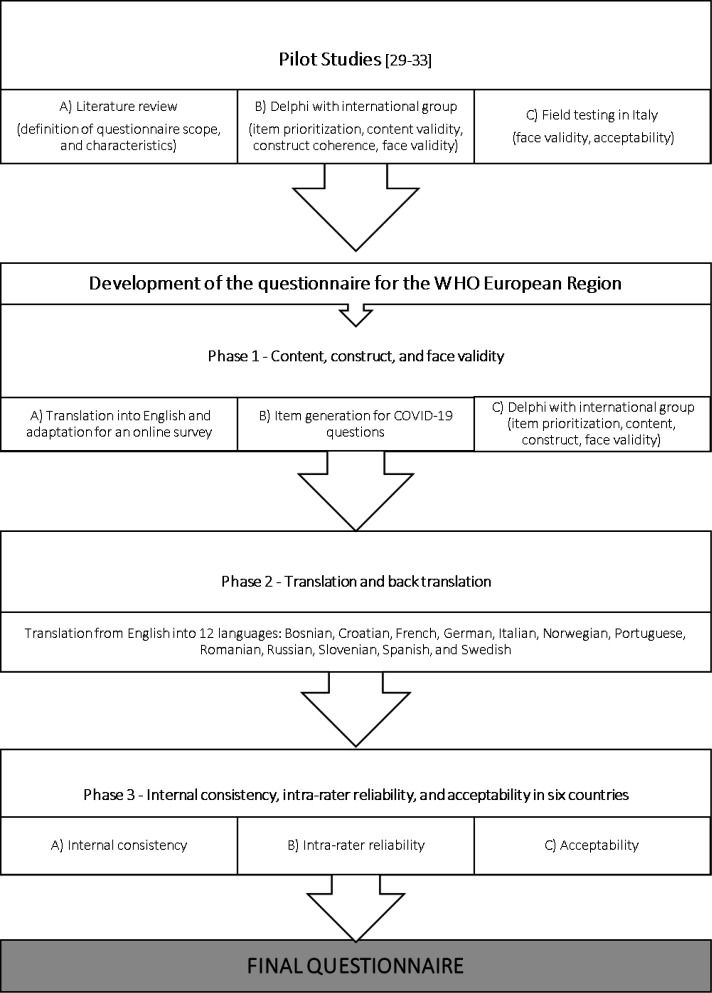
The questionnaire is based on lessons learnt in previous studies, and was developed in three sequential phases: (1) WHO Quality Measures were prioritised and content, construct and face validity were assessed through a Delphi involving a multidisciplinary board of experts from 11 countries of the WHO European Region; (2) translation/back translation of the English version was conducted following The Professional Society for Health Economics and Outcomes Research guidelines; (3) internal consistency, intrarater reliability and acceptability were assessed among 600 health workers in six countries.
The questionnaire included 40 items based on WHO Standards Quality Measures, equally divided into four domains: provision of care, experience of care, availability of human and physical resources, organisational changes due to COVID-19; and its organised in six sections. It was translated/back translated in 12 languages: Bosnian, Croatian, French, German, Italian, Norwegian, Portuguese, Romanian, Russian, Slovenian, Spanish and Swedish. The Cronbach's alpha values were ≥0.70 for each questionnaire section where questions were hypothesised to be interrelated, indicating good internal consistence. Cohen K or Gwet's AC1 values were ≥0.60, suggesting good intrarater reliability, except for one question. Acceptability was good with only 1.70% of health workers requesting minimal changes in question wording.
Findings suggest that the questionnaire has good content, construct, face validity, internal consistency, intrarater reliability and acceptability in six countries of the WHO European Region. Future studies may further explore the questionnaire's use in other countries, and how to translate evidence generated by this tool into policies to improve the QMNC.
NCT04847336.
开发并验证一个基于世卫组织标准的在线问卷,从卫生工作者的角度衡量分娩前后的孕产妇和新生儿护理质量(QMNC)。
混合方法研究。
世卫组织欧洲区域的六个国家。
该问卷基于以往研究的经验教训,并分三个连续阶段开发:(1)优先考虑世卫组织质量措施,并通过涉及来自世卫组织欧洲区域 11 个国家的多学科专家的德尔菲法评估内容、结构和表面有效性;(2)按照健康经济学和结果研究专业学会的指南进行英文版本的翻译/回译;(3)在六个国家的 600 名卫生工作者中评估内部一致性、内部可靠性和可接受性。
问卷包括 40 个项目,基于世卫组织标准质量措施,平均分为四个领域:提供护理、护理体验、人力资源和物质资源的可用性、因 COVID-19 而发生的组织变革;并分为六个部分。它被翻译成/回译为 12 种语言:波斯尼亚语、克罗地亚语、法语、德语、意大利语、挪威语、葡萄牙语、罗马尼亚语、俄语、斯洛文尼亚语、西班牙语和瑞典语。每个问卷部分的克朗巴赫的α值均≥0.70,其中假设问题相互关联,表明内部一致性良好。除了一个问题外,科恩 K 或格韦特的 AC1 值均≥0.60,表明内部可靠性良好。可接受性良好,只有 1.70%的卫生工作者要求对问题措辞进行最小更改。
研究结果表明,该问卷在世卫组织欧洲区域的六个国家具有良好的内容、结构、表面有效性、内部一致性、内部可靠性和可接受性。未来的研究可能会进一步探索该问卷在其他国家的使用情况,以及如何将该工具生成的证据转化为改善 QMNC 的政策。
NCT04847336。