
通过开源人工智能实现快速、自动化的神经组织形态计量学分析。
Rapid, automated nerve histomorphometry through open-source artificial intelligence.
机构信息
SickKids Research Institute, Neuroscience and Mental Health Program, Hospital for Sick Children (SickKids), Toronto, ON, Canada.
NeuroPoly Laboratory, Institute of Biomedical Engineering, Polytechnique Montreal, Montreal, QC, Canada.
出版信息
Sci Rep. 2022 Apr 8;12(1):5975. doi: 10.1038/s41598-022-10066-6.
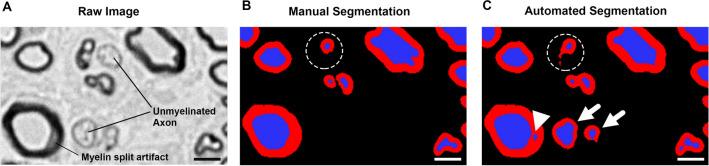
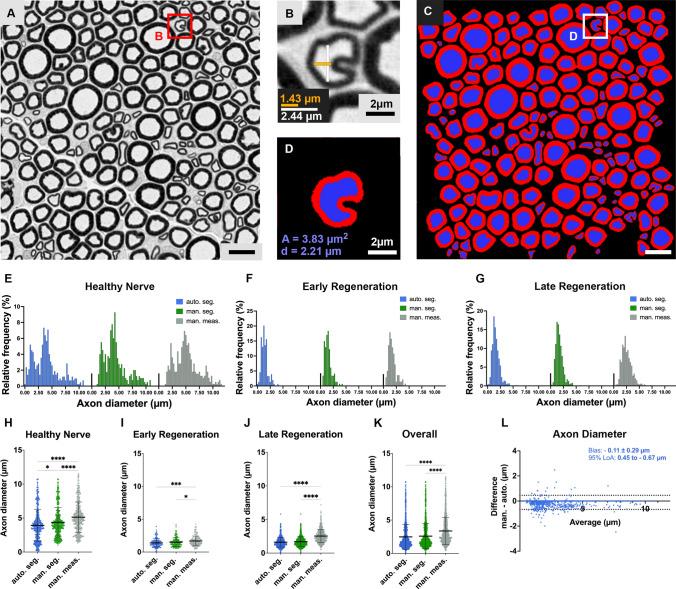
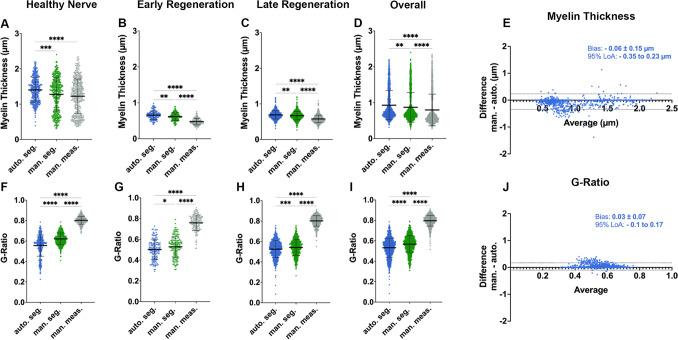
We aimed to develop and validate a deep learning model for automated segmentation and histomorphometry of myelinated peripheral nerve fibers from light microscopic images. A convolutional neural network integrated in the AxonDeepSeg framework was trained for automated axon/myelin segmentation using a dataset of light-microscopic cross-sectional images of osmium tetroxide-stained rat nerves including various axonal regeneration stages. In a second dataset, accuracy of automated segmentation was determined against manual axon/myelin labels. Automated morphometry results, including axon diameter, myelin sheath thickness and g-ratio were compared against manual straight-line measurements and morphometrics extracted from manual labels with AxonDeepSeg as a reference standard. The neural network achieved high pixel-wise accuracy for nerve fiber segmentations with a mean (± standard deviation) ground truth overlap of 0.93 (± 0.03) for axons and 0.99 (± 0.01) for myelin sheaths, respectively. Nerve fibers were identified with a sensitivity of 0.99 and a precision of 0.97. For each nerve fiber, the myelin thickness, axon diameter, g-ratio, solidity, eccentricity, orientation, and individual x -and y-coordinates were determined automatically. Compared to manual morphometry, automated histomorphometry showed superior agreement with the reference standard while reducing the analysis time to below 2.5% of the time needed for manual morphometry. This open-source convolutional neural network provides rapid and accurate morphometry of entire peripheral nerve cross-sections. Given its easy applicability, it could contribute to significant time savings in biomedical research while extracting unprecedented amounts of objective morphologic information from large image datasets.
我们旨在开发和验证一种深度学习模型,以实现从光镜图像自动分割和组织形态计量学分析有髓周围神经纤维。使用包括各种轴突再生阶段的锇四氧化染色大鼠神经的光镜横截面图像数据集,通过集成在 AxonDeepSeg 框架中的卷积神经网络,对该网络进行了自动轴突/髓鞘分割的训练。在第二个数据集上,根据手动轴突/髓鞘标签确定了自动分割的准确性。将自动形态计量学结果(包括轴突直径、髓鞘厚度和 g 比值)与手动直线测量值以及使用 AxonDeepSeg 作为参考标准从手动标签中提取的形态计量学进行了比较。该神经网络对神经纤维分割具有很高的像素级精度,轴突的平均(±标准偏差)真实重叠率为 0.93(±0.03),髓鞘分别为 0.99(±0.01)。神经纤维的灵敏度为 0.99,精度为 0.97。对于每条神经纤维,自动确定髓鞘厚度、轴突直径、g 比值、形态复杂度、偏心度、方向以及各个 x 和 y 坐标。与手动形态计量学相比,自动组织形态计量学与参考标准具有更好的一致性,同时将分析时间减少到手动形态计量学所需时间的 2.5%以下。这种开源卷积神经网络可快速、准确地对整个周围神经横断面进行形态计量学分析。鉴于其易于应用,它可以在从大型图像数据集中提取前所未有的大量客观形态学信息的同时,为生物医学研究节省大量时间。


 Zotero 插件