Murru Elisabetta, Manca Claudia, Carta Gianfranca, Banni Sebastiano
Department of Biomedical Sciences, University of Cagliari, Cagliari, Italy.
Front Nutr. 2022 Mar 23;9:861664. doi: 10.3389/fnut.2022.861664. eCollection 2022.
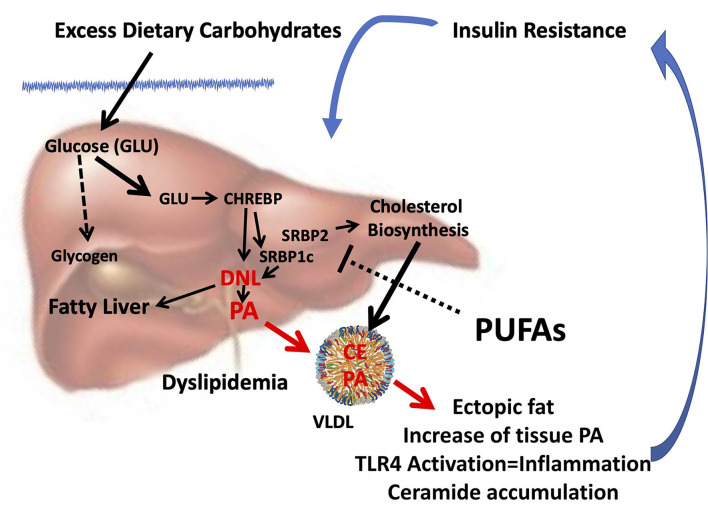
Palmitic acid (PA) is ubiquitously present in dietary fat guaranteeing an average intake of about 20 g/d. The relative high requirement and relative content in the human body, which accounts for 20-30% of total fatty acids (FAs), is justified by its relevant nutritional role. In particular physiological conditions, such as in the fetal stage or in the developing brain, the respectively inefficient placental and brain blood-barrier transfer of PA strongly induces its endogenous biosynthesis from glucose lipogenesis (DNL) to secure a tight homeostatic control of PA tissue concentration required to exert its multiple physiological activities. However, pathophysiological conditions (insulin resistance) are characterized by a sustained DNL in the liver and aimed at preventing the excess accumulation of glucose, which result in increased tissue content of PA and disrupted homeostatic control of its tissue concentration. This leads to an overaccumulation of tissue PA, which results in dyslipidemia, increased ectopic fat accumulation, and inflammatory tone toll-like receptor 4. Any change in dietary saturated FAs (SFAs) usually reflects a complementary change in polyunsaturated FA (PUFA) intake. Since PUFA particularly n-3 highly PUFA, suppress lipogenic gene expression, their reduction in intake rather than excess of dietary SFA may promote endogenous PA production DNL. Thereby, the increase in tissue PA and its deleterious consequences from dysregulated DNL can be mistakenly attributed to dietary intake of PA.
棕榈酸(PA)普遍存在于膳食脂肪中,保证了平均每日摄入量约为20克。它在人体中的相对高需求量和相对含量(占总脂肪酸(FAs)的20 - 30%),是由其相关的营养作用所决定的。在特定的生理条件下,如胎儿期或发育中的大脑,PA分别通过胎盘和血脑屏障的低效转运,强烈诱导其从葡萄糖通过脂肪生成(DNL)进行内源性生物合成,以确保对发挥其多种生理活性所需的PA组织浓度进行严格的稳态控制。然而,病理生理状况(胰岛素抵抗)的特征是肝脏中持续的DNL,旨在防止葡萄糖的过量积累,这导致PA的组织含量增加及其组织浓度的稳态控制被破坏。这会导致组织PA过度积累,进而导致血脂异常、异位脂肪堆积增加以及炎症反应(通过Toll样受体4)。膳食饱和脂肪酸(SFAs)的任何变化通常反映了多不饱和脂肪酸(PUFA)摄入量的互补性变化。由于PUFA,特别是n - 3高PUFA,会抑制脂肪生成基因的表达,它们摄入量的减少而非膳食SFA的过量,可能会促进内源性PA的产生(DNL)。因此,组织PA的增加及其因DNL失调而产生的有害后果可能会被错误地归因于膳食中PA的摄入。