• 文献检索
  • 文档翻译
  • 深度研究
  • 学术资讯
  • Suppr Zotero 插件Zotero 插件
  • 邀请有礼
  • 套餐&价格
  • 历史记录
应用&插件
Suppr Zotero 插件Zotero 插件浏览器插件Mac 客户端Windows 客户端微信小程序
定价
高级版会员购买积分包购买API积分包
服务
文献检索文档翻译深度研究API 文档MCP 服务
关于我们
关于 Suppr公司介绍联系我们用户协议隐私条款
关注我们

Suppr 超能文献

核心技术专利:CN118964589B侵权必究
粤ICP备2023148730 号-1Suppr @ 2026

文献检索

告别复杂PubMed语法,用中文像聊天一样搜索,搜遍4000万医学文献。AI智能推荐,让科研检索更轻松。

立即免费搜索

文件翻译

保留排版,准确专业,支持PDF/Word/PPT等文件格式,支持 12+语言互译。

免费翻译文档

深度研究

AI帮你快速写综述,25分钟生成高质量综述,智能提取关键信息,辅助科研写作。

立即免费体验

机器人辅助人工耳蜗植入手术的合适电极选择:手动电极插入不良事件的系统文献综述

Suitable Electrode Choice for Robotic-Assisted Cochlear Implant Surgery: A Systematic Literature Review of Manual Electrode Insertion Adverse Events.

作者信息

Van de Heyning Paul, Roland Peter, Lassaletta Luis, Agrawal Sumit, Atlas Marcus, Baumgartner Wolf-Dieter, Brown Kevin, Caversaccio Marco, Dazert Stefan, Gstoettner Wolfgang, Hagen Rudolf, Hagr Abdulrahman, Jablonski Greg Eigner, Kameswaran Mohan, Kuzovkov Vladislav, Leinung Martin, Li Yongxin, Loth Andreas, Magele Astrid, Mlynski Robert, Mueller Joachim, Parnes Lorne, Radeloff Andreas, Raine Chris, Rajan Gunesh, Schmutzhard Joachim, Skarzynski Henryk, Skarzynski Piotr H, Sprinzl Georg, Staecker Hinrich, Stöver Timo, Tavora-Viera Dayse, Topsakal Vedat, Usami Shin-Ichi, Van Rompaey Vincent, Weiss Nora M, Wimmer Wilhelm, Zernotti Mario, Gavilan Javier

机构信息

Department of Otorhinolaryngology Head and Neck Surgery, Antwerp University Hospital, University of Antwerp, Antwerp, Belgium.

Department of Translational Neurosciences, University of Antwerp, Antwerp, Belgium.

出版信息

Front Surg. 2022 Mar 24;9:823219. doi: 10.3389/fsurg.2022.823219. eCollection 2022.

DOI:10.3389/fsurg.2022.823219
PMID:35402479
原文链接:https://pmc.ncbi.nlm.nih.gov/articles/PMC8987358/
Abstract

BACKGROUND AND OBJECTIVE

The cochlear implant (CI) electrode insertion process is a key step in CI surgery. One of the aims of advances in robotic-assisted CI surgery (RACIS) is to realize better cochlear structure preservation and to precisely control insertion. The aim of this literature review is to gain insight into electrode selection for RACIS by acquiring a thorough knowledge of electrode insertion and related complications from classic CI surgery involving a manual electrode insertion process.

METHODS

A systematic electronic search of the literature was carried out using PubMed, Scopus, Cochrane, and Web of Science to find relevant literature on electrode tip fold over (ETFO), electrode scalar deviation (ESD), and electrode migration (EM) from both pre-shaped and straight electrode types.

RESULTS

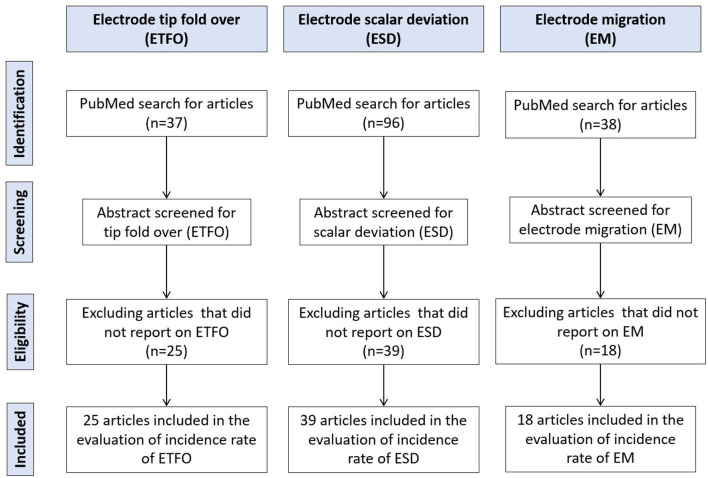
A total of 82 studies that include 8,603 ears implanted with a CI, i.e., pre-shaped (4,869) and straight electrodes (3,734), were evaluated. The rate of ETFO (25 studies, 2,335 ears), ESD (39 studies, 3,073 ears), and EM (18 studies, 3,195 ears) was determined. An incidence rate (±95% CI) of 5.38% (4.4-6.6%) of ETFO, 28.6% (26.6-30.6%) of ESD, and 0.53% (0.2-1.1%) of EM is associated with pre-shaped electrodes, whereas with straight electrodes it was 0.51% (0.1-1.3%), 11% (9.2-13.0%), and 3.2% (2.5-3.95%), respectively. The differences between the pre-shaped and straight electrode types are highly significant ( < 0.001). Laboratory experiments show evidence that robotic insertions of electrodes are less traumatic than manual insertions. The influence of round window (RW) vs. cochleostomy (Coch) was not assessed.

CONCLUSION

Considering the current electrode designs available and the reported incidence of insertion complications, the use of straight electrodes in RACIS and conventional CI surgery (and manual insertion) appears to be less traumatic to intracochlear structures compared with pre-shaped electrodes. However, EM of straight electrodes should be anticipated. RACIS has the potential to reduce these complications.

摘要

背景与目的

人工耳蜗(CI)电极植入过程是CI手术的关键步骤。机器人辅助CI手术(RACIS)进展的目标之一是更好地保留耳蜗结构并精确控制植入。本综述的目的是通过全面了解经典CI手术(涉及手动电极植入过程)中的电极植入及相关并发症,深入了解RACIS中电极的选择。

方法

使用PubMed、Scopus、Cochrane和Web of Science对文献进行系统的电子检索,以查找有关预成型电极和直电极的电极尖端折叠(ETFO)、电极鼓阶偏差(ESD)和电极移位(EM)的相关文献。

结果

共评估了82项研究,包括8603只植入CI的耳朵,即预成型电极(4869只)和直电极(3734只)。确定了ETFO(25项研究,2335只耳朵)、ESD(39项研究,3073只耳朵)和EM(18项研究,3195只耳朵)的发生率。预成型电极的ETFO发生率(±95%CI)为5.38%(4.4 - 6.6%),ESD为28.6%(26.6 - 30.6%),EM为0.53%(0.2 - 1.1%);而直电极的发生率分别为0.51%(0.1 - 1.3%)、11%(9.2 - 13.0%)和3.2%(2.5 - 3.95%)。预成型电极和直电极类型之间的差异非常显著(<0.001)。实验室实验表明,机器人植入电极比手动植入创伤更小。未评估圆窗(RW)与耳蜗造口术(Coch)的影响。

结论

考虑到现有的电极设计以及报道的植入并发症发生率,与预成型电极相比,在RACIS和传统CI手术(以及手动植入)中使用直电极对耳蜗内结构的创伤似乎更小。然而,应预见到直电极的EM。RACIS有可能减少这些并发症。
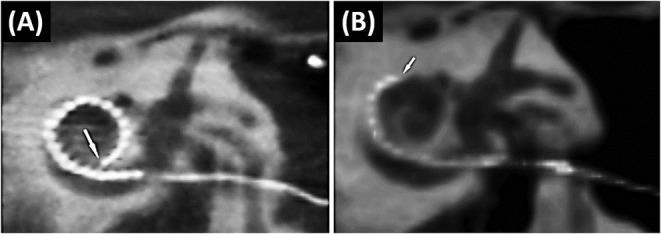
https://cdn.ncbi.nlm.nih.gov/pmc/blobs/e5b6/8987358/951467862d6b/fsurg-09-823219-g0006.jpg
https://cdn.ncbi.nlm.nih.gov/pmc/blobs/e5b6/8987358/cf73e5c79531/fsurg-09-823219-g0001.jpg
https://cdn.ncbi.nlm.nih.gov/pmc/blobs/e5b6/8987358/a5827b4529f1/fsurg-09-823219-g0002.jpg
https://cdn.ncbi.nlm.nih.gov/pmc/blobs/e5b6/8987358/ed803f4c8205/fsurg-09-823219-g0003.jpg
https://cdn.ncbi.nlm.nih.gov/pmc/blobs/e5b6/8987358/7aed8222c640/fsurg-09-823219-g0004.jpg
https://cdn.ncbi.nlm.nih.gov/pmc/blobs/e5b6/8987358/9217101cc690/fsurg-09-823219-g0005.jpg
https://cdn.ncbi.nlm.nih.gov/pmc/blobs/e5b6/8987358/951467862d6b/fsurg-09-823219-g0006.jpg
https://cdn.ncbi.nlm.nih.gov/pmc/blobs/e5b6/8987358/cf73e5c79531/fsurg-09-823219-g0001.jpg
https://cdn.ncbi.nlm.nih.gov/pmc/blobs/e5b6/8987358/a5827b4529f1/fsurg-09-823219-g0002.jpg
https://cdn.ncbi.nlm.nih.gov/pmc/blobs/e5b6/8987358/ed803f4c8205/fsurg-09-823219-g0003.jpg
https://cdn.ncbi.nlm.nih.gov/pmc/blobs/e5b6/8987358/7aed8222c640/fsurg-09-823219-g0004.jpg
https://cdn.ncbi.nlm.nih.gov/pmc/blobs/e5b6/8987358/9217101cc690/fsurg-09-823219-g0005.jpg
https://cdn.ncbi.nlm.nih.gov/pmc/blobs/e5b6/8987358/951467862d6b/fsurg-09-823219-g0006.jpg

相似文献

1
Suitable Electrode Choice for Robotic-Assisted Cochlear Implant Surgery: A Systematic Literature Review of Manual Electrode Insertion Adverse Events.机器人辅助人工耳蜗植入手术的合适电极选择:手动电极插入不良事件的系统文献综述
Front Surg. 2022 Mar 24;9:823219. doi: 10.3389/fsurg.2022.823219. eCollection 2022.
2
Does pediatric cochlear implant insertion technique affect intraoperative neural response telemetry thresholds?小儿人工耳蜗植入技术会影响术中神经反应遥测阈值吗?
Int J Pediatr Otorhinolaryngol. 2015 Sep;79(9):1404-7. doi: 10.1016/j.ijporl.2015.05.038. Epub 2015 Jul 2.
3
Review on cochlear implant electrode array tip fold-over and scalar deviation.人工耳蜗电极阵列尖端折叠和蜗管偏移的综述。
J Otol. 2019 Sep;14(3):94-100. doi: 10.1016/j.joto.2019.01.002. Epub 2019 Jan 9.
4
Cochlear Implant Electrode Tip Fold-Over: Our Experience With Long and Flexible Electrode.人工耳蜗电极尖端折叠:我们在长而灵活电极方面的经验。
Otol Neurotol. 2022 Jan 1;43(1):64-71. doi: 10.1097/MAO.0000000000003362.
5
Evaluation of Insertion Forces and Cochlea Trauma Following Robotics-Assisted Cochlear Implant Electrode Array Insertion.机器人辅助人工耳蜗电极植入术后植入力与耳蜗创伤评估。
Otol Neurotol. 2020 Jun;41(5):631-638. doi: 10.1097/MAO.0000000000002608.
6
Intraoperative Evaluation of Cochlear Implant Electrodes Using Mobile Cone-Beam Computed Tomography.术中应用移动锥形束 CT 评估人工耳蜗电极
Otol Neurotol. 2019 Feb;40(2):177-183. doi: 10.1097/MAO.0000000000002097.
7
True keyhole cochlear implant surgery.真正的锁孔耳蜗植入手术。
Am J Otolaryngol. 2023 Jul-Aug;44(4):103926. doi: 10.1016/j.amjoto.2023.103926. Epub 2023 May 22.
8
Does cochleostomy location influence electrode trajectory and intracochlear trauma?蜗窗造口位置会影响电极轨迹和耳蜗内创伤吗?
Laryngoscope. 2015 Apr;125(4):966-71. doi: 10.1002/lary.24986. Epub 2014 Oct 27.
9
Robot-assisted Cochlear Implant Electrode Array Insertion in Adults: A Comparative Study With Manual Insertion.机器人辅助成人耳蜗植入电极阵列插入:与手动插入的对比研究。
Otol Neurotol. 2021 Apr 1;42(4):e438-e444. doi: 10.1097/MAO.0000000000003002.
10
Potential insertion complications with cochlear implant electrodes.人工耳蜗电极植入的潜在并发症。
Cochlear Implants Int. 2020 Jul;21(4):206-219. doi: 10.1080/14670100.2020.1730066. Epub 2020 Feb 20.

引用本文的文献

1
The role of pressure and friction forces in automated insertion of cochlear implants.压力和摩擦力在人工耳蜗自动植入中的作用。
Front Neurol. 2024 Aug 6;15:1430694. doi: 10.3389/fneur.2024.1430694. eCollection 2024.
2
Cochlear implant electrode design for safe and effective treatment.用于安全有效治疗的人工耳蜗电极设计
Front Neurol. 2024 May 2;15:1348439. doi: 10.3389/fneur.2024.1348439. eCollection 2024.
3
Inverted clip technique for cochlear implant electrode array fixation: how I do it.倒夹技术在耳蜗植入电极阵列固定中的应用:我的操作方法。

本文引用的文献

1
First Study in Men Evaluating a Surgical Robotic Tool Providing Autonomous Inner Ear Access for Cochlear Implantation.首例评估用于人工耳蜗植入、可自主进入内耳的手术机器人工具的男性研究。
Front Neurol. 2022 Mar 21;13:804507. doi: 10.3389/fneur.2022.804507. eCollection 2022.
2
Robotics, automation, active electrode arrays, and new devices for cochlear implantation: A contemporary review.机器人技术、自动化、有源电极阵列和人工耳蜗植入的新设备:当代综述。
Hear Res. 2022 Feb;414:108425. doi: 10.1016/j.heares.2021.108425. Epub 2021 Dec 25.
3
Image-Based Planning of Minimally Traumatic Inner Ear Access for Robotic Cochlear Implantation.
Eur Arch Otorhinolaryngol. 2024 Feb;281(2):1057-1060. doi: 10.1007/s00405-023-08329-7. Epub 2023 Nov 25.
4
Otological Planning Software-OTOPLAN: A Narrative Literature Review.耳科规划软件-OTOPLAN:一篇叙述性文献综述。
Audiol Res. 2023 Oct 18;13(5):791-801. doi: 10.3390/audiolres13050070.
5
The growth of the mastoid volume in children with a cochlear implant.儿童人工耳蜗植入后头骨乳突体积的增长。
Sci Rep. 2023 Jul 6;13(1):10967. doi: 10.1038/s41598-023-37160-7.
6
Personalized Medicine in Otolaryngology: Special Topic Otology.耳鼻咽喉头颈外科学中的精准医疗:耳科学专题
J Pers Med. 2022 Nov 2;12(11):1820. doi: 10.3390/jpm12111820.
7
Systematic Literature Review of Hearing Preservation Rates in Cochlear Implantation Associated With Medium- and Longer-Length Flexible Lateral Wall Electrode Arrays.与中长型柔性侧壁电极阵列相关的人工耳蜗植入听力保留率的系统文献综述
Front Surg. 2022 Jul 1;9:893839. doi: 10.3389/fsurg.2022.893839. eCollection 2022.
基于图像的机器人人工耳蜗植入微创内耳入路规划
Front Surg. 2021 Nov 25;8:761217. doi: 10.3389/fsurg.2021.761217. eCollection 2021.
4
Fusion of Technology in Cochlear Implantation Surgery: Investigation of Fluoroscopically Assisted Robotic Electrode Insertion.人工耳蜗植入手术中的技术融合:荧光镜辅助机器人电极插入的研究
Front Surg. 2021 Nov 8;8:741401. doi: 10.3389/fsurg.2021.741401. eCollection 2021.
5
Evaluation of cochlear implant electrode scalar position by 3 Tesla magnet resonance imaging.评估耳蜗植入电极标量位置的 3 特斯拉磁共振成像。
Sci Rep. 2021 Oct 29;11(1):21298. doi: 10.1038/s41598-021-00824-3.
6
Cochlear Implant Electrode Tip Fold-Over: Our Experience With Long and Flexible Electrode.人工耳蜗电极尖端折叠:我们在长而灵活电极方面的经验。
Otol Neurotol. 2022 Jan 1;43(1):64-71. doi: 10.1097/MAO.0000000000003362.
7
Restoration of High Frequency Auditory Perception After Robot-Assisted or Manual Cochlear Implantation in Profoundly Deaf Adults Improves Speech Recognition.在极重度聋成年患者中,机器人辅助或手动植入人工耳蜗后高频听觉感知的恢复可改善语音识别。
Front Surg. 2021 Sep 10;8:729736. doi: 10.3389/fsurg.2021.729736. eCollection 2021.
8
Cochlear Implant Failure in the Pediatric Population.儿科人群中的人工耳蜗植入失败
J Audiol Otol. 2021 Oct;25(4):217-223. doi: 10.7874/jao.2021.00325. Epub 2021 Sep 23.
9
CT imaging-based approaches to cochlear duct length estimation-a human temporal bone study.基于 CT 成像的耳蜗管长度估计方法——一项人类颞骨研究。
Eur Radiol. 2022 Feb;32(2):1014-1023. doi: 10.1007/s00330-021-08189-x. Epub 2021 Aug 31.
10
Traumatic Cochlear Implant Electrode Extrusion: Considerations, Management, and Outcome.创伤性人工耳蜗电极脱出:考量、处理及结果
Case Rep Otolaryngol. 2021 Jul 30;2021:2918859. doi: 10.1155/2021/2918859. eCollection 2021.