Department of Clinical Microbiology, Aarhus University Hospitalgrid.154185.c, Aarhus, Denmark.
Department of Neurosurgery, Aarhus University Hospitalgrid.154185.c, Aarhus, Denmark.
Microbiol Spectr. 2022 Apr 27;10(2):e0240721. doi: 10.1128/spectrum.02407-21. Epub 2022 Apr 11.
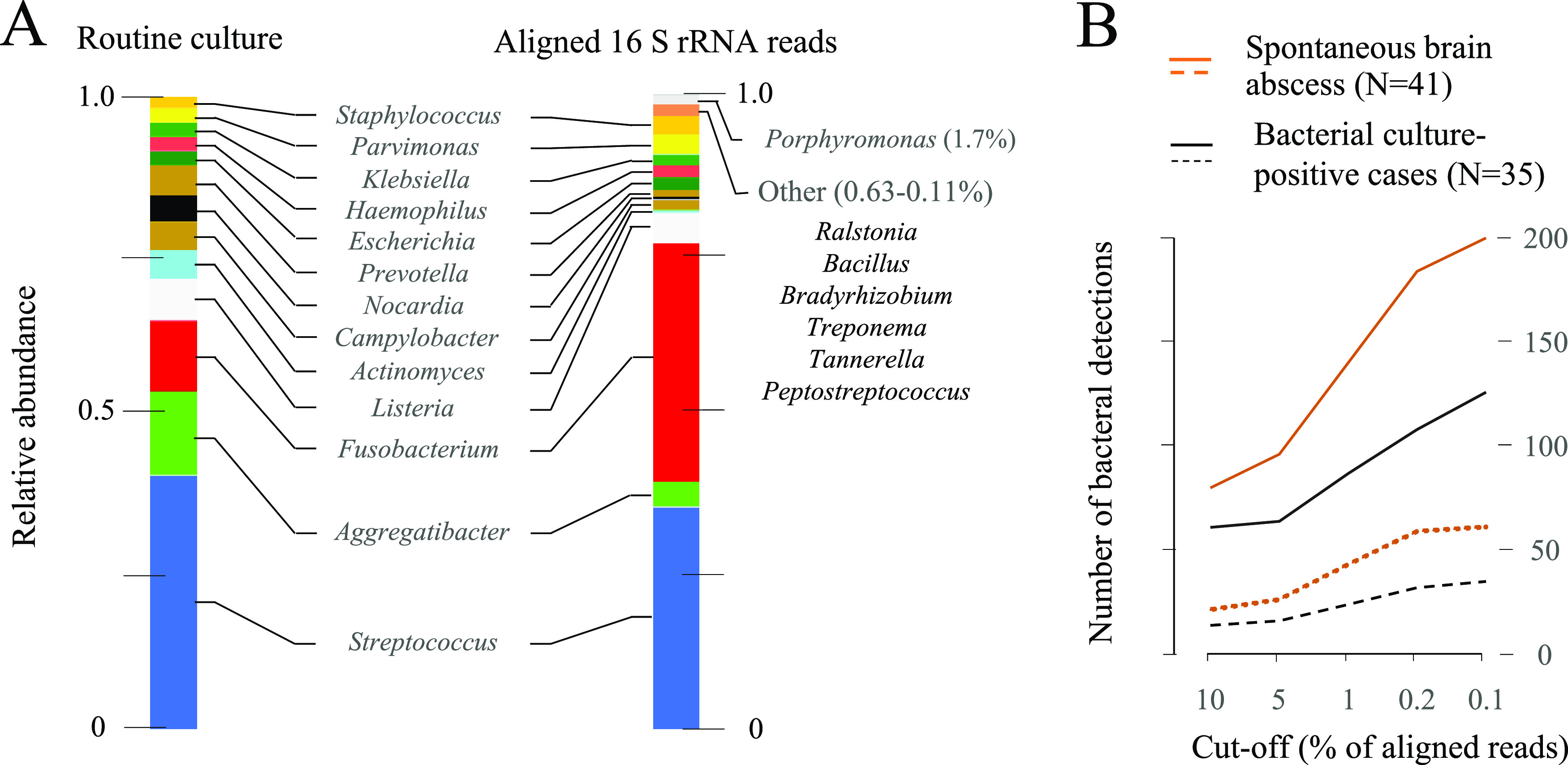
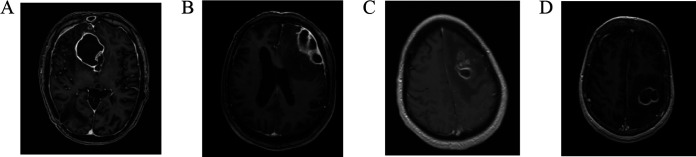
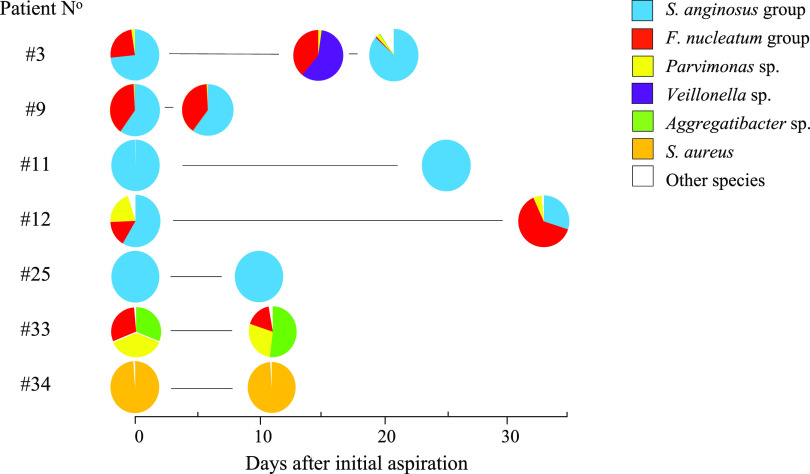
Forty-one stored samples from cases of spontaneous brain abscess were investigated to gain insight into the natural history, causative agents, and relevant laboratory diagnostics of a rare infection. Samples from a larger collection were selected based on retrospective analysis of patient records. All samples were subjected to amplicon sequencing of 16S rRNA gene fragments. Supplementary culture on selected media was performed as suggested by bioinformatics analysis. For three cases, no microorganism was disclosed, while Toxoplasma gondii, Aspergillus fumigatus, and various bacteria were the cause of 1, 2, and 35 cases, respectively. Bacterial infections were monomicrobial in 20 cases and polymicrobial in 15; the microorganisms of the latter cases were restricted to residents of cavum oris. Amplicon sequencing did not further enhance the importance of the Streptococcus anginosus group, which was involved in 17 cases, and the single primer set used may be suboptimal for amplification of and . But, amplicon-based sequencing unquestionably expanded the number of polybacterial infections, with focus on the Fusobacterium nucleatum group, , and . Culture on selective media confirmed the presence of F. nucleatum group bacteria, which attained a prominence in spontaneous brain abscess similar to the group. Metagenomics is a powerful tool to disclose the spectrum of agents in polymicrobial infections, but a reliable cutoff value for substantial detection is complex. Commercial media for isolation of F. nucleatum group bacteria from mixed infections are available, and these pathogens should be carefully characterized. Isolation of and in polymicrobial infections has not been resolved. Polymicrobial brain abscess is a challenge to the clinical microbiology laboratory due to the aggregative nature of the dental and oral microbiota. Because polymicrobial infections may escape detection by conventional culture methods, directed therapy toward a single detected bacterium is problematic. Amplicon-based sequencing provides important clues to these infections, but only cultured microorganisms can be fully characterized, subjected to antimicrobial susceptibility testing, and formally named. By use of specific selective culture plates, we successfully isolated bacteria of the Fusobacterium nucleatum group, and these bacteria rose to the same prominence as the widely recognized pathogen, the Streptococcus anginosus group. Named and unnamed members of the Fusobacterium nucleatum group must be further investigated to gain insight into a rare but grave disease.
对 41 例自发性脑脓肿病例的储存样本进行了研究,以深入了解这种罕见感染的自然病史、病原体和相关实验室诊断。根据患者病历的回顾性分析,从更大的样本集中选择了所有样本。所有样本均进行了 16S rRNA 基因片段的扩增子测序。根据生物信息学分析的建议,对选定的培养基进行了补充培养。对于 3 个病例,未发现微生物,而弓形体、烟曲霉和各种细菌分别是 1、2 和 35 个病例的病因。20 例为单一细菌感染,15 例为混合细菌感染;后者病例的微生物仅限于口腔空洞。扩增子测序并没有进一步增强涉及 17 例的咽峡炎链球菌组的重要性,并且使用的单一引物组可能不适用于扩增 和 。但是,基于扩增子的测序无疑扩大了多细菌感染的数量,重点是梭杆菌属、卟啉单胞菌属和普雷沃氏菌属。选择性培养基培养证实了存在核梭杆菌组细菌,该细菌在自发性脑脓肿中的突出地位与 组相似。宏基因组学是揭示多微生物感染中病原体谱的有力工具,但可靠的大量检测截断值很复杂。从混合感染中分离核梭杆菌组细菌的商业培养基是可用的,这些病原体应仔细进行特征描述。在多微生物感染中分离 和 尚未解决。多微生物脑脓肿对临床微生物学实验室是一个挑战,因为口腔和口腔微生物群具有聚集性。由于多微生物感染可能会逃避常规培养方法的检测,因此针对单一检测到的细菌进行定向治疗是有问题的。基于扩增子的测序为这些感染提供了重要线索,但只有培养的微生物才能得到充分的特征描述、进行药敏试验,并正式命名。通过使用特定的选择性培养板,我们成功地分离出核梭杆菌组的细菌,这些细菌与广泛认可的病原体咽峡炎链球菌组一样突出。必须进一步研究命名和未命名的核梭杆菌组成员,以深入了解这种罕见但严重的疾病。