Department of Surgery, NewYork-Presbyterian Brooklyn Methodist Hospital, New York, NY 11215, USA.
Department of Population Health Sciences, Weill Cornell Medicine, New York, NY 10065, USA.
Int J Environ Res Public Health. 2022 Apr 1;19(7):4218. doi: 10.3390/ijerph19074218.
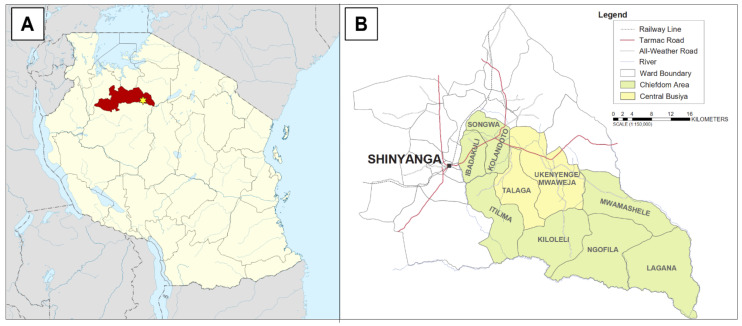
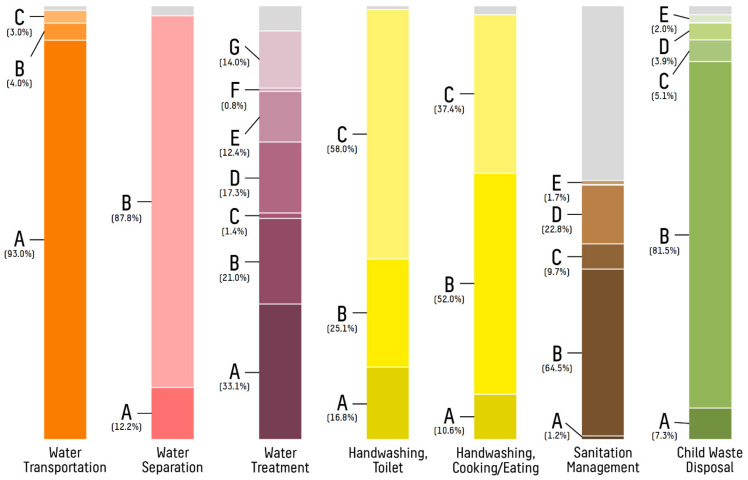
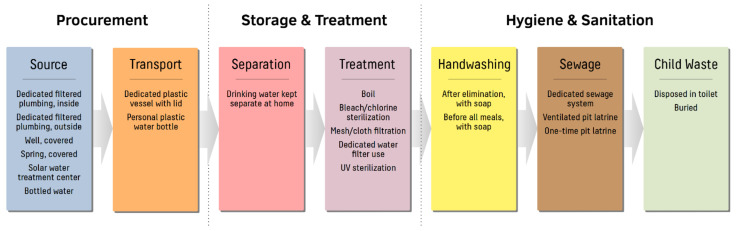
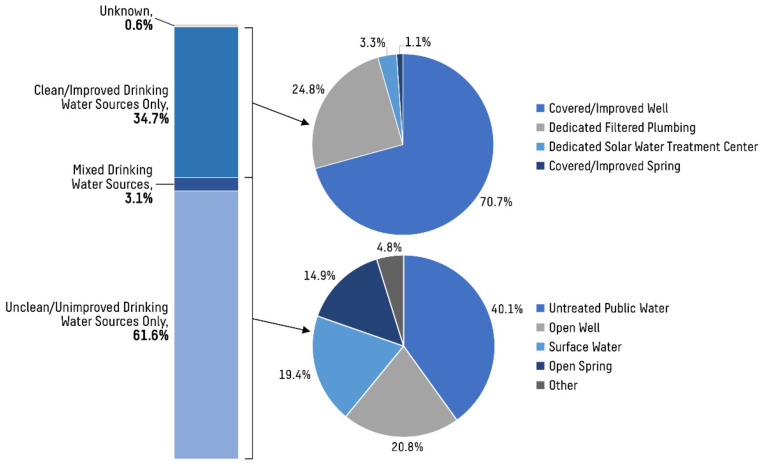
Diarrhea remains a significant cause of morbidity and mortality among children in developing countries. Water, sanitation, and hygiene practices (WASH) have demonstrated improved diarrhea-related outcomes but may have limited implementation in certain communities. This study analyzes the adoption and effect of WASH-based practices on diarrhea in children under age five in the rural Busiya chiefdom in northwestern Tanzania. In a cross-sectional analysis spanning July-September 2019, 779 households representing 1338 under-five children were surveyed. Among households, 250 (32.1%) reported at least one child with diarrhea over a two-week interval. Diarrhea prevalence in under-five children was 25.6%. In per-household and per-child analyses, the strongest protective factors against childhood diarrhea included dedicated drinking water storage (OR 0.25, 95% CI 0.18−0.36; p < 0.001), improved waste management (OR 0.37, 95% CI 0.27−0.51; p < 0.001), and separation of drinking water (OR 0.38, 95% CI 0.24−0.59; p < 0.001). Improved water sources were associated with decreased risk of childhood diarrhea in per-household analysis (OR 0.72, 95% CI 0.52−0.99, p = 0.04), but not per-child analysis (OR 0.83, 95% CI 0.65−1.05, p = 0.13). Diarrhea was widely treated (87.5%), mostly with antibiotics (44.0%) and oral rehydration solution (27.3%). Targeting water transportation, storage, and sanitation is key to reducing diarrhea in rural populations with limited water access.
腹泻仍然是发展中国家儿童发病率和死亡率的重要原因。水、环境卫生和个人卫生做法(WASH)已证明可改善与腹泻相关的结果,但在某些社区的实施可能有限。本研究分析了基于 WASH 的做法在坦桑尼亚西北部布西亚酋长国五岁以下儿童腹泻方面的采用情况和效果。在 2019 年 7 月至 9 月的横断面分析中,调查了 779 户家庭,代表了 1338 名五岁以下儿童。在家庭中,有 250 户(32.1%)报告在两周内至少有一名儿童腹泻。五岁以下儿童腹泻的患病率为 25.6%。在每户和每个儿童的分析中,针对儿童腹泻的最强保护因素包括专用饮用水储存(OR 0.25,95%CI 0.18-0.36;p<0.001)、改善的废物管理(OR 0.37,95%CI 0.27-0.51;p<0.001)和饮用水分离(OR 0.38,95%CI 0.24-0.59;p<0.001)。在每户家庭分析中,改善的水源与儿童腹泻风险降低相关(OR 0.72,95%CI 0.52-0.99,p=0.04),但在每个儿童的分析中没有相关性(OR 0.83,95%CI 0.65-1.05,p=0.13)。腹泻得到了广泛治疗(87.5%),主要使用抗生素(44.0%)和口服补液盐(27.3%)。针对水资源运输、储存和卫生设施的目标是减少水资源有限的农村地区腹泻的关键。